
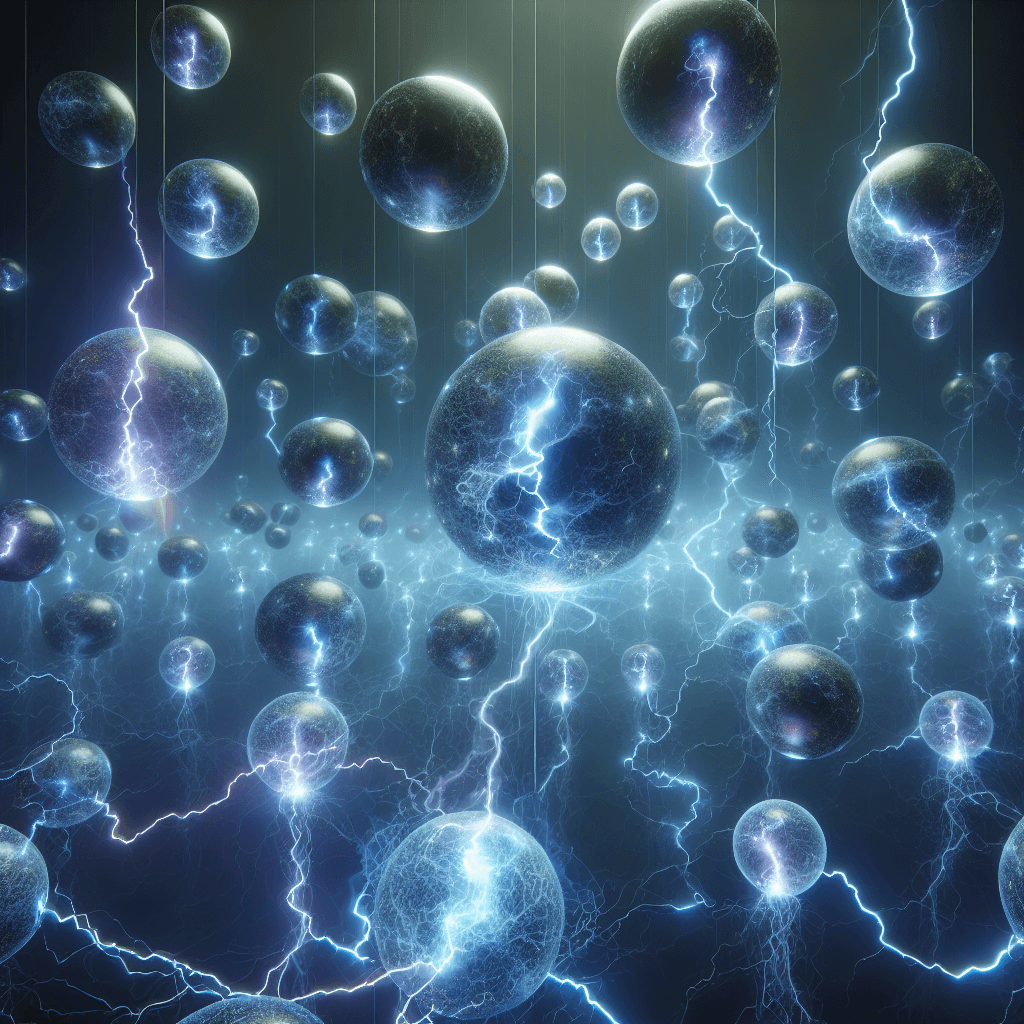
What creates the bizarre floating balls of lightning that can pass through solid walls
It’s a natural phenomenon that defies the laws of physics: a ghostly orb of lightning that can drift silently through a solid wall. We’re exploring the radical theories that attempt to explain one of nature’s most terrifying and bizarre mysteries.

Too Long; Didn't Read
TLDR: Ball lightning is likely a floating ball of burning silicon particles, created when lightning hits the ground. Its bizarre behavior, like passing through walls, is still not fully understood by scientists.
Blog Post Title: The Fiery Enigma: What Creates the Bizarre Floating Balls of Lightning That Can Pass Through Solid Walls?
Introduction
Imagine a thunderstorm raging outside. Suddenly, a silent, glowing sphere of light drifts through your closed window, hovers in your living room for a few moments, and then vanishes without a trace. This is not a scene from a science fiction movie; it's a description of ball lightning, one of nature's most baffling and persistent mysteries. For centuries, eyewitness accounts of these spectral orbs have been dismissed as hallucinations or folklore. Yet, with thousands of documented sightings, the scientific community now acknowledges ball lightning as a real, albeit incredibly rare, phenomenon. This post will delve into the perplexing world of ball lightning, exploring the leading scientific theories that attempt to explain what creates these strange fiery spheres and how they perform their most mystifying trick: passing through solid objects.
Main Content
What Exactly is Ball Lightning?
Before we explore its origins, it's crucial to understand what we're talking about. Ball lightning is typically described as a luminous, spherical object that appears during or immediately after a thunderstorm. Its characteristics can vary wildly, but most accounts agree on a few key features:
- Appearance: It can range in size from a golf ball to a beach ball and often glows with the brightness of a 100-watt light bulb. Colors reported include white, yellow, orange, red, and blue.
- Movement: It usually moves slowly and horizontally, a few feet above the ground, often ignoring wind currents. It can be motionless or move erratically.
- Duration: Most sightings last for only a few seconds, though some have been reported to persist for over a minute.
- Dissipation: It typically ends in one of two ways: either silently fading away or dissipating with a loud pop or bang.
The unpredictable and fleeting nature of ball lightning makes it notoriously difficult to study, which is why a single, universally accepted explanation has remained elusive.
The Leading Scientific Theories
For years, scientists have proposed numerous hypotheses to explain this phenomenon. While no theory is perfect, a few have gained significant traction based on laboratory experiments and the rare observational data that exists.
The Silicon Nanoparticle Theory
One of the most widely supported explanations suggests that ball lightning is, in essence, a burning ball of dirt. Proposed by John Abrahamson and James Dinniss, this theory posits the following sequence of events:
- A conventional lightning bolt strikes the ground, which is rich in silica (silicon dioxide).
- The intense heat of the strike—up to 30,000°C—vaporizes the silica and separates the silicon from the oxygen.
- This silicon vapor, along with other minerals, is ejected into the air. As it cools, it condenses into a loose, tangled web of nanoscale silicon particles.
- This floating aerosol ball then glows as the silicon nanoparticles slowly oxidize (chemically react with the oxygen in the air), releasing light and heat.
This theory gained substantial support in 2012 when Chinese researchers managed to capture a naturally occurring ball lightning event on video and with spectrographs. Their analysis revealed that the orb’s chemical makeup was rich in silicon, iron, and calcium—the very elements expected to be found in soil.
The Microwave Cavity Theory
Another compelling but more complex theory suggests that ball lightning is a form of trapped electromagnetic energy. According to this model, atmospheric microwaves, generated by the electrical activity in thunderclouds, can become contained within a spherical bubble of plasma. This creates a "maser-soliton," a self-sustaining standing wave of energy. The glowing ball is the visible manifestation of this trapped energy exciting the air molecules inside the plasma bubble.
This theory is particularly useful for explaining one of ball lightning's most bizarre reported behaviors: its ability to pass through solid objects.
Passing Through Solid Walls: The Ultimate Puzzle
The idea of a fiery orb passing through a glass window or a wooden wall seems to defy the laws of physics. However, the leading theories offer potential explanations.
The Microwave Cavity Theory provides the most direct answer. Microwaves can easily pass through non-conductive materials like glass. The theory suggests that the microwave energy could pass through a windowpane and then re-form the plasma bubble on the other side, giving the appearance that the ball itself moved through the solid object.
The Silicon Nanoparticle Theory has a harder time explaining this phenomenon. One possibility is that the loosely bound aerosol ball is porous enough to pass through very small openings that an observer might not notice. Another is that reports of it passing through solid walls are exaggerations or misinterpretations. This remains a key point of debate and a significant challenge for any single theory to overcome.
Conclusion
Ball lightning continues to be a captivating scientific puzzle. While it was once relegated to the realm of myth, credible research and rare observations have established it as a genuine atmospheric phenomenon demanding explanation. The Silicon Nanoparticle Theory, supported by spectroscopic evidence, offers a powerful chemical explanation for its existence. Meanwhile, the Microwave Cavity Theory provides an elegant physics-based model that could account for its strangest behaviors, including its apparent ability to defy solid barriers. It is likely that the final answer may involve a combination of these ideas or a new mechanism entirely. For now, these bizarre floating balls of lightning serve as a humbling reminder that even in our modern world, nature still holds profound and beautiful mysteries.


