
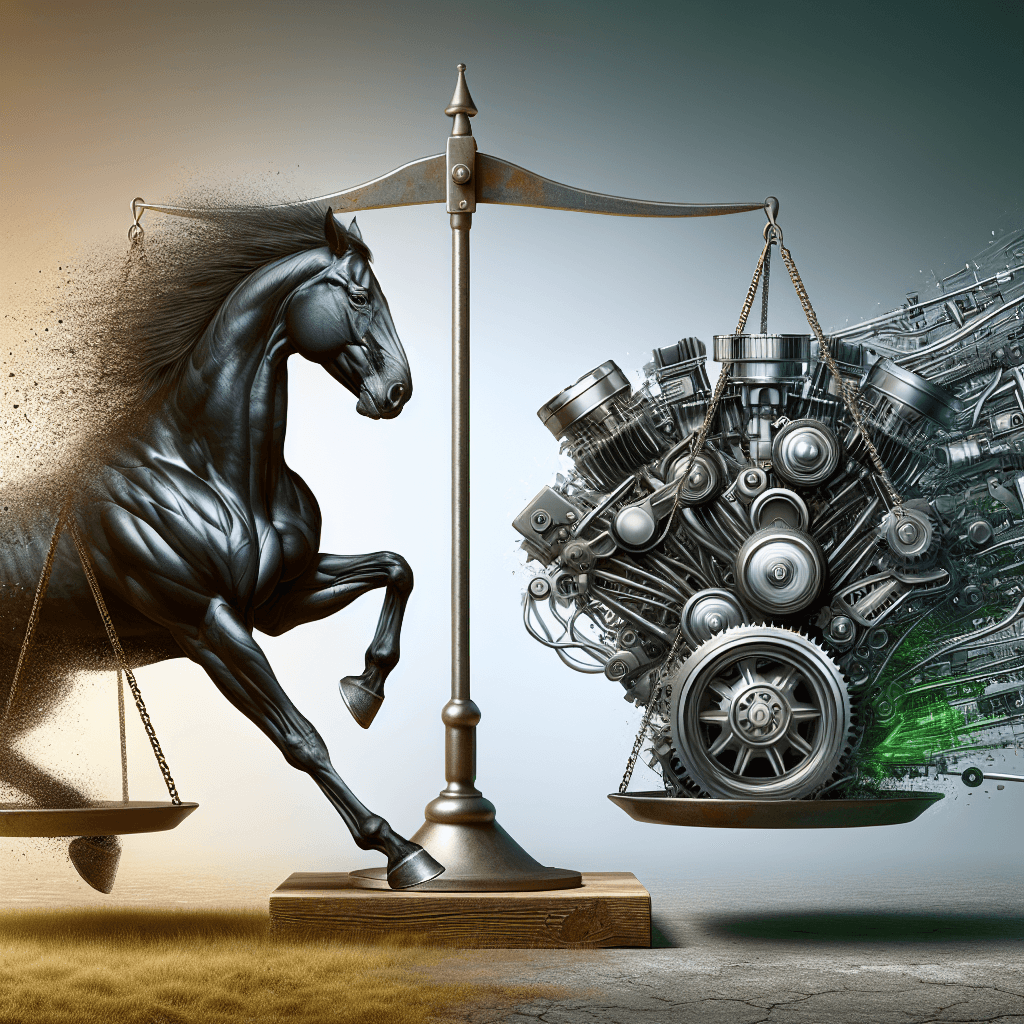
What does the strength of a horse actually have to do with your car's engine
Spoiler alert: A real horse can produce nearly 15 horsepower. Uncover the surprising 18th-century marketing ploy that ended up defining your car's engine today.

Too Long; Didn't Read
TLDR: Horsepower is a marketing term invented by James Watt to compare his steam engines to the horses they replaced. He standardized the work rate of a mill horse into a unit of measurement, so your car's horsepower isn't about literal horses, it's just a standard way to compare engine power.
From Hay to Highways: What does the strength of a horse actually have to do with your car's engine?
When you’re browsing for a new car, one of the first specifications you’ll see is “horsepower.” We instinctively understand that a 300-horsepower sports car is more powerful than a 120-horsepower subcompact. But have you ever stopped to wonder if that sports car truly has the pulling power of 300 horses? The connection between the animal and the engine is more of a fascinating marketing story than a direct scientific comparison. This post will delve into the historical origins of horsepower, define what the term actually measures, and clarify the real relationship between the power in your engine and the strength of a single horse.
A Tale of Steam and Scottish Ingenuity: The Birth of Horsepower
To understand horsepower, we have to travel back to the 18th century and meet the Scottish inventor, James Watt. While famous for his revolutionary improvements to the steam engine, Watt was also a savvy businessman. His challenge wasn't just building a better engine; it was selling it to customers who were still using the original "engine" of industry: the draft horse.
Mine owners and brewers used horses to walk in circles, turning wheels that powered pumps and mills. To convince them to invest in his new, loud, and expensive steam technology, Watt needed a simple, relatable way to demonstrate its superiority. He needed to answer a direct question: "How many of my horses can your engine replace?" To do that, he had to first quantify the power of an average horse.
So, What Exactly IS One Horsepower?
After observing horses working at a London brewery, Watt calculated that a typical draft horse could turn a mill wheel 144 times in an hour. Based on the wheel's size and the force required, he determined that a horse could lift, on average, 33,000 pounds a distance of one foot in one minute.
He standardized this observation into a unit of measurement:
- 1 Horsepower = 33,000 foot-pounds of work per minute (or 550 foot-pounds per second).
This became the benchmark. If Watt’s steam engine could perform 330,000 foot-pounds of work per minute, he could confidently market it as a "10-horsepower engine," making it an easy sell for a business owner looking to replace ten horses and their associated costs. It’s important to note that many historians believe Watt was very conservative with his estimate—and may have even inflated it slightly—to make his engines appear more powerful in comparison.
Can a Horse Actually Produce More Than One Horsepower?
Here is where the marketing term diverges from biological reality. The simple answer is yes, a real horse is significantly more powerful than one "horsepower."
Watt’s measurement was based on the sustained rate of work a horse could perform over an entire day without tiring. Think of it as a marathon runner's steady pace. However, just like a human athlete, a horse has a much higher peak output for short bursts of effort. Studies and observations have shown that for a few seconds, a real horse can generate a peak output of nearly 15 horsepower.
So, while your 150-horsepower sedan can consistently deliver that power, it doesn’t have the peak strength of 150 actual horses. It has the sustained power equivalent of 150 of James Watt's very hard-working, theoretical horses.
Why Your Car Isn't Pulled by 300 Invisible Horses
In a modern car, horsepower is a measure of the engine's rate of doing work—how quickly it can move the vehicle's weight. It’s calculated from another important metric: torque.
- Torque is the rotational force of the engine, or its "pulling power." It's what gets you moving from a standstill.
- Horsepower is how fast that work can be done. It's what gives you speed at the top end.
An engine’s horsepower rating is a measurement of its total power output under ideal conditions. It's a standardized, reliable figure, but it’s a far cry from a literal herd of animals under the hood.
Conclusion
The term "horsepower" is a brilliant piece of 18th-century marketing that has survived into the 21st century. It was created by James Watt not as a perfect measure of an animal's strength, but as a relatable unit to sell his groundbreaking steam engines. We now know that his unit represents the steady, all-day working power of a horse, not its impressive peak strength. So, the next time you hear a car's power being discussed, you’ll understand the true story. You're not talking about a stable of horses, but about a legacy of the Industrial Revolution that continues to define how we measure mechanical might.


