
Why are moths so irresistibly attracted to artificial lights
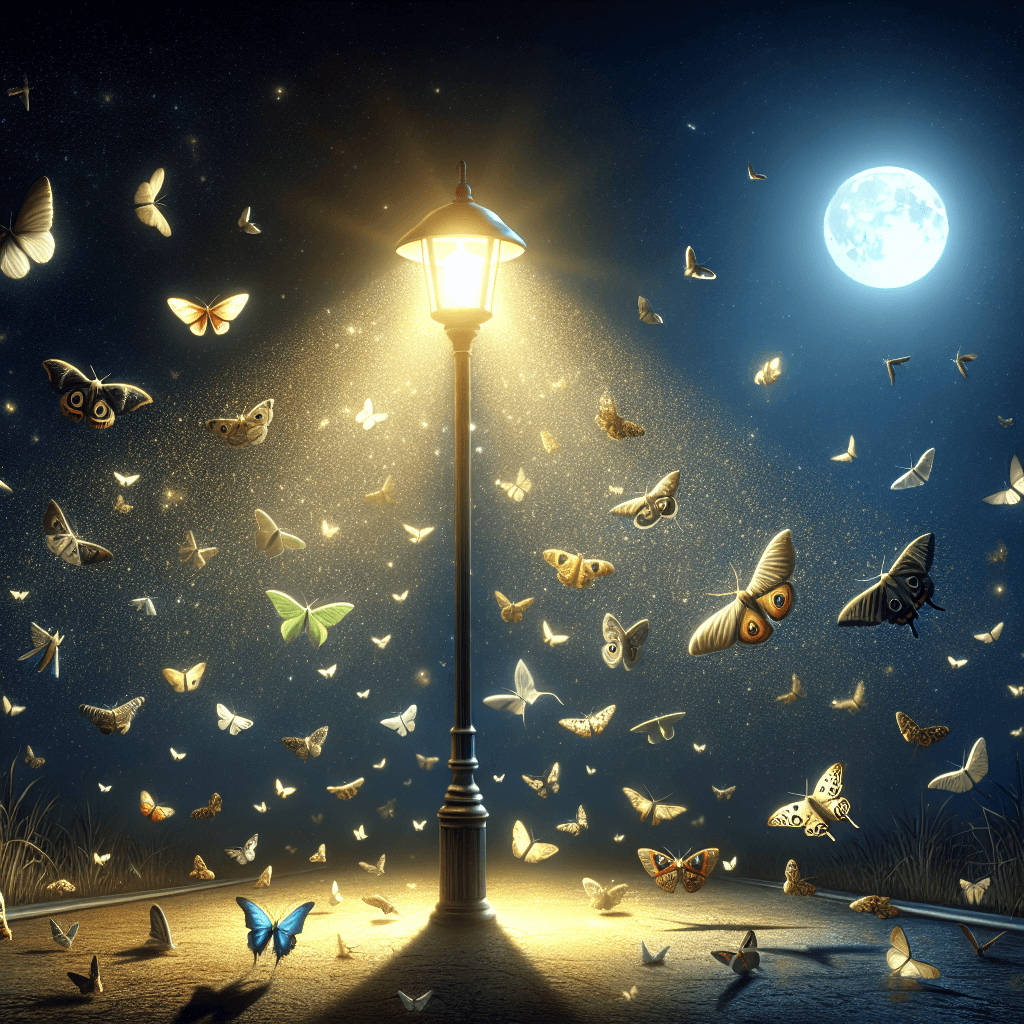
That moth isn't in love with your lamp; it's an ancient navigator whose internal compass has been tragically scrambled by our artificial moon.

Too Long; Didn't Read
Moths are not attracted to light; they are disoriented by it. They evolved to use the moon for navigation, and nearby artificial lights scramble their internal compass, causing them to fly in confusing spirals.
Drawn to the Flame: The Science Behind Why Moths Are So Irresistibly Attracted to Artificial Lights?
It’s a familiar summer night scene: a lone moth fluttering erratically around a porch light, seemingly desperate to reach the glowing bulb. We’ve all seen it, but have you ever stopped to wonder why? This seemingly simple act is actually a complex biological puzzle that has intrigued scientists for decades. It’s not a simple love affair with light; instead, it's a profound and often fatal case of navigational confusion. This post will delve into the leading scientific theories that explain why moths are so irresistibly drawn to our artificial lights, exploring a phenomenon where ancient instincts clash with the modern world.
The Leading Theories: Unraveling the Mystery
For years, the common assumption was that moths simply mistook artificial lights for the moon. While this idea holds a kernel of truth, recent research has provided a more nuanced and compelling explanation for this behavior, known as positive phototaxis. Let's explore the main scientific theories.
Theory 1: Celestial Navigation Gone Wrong
The most long-standing theory is called transverse orientation. For millennia, nocturnal insects like moths have evolved to use the most reliable light source in the night sky—the moon and distant stars—as a navigational compass. By keeping this distant light at a constant angle to their body, they can fly in a straight line, which is crucial for migrating, finding food, or locating a mate.
The problem arises with our artificial lights. A porch light or a streetlight is a proximate, not a distant, light source. When a moth tries to apply its ancient navigational rule, it gets trapped. As it flies, the angle to the nearby light source changes rapidly. To correct this and maintain a constant angle, the moth must constantly turn, resulting in a spiraling flight path that leads it closer and closer to the bulb. It’s not so much an attraction as it is a navigational system being short-circuited.
Theory 2: An Upside-Down World - The Dorsal Light Reflex
A groundbreaking theory, supported by recent high-speed camera studies from institutions like Imperial College London, suggests a more fundamental reflex is at play. This is the "dorsal light reflex," an innate mechanism many insects use to orient themselves in flight.
Essentially, insects determine which way is "up" by assuming the brightest part of their visual field is the sky. They instinctively keep their backs (their dorsal side) tilted towards this light. Under natural conditions, this works perfectly, keeping them stable and parallel to the ground. However, an artificial light source on the ground or the side of a building throws this reflex into chaos.
When a moth flies past a porch light, the bulb becomes the brightest object in its view. The moth's reflex kicks in, telling it to tilt its back towards the light. This action forces the moth into a perpetual, looping bank, trapping it in an orbit around the light source. The chaotic, fluttering dance we see is the moth endlessly trying to correct its orientation in a world turned upside down.
Theory 3: The Lure of Specific Wavelengths
Beyond navigational confusion, the type of light also plays a significant role. Moths are particularly sensitive to shorter wavelengths of light, especially ultraviolet (UV), which are invisible to the human eye. Here’s why that matters:
- Flower Patterns: Many flowers have nectar guides—patterns only visible in UV light—that direct pollinators like moths. Artificial lights that emit UV, such as older fluorescent bulbs and "bug zappers," may appear incredibly bright and attractive to a moth, mimicking a rich source of nectar.
- Pheromone Mimicry: Some researchers have theorized that the infrared radiation (heat) from incandescent bulbs might mimic the pheromones of female moths, adding another layer of fatal attraction.
Conclusion: A Fatal Disruption
So, why are moths so irresistibly attracted to artificial lights? The evidence strongly suggests it isn't an attraction at all, but a profound sensory disruption. Whether it's the short-circuiting of an ancient celestial compass or the scrambling of an innate flight reflex, our artificial lights trap these nocturnal creatures in a confusing and often deadly loop. This phenomenon serves as a poignant reminder of how human technology can inadvertently interfere with the finely tuned instincts of the natural world. The moth at your window isn't in love with your lamp; it's a navigator who has lost its stars, desperately trying to find its way in a world we have illuminated.


