
Why can a simple knot cut a strong rope’s strength in half
It’s a dangerous paradox: the very knot you trust for security creates a tiny, sharp bend that concentrates immense force, effectively turning your rope’s greatest strength into its most critical weak point.

Too Long; Didn't Read
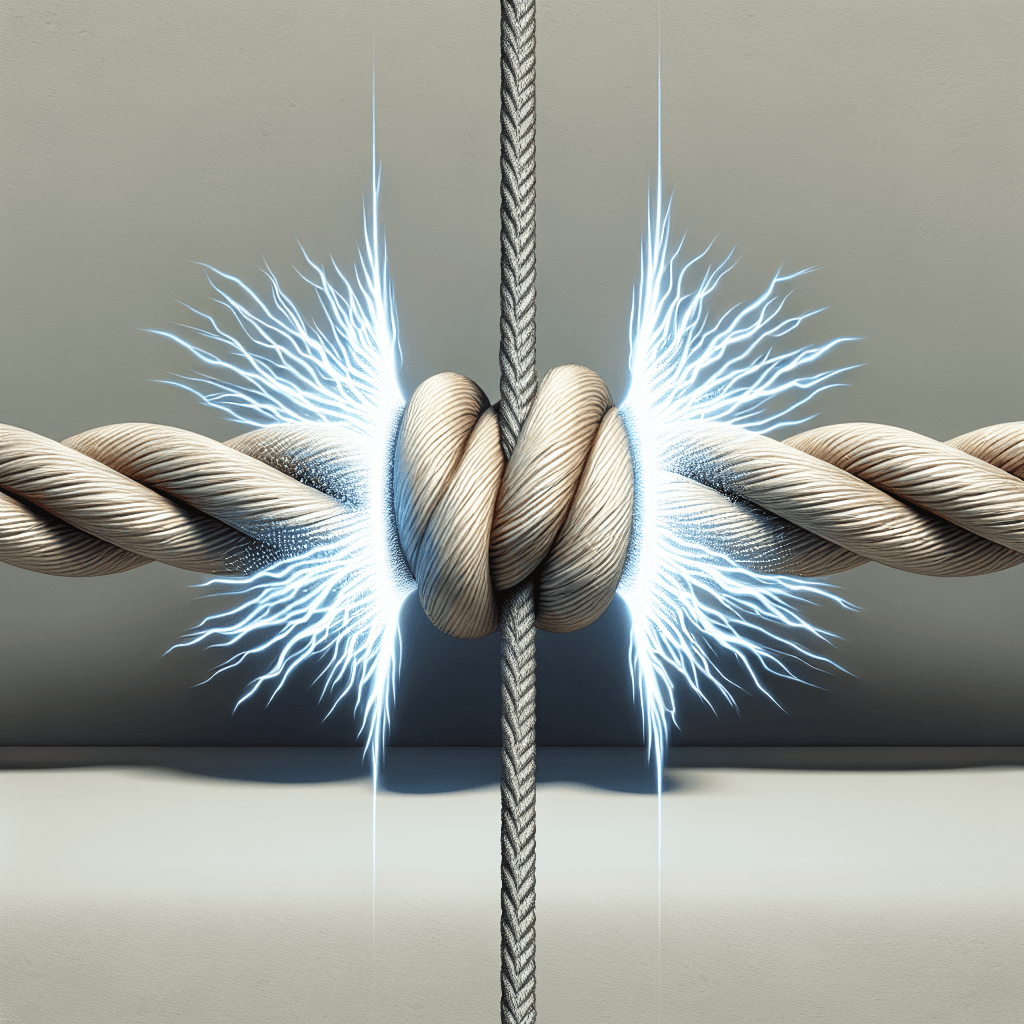
TLDR: A knot creates a sharp bend, forcing the rope's outer fibers to carry the entire load while the inner fibers are compressed and do nothing. These few over-stressed outer fibers snap easily, causing a chain reaction that breaks the rope well below its actual strength.
The Knot Paradox: Why Can a Simple Knot Cut a Strong Rope’s Strength in Half?
Imagine you’re using a brand-new rope, rated to hold 5,000 pounds. To secure it, you tie a simple, tight knot. Logically, it should be just as strong, right? The surprising and critical truth is that the simple act of tying that knot has likely just slashed the rope’s effective strength to 2,500 pounds, or even less. This isn't a defect in the rope; it's a fundamental principle of physics that every climber, sailor, and safety professional must understand. This post will unravel the science behind this paradox, exploring exactly how a knot becomes the weakest link in an otherwise powerful rope.
The Hidden Stress: How Knots Create Weak Points
A rope's incredible strength comes from a simple principle: perfect load distribution. When pulled in a straight line, every fiber along its length shares the tension equally. This collective effort allows the rope to withstand immense force.
However, the moment you introduce a knot, you destroy this perfect distribution. A knot forces the rope into a series of tight bends, curves, and crossovers. This geometry creates highly localized stress points where the rope is no longer working as a unified whole. Instead of all fibers pulling together, a small percentage of fibers on the outside of the bends are forced to carry a disproportionate amount of the load, while others on the inside are compressed and rendered almost useless.
Think of it like bending a plastic drinking straw back and forth. The outer edge of the bend stretches and weakens until it eventually snaps. The same thing happens to the fibers in a rope, just on a microscopic scale.
The Three Culprits: Bends, Friction, and Compression
The dramatic loss of strength within a knot can be attributed to three primary physical forces working against the rope's integrity.
1. Sharp Bends
This is the number one cause of strength reduction. The tighter the curve a rope is forced into, the greater the strength loss. This is often referred to as the "bend radius."
- Outer Fibers: The fibers on the outside of the bend are stretched much more than the rest of the rope and are put under extreme tension. They reach their breaking point long before the fibers in the straight sections of the rope do.
- Inner Fibers: Conversely, the fibers on the inside of the curve become compressed. They can't carry their share of the load and may even be crushed against each other, causing damage.
This unequal loading means the rope will fail at the knot, where only a fraction of its fibers are doing the majority of the work.
2. Internal Friction
As a knot tightens under load, the strands of the rope grind against each other. This creates friction, which generates heat and causes abrasion. Over time, or under a sudden shock load, this friction can saw through and damage the rope’s fibers from the inside out, further weakening the structure.
3. Compression and Shearing
Where one part of the rope presses down on another within the knot, it creates immense compressive force. This pressure can crush the fibers, but it also creates a shearing effect. When the rope is pulled taut, the strands can act like tiny blades, attempting to cut through one another at the crossover point.
Do All Knots Weaken a Rope Equally?
No, the design of the knot matters immensely. The key difference lies in the sharpness of the bends. A knot with gradual, sweeping curves will always be stronger than one with tight, sharp angles.
- Overhand Knot: This is one of the simplest knots to tie but also one of the most damaging. Its very tight, sharp bend can reduce a rope’s strength by as much as 45-50%.
- Figure-Eight Knot: Favored by climbers, this knot uses broader, more gentle curves. This distributes the stress more effectively, typically reducing the rope's strength by a more manageable 20-30%.
- Bowline Knot: A classic boating knot, the bowline creates a secure loop. Its structure also results in a strength reduction of around 30-40%.
This is why professionals are meticulously trained to use the right knot for the right application—the choice can literally be the difference between safety and failure.
In conclusion, a knot’s power to weaken a rope is not magic, but a matter of focused stress. By forcing a rope into tight bends and creating points of high friction and compression, a knot disrupts the even distribution of force that gives the rope its strength. It forces a small number of fibers to do the work of the whole collective, causing them to fail prematurely. So, the next time you tie a knot in a critical line, remember that you are not just creating a loop; you are engineering a potential point of failure. Choose your knot wisely.


