
Why did a curved London skyscraper accidentally melt parked cars and set doormats on fire with reflected sunlight
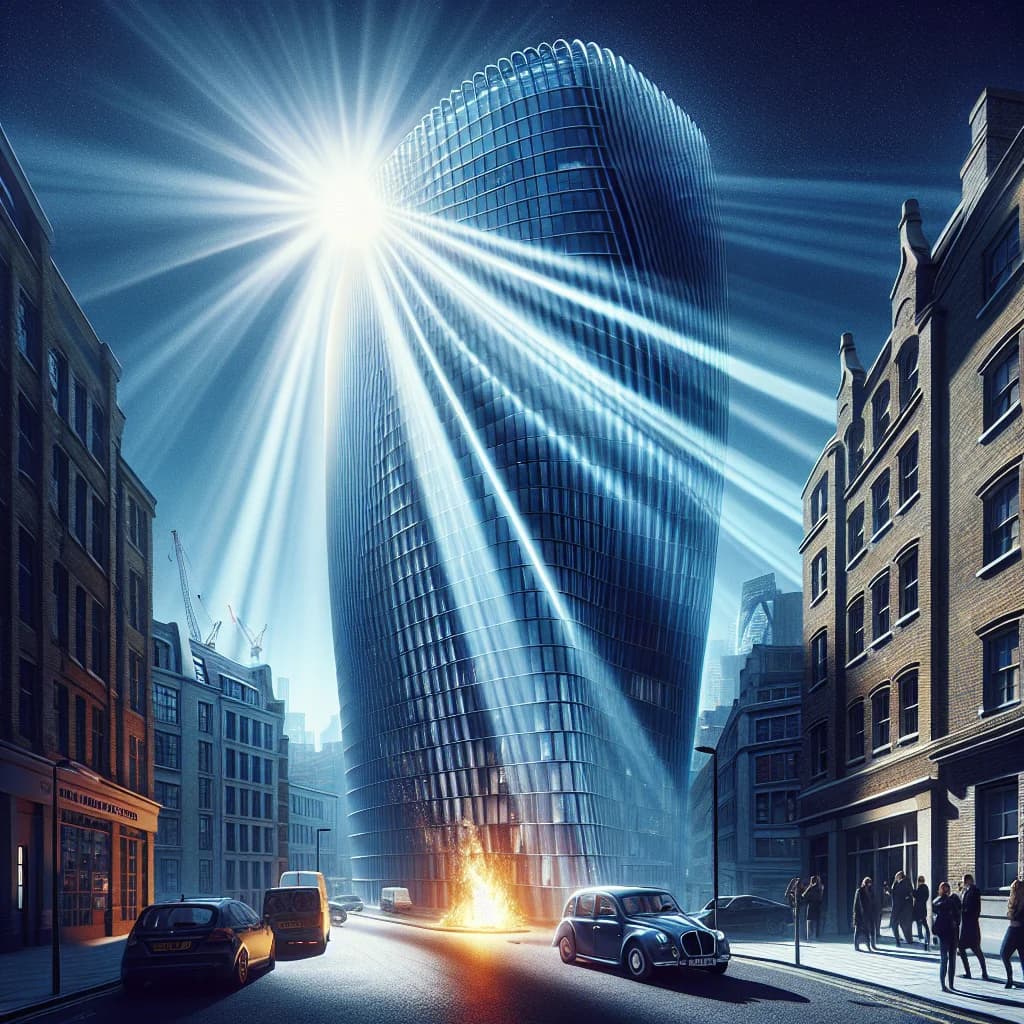
When a luxury London skyscraper began melting Jaguars and igniting doormats, the city realized it had accidentally built a giant solar death ray. Uncover the mind-bending architectural flaw that turned a billion-dollar building into a literal magnifying glass.

Too Long; Didn't Read
Londons Walkie Talkie skyscraper features a concave glass design that acted like a giant magnifying glass, focusing sunlight into a concentrated heat beam on the streets below. This architectural oversight created temperatures high enough to melt car parts and scorch doormats, eventually requiring the installation of permanent sunshades to diffuse the reflection.
The "Walkie-Scorchie" Effect: Why did a curved London skyscraper accidentally melt parked cars and set doormats on fire with reflected sunlight?
Imagine parking your luxury car on a London street, only to return two hours later to find the plastic panels warped, the wing mirror melted, and a distinct smell of burning emanating from the chassis. This was the surreal reality for Martin Lindsay in 2013, whose Jaguar XJ fell victim to a skyscraper located at 20 Fenchurch Street. Known colloquially as the "Walkie Talkie" due to its distinctive shape, the building became a global news sensation for all the wrong reasons. But how does a stationary office tower become a functional heat ray? This post explores the physics and architectural oversights behind why a curved London skyscraper accidentally melt parked cars and set doormats on fire with reflected sunlight.
The Architecture of 20 Fenchurch Street
Designed by the late architect Rafael Viñoly, 20 Fenchurch Street is a 38-story skyscraper in London’s financial district. Its design is unique; the building bursts outward, with the upper floors being significantly wider than the base. To maximize floor space and provide a distinct aesthetic, the southern facade of the building was designed with a dramatic concave curve.
While the design was intended to be a modern marvel, it inadvertently created a massive parabolic mirror. Covered in high-reflectivity glass, the south-facing side of the building captured the sun's rays and reflected them down toward Eastcheap, a busy street below.
The Science of Solar Convergence
The primary reason for the intense heat was a phenomenon known as solar convergence. Because the building’s surface was concave (curved inward), it acted like a giant magnifying glass.
- Parabolic Reflection: When sunlight hits a flat mirror, it reflects at the same angle. However, when it hits a concave surface, the light is directed toward a single focal point.
- The Focal Point: During certain times of the year and specific hours of the day, the sun’s path aligned perfectly with the building's curve. This focused the energy of a massive surface area of glass into a small, concentrated beam on the sidewalk.
- Intense Temperatures: According to reports from the BBC at the time, temperatures within this "hot spot" reached over 90°C (194°F), and some measurements even suggested peaks of 110°C (230°F).
This concentrated beam was so powerful that it didn't just melt car parts; it scorched doormats of local businesses, cracked floor tiles in shop entrances, and even allowed a journalist to famously fry an egg in a pan using only the reflected light.
Lessons in Urban Design and Climate
Surprisingly, this was not the first time such an incident had occurred. Architect Rafael Viñoly had previously designed the Vdara Hotel in Las Vegas, which featured a similar concave design that created a "death ray" over the hotel’s pool deck, singeing the hair of guests.
The London incident highlighted several critical challenges in modern architecture:
- Solar Modeling: The incident proved that traditional architectural modeling must account for the "specular reflection" of glass facades during different seasons.
- Material Selection: High-reflectivity glass increases energy efficiency for the building itself by reflecting heat, but it can create external hazards for the surrounding environment.
- Urban Heat Islands: As cities become more densely packed with glass-clad towers, the management of reflected light and heat becomes a public safety concern.
The Fix: Cooling the Walkie-Scorchie
To resolve the issue and prevent further damage, the developers were forced to install a permanent solution. In 2014, they fitted a "brise-soleil" (a permanent sunshade) to the south-facing windows. This series of horizontal slats breaks up the reflection and diffuses the light, preventing it from focusing into a dangerous beam. While it altered the building's aesthetic slightly, it successfully neutralized the heat ray.
Conclusion
The story of 20 Fenchurch Street serves as a fascinating, if cautionary, tale of how high-concept design can have unexpected physical consequences. Understanding why a curved London skyscraper accidentally melt parked cars and set doormats on fire with reflected sunlight requires a look at the intersection of geometry, physics, and urban planning. It reminds us that buildings do not exist in isolation; they interact with the sun, the wind, and the streets around them. Today, the "Walkie Talkie" remains a prominent fixture of the London skyline, now famous not just for its Sky Garden, but as a reminder to architects everywhere that the sun’s power is not to be underestimated.


