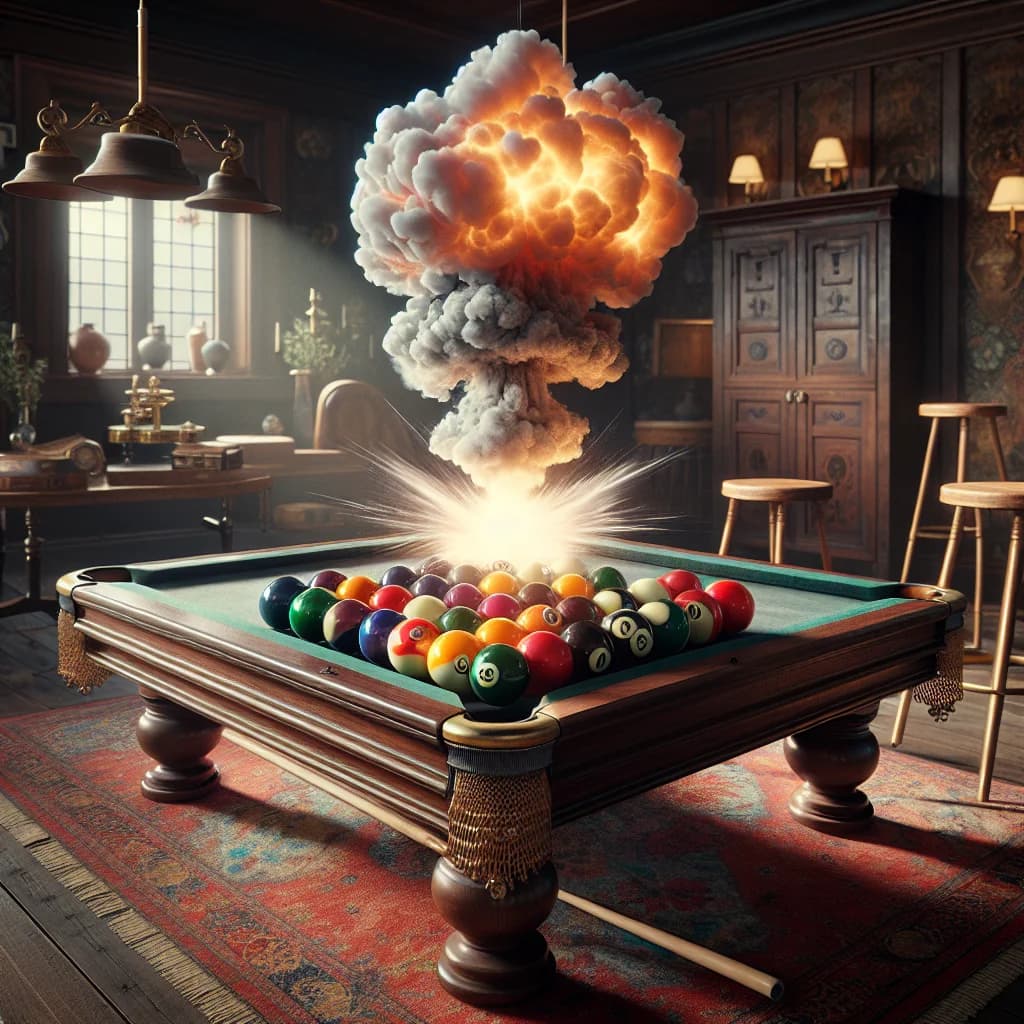
Why did early celluloid billiard balls occasionally explode with a loud bang when they collided during a game
Imagine a high-stakes game of pool where a single collision sounds like a gunshot and could actually spark a fire. Discover the volatile chemistry behind early celluloid balls and why hitting them too hard once turned billiard halls into literal minefields.

Too Long; Didn't Read
Early billiard balls were made of celluloid, which contained nitrocellulose, a key ingredient in gunpowder. High-impact collisions occasionally generated enough heat and friction to ignite the unstable material, causing a small explosion and a loud bang.
The Explosive History of Pool: Why Did Early Celluloid Billiard Balls Occasionally Explode with a Loud Bang When They Collided During a Game?
Imagine a quiet, smoke-filled billiard hall in the late 19th century. A player leans over the table, focuses on the cue ball, and delivers a powerful break. Instead of the satisfying "clack" of spheres meeting, the room is suddenly filled with a sharp, deafening report—sounding remarkably like a gunshot. This was not a rare occurrence in the 1870s and 1880s. The culprit was not a hidden firearm, but the very equipment used for the game.
The transition from ivory to synthetic materials revolutionized manufacturing, but it came with a volatile learning curve. Understanding why early celluloid billiard balls occasionally exploded with a loud bang when they collided during a game requires a look into the chemistry of early plastics and the desperate search for an ivory alternative. This post explores the science and history behind these literal "power shots."
The Ivory Crisis and the Search for a Substitute
For centuries, billiard balls were crafted exclusively from the tusks of elephants. However, by the mid-1800s, the popularity of the game had created a conservation and supply-chain crisis. A single elephant tusk could only produce about three to five high-quality balls, and thousands of elephants were being slaughtered annually to keep up with the demand in Europe and America.
In 1863, the billiard supply firm Phelan and Collender offered a $10,000 prize to anyone who could develop a suitable replacement for ivory. This challenge caught the attention of inventor John Wesley Hyatt, who began experimenting with a substance known as nitrocellulose. By 1869, he patented "celluloid"—a mixture of nitrocellulose, camphor, and alcohol—creating the first commercially successful thermoplastic.
The Volatile Chemistry of Nitrocellulose
The primary reason these early balls were prone to mini-explosions lies in their chemical composition. Nitrocellulose is the same basic ingredient found in "guncotton," an explosive propellant used as a more powerful alternative to gunpowder.
While Hyatt’s addition of camphor stabilized the material enough to be molded into a solid sphere, the underlying chemistry remained inherently unstable. Several factors contributed to the occasional "bang":
- Impact Sensitivity: Celluloid is highly sensitive to friction and sudden heat. When two balls collided with significant force, the kinetic energy converted into a localized "hot spot" at the point of impact.
- The "Percussion Cap" Effect: Under specific conditions, the friction of a high-velocity collision could trigger a rapid chemical decomposition of the nitrocellulose. This resulted in a small, localized explosion similar to the discharge of a percussion cap on a vintage rifle.
- Flammability: Beyond the sound, celluloid was incredibly flammable. Historical accounts suggest that if a player were smoking and a hot ash touched a chipped ball, the sphere could theoretically burst into flames.
Real-World Consequences in the Billiard Hall
The explosions were rarely powerful enough to shatter the ball into dangerous shrapnel, but they were certainly loud enough to cause a panic. John Wesley Hyatt himself famously noted that the sound of a collision could be mistaken for a pistol shot.
According to historical anecdotes and Hyatt’s own records, the frequency of these "explosions" led to some colorful scenarios:
- In Western saloons, the sound of a loud billiard collision occasionally caused patrons to draw their revolvers, believing a gunfight had broken out.
- Players complained that the balls were "prone to chipping" after these mini-detonations, which ruined the accuracy of the game.
- The smell of camphor—a medicinal, mothball-like scent—would fill the room after a particularly violent collision.
The Evolution to Modern Safety
The era of explosive pool balls was relatively short-lived. Manufacturers quickly realized that while celluloid was cheaper than ivory, its volatility was a liability. By the early 20th century, the industry shifted toward safer materials:
- Bakelite: Developed by Leo Baekeland in 1907, this phenolic resin was heat-resistant and chemically stable.
- Phenolic Resins (Modern Standard): Today, companies like Saluc (under the brand name Aramith) use high-tech phenolic resins. These balls are engineered for perfect balance and durability without any risk of combustion.
Conclusion
The story of why early celluloid billiard balls occasionally exploded with a loud bang when they collided during a game serves as a fascinating chapter in the history of material science. It highlights a time when the rush to innovate outpaced the full understanding of chemical stability. While the "guncotton" spheres of the 19th century provided a necessary alternative to ivory, their tendency to mimic a gunshot made for a much more high-stakes game than players intended.
Today, we enjoy the precision and safety of modern resin balls, but the explosive history of the billiard table remains a testament to the volatile beginnings of the plastic age. If you are a fan of game history or chemistry, the next time you hear the "click" of a break, you can be thankful it isn't a "bang."