
Why did nineteenth century winemakers wear heavy iron masks to protect themselves from spontaneously exploding champagne bottles
Before it was a symbol of celebration, champagne was known as the volatile "devil’s wine" that turned cellars into deadly minefields of flying glass shrapnel. Discover why nineteenth-century winemakers had to dress like medieval knights just to survive a routine day on the job.

Too Long; Didn't Read
In the 1800s, unstable secondary fermentation often caused champagne bottles to explode under extreme pressure. Winemakers wore heavy iron masks and protective gear to shield themselves from lethal flying glass shards, as a single bottle bursting could trigger a dangerous chain reaction in the cellars.
The Devil in the Cellar: Why Did Nineteenth Century Winemakers Wear Heavy Iron Masks to Protect Themselves from Spontaneously Exploding Champagne Bottles?
Imagine stepping into a dark, damp wine cellar in 19th-century France, only to find the workers dressed like medieval knights or early fencers. These laborers weren't preparing for a duel; they were simply trying to survive their shift. During this era, the production of Champagne was so perilous that bottles frequently shattered without warning, turning glass shards into lethal projectiles. This volatility earned Champagne the nickname "the Devil’s Wine" (le vin du diable). To understand why did nineteenth century winemakers wear heavy iron masks to protect themselves from spontaneously exploding champagne bottles, one must look at the intersection of primitive glassmaking, unpredictable sugar levels, and the high-pressure chemistry of fermentation.
The Volatile Chemistry of "The Devil’s Wine"
The primary reason for the explosive nature of 19th-century Champagne was an incomplete understanding of secondary fermentation. Champagne undergoes a second fermentation process inside the bottle to create its signature bubbles. However, in the 1800s, winemakers struggled to calculate the exact amount of sugar needed to produce the desired effervescence without over-pressurizing the container.
According to historical records from the Champagne region, if a winemaker added too much sugar, the resulting carbon dioxide pressure could exceed 90 pounds per square inch (psi)—nearly triple the pressure in a modern car tire. When one bottle in a stack succumbed to the pressure and burst, the shockwave often triggered a chain reaction, causing thousands of surrounding bottles to explode in rapid succession. It was not uncommon for a cellar to lose 20% to 90% of its inventory in a single season.
The Engineering Failure of Early Glass
While the internal pressure was a major factor, the fragility of the glass itself exacerbated the danger. Before the mid-19th century, glass bottles were hand-blown, leading to significant inconsistencies in thickness and strength.
- Uneven Cooling: Hand-blown glass often contained internal stresses or microscopic air bubbles that created weak points.
- Heat Sources: Many French glassworks used wood-fired kilns, which did not reach the high, consistent temperatures of the coal-fired kilns used in England. Consequently, French glass was often thinner and more brittle than its English counterparts.
- The "Weakest Link" Phenomenon: Even a minor scratch on the glass surface could provide a starting point for a catastrophic fracture under pressure.
Because the bottles were stored in tightly packed stacks, a single failure was devastating. Cellar workers, known as remueurs (riddlers), had to manually turn each bottle daily to move sediment toward the neck. This physical contact made them highly vulnerable to sudden bursts.
The Protection: Heavy Iron Masks and Chainmail
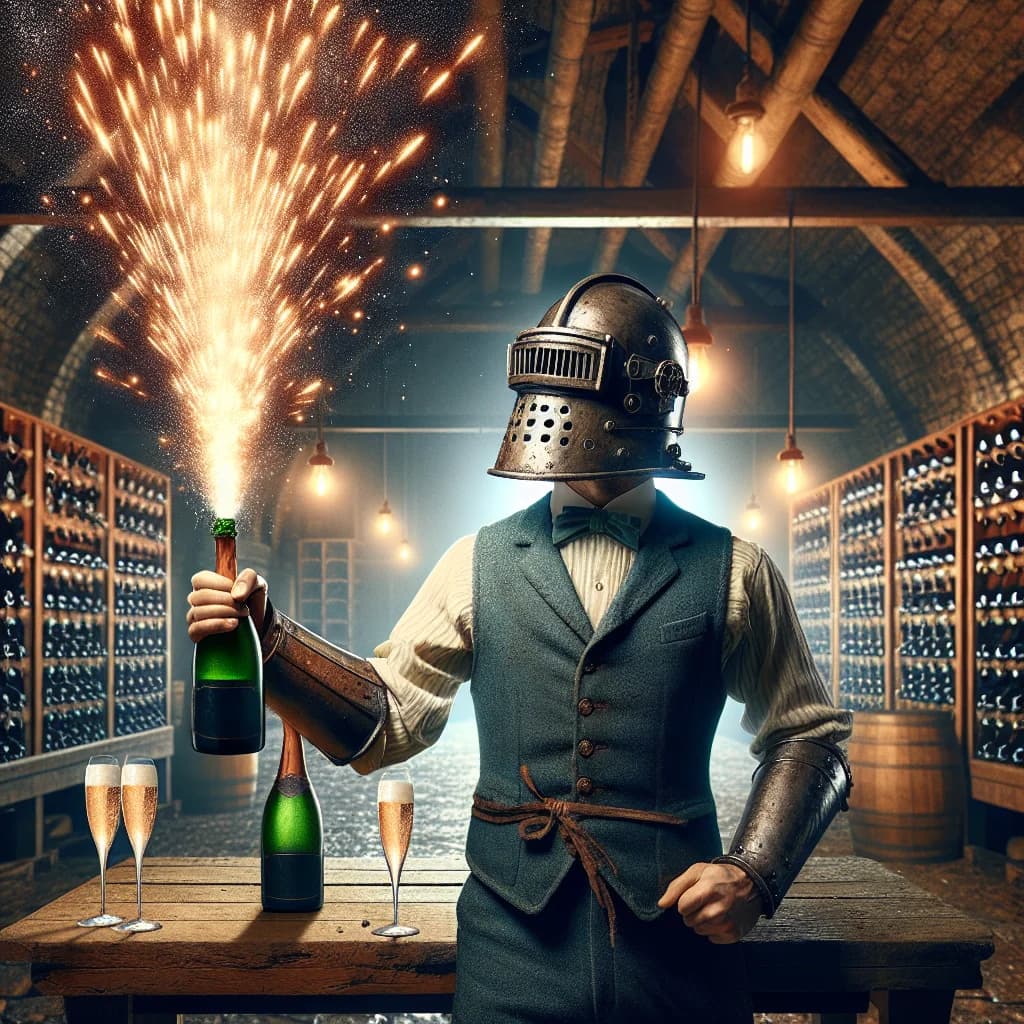
To mitigate the risk of blindness and facial disfigurement, winemakers and cellar hands adopted protective gear. The most iconic piece of equipment was the heavy iron mask. These masks typically featured:
- Wire Mesh or Solid Iron Plates: Designed to deflect high-velocity glass shards.
- Narrow Eye Slits: To provide visibility while offering maximum protection to the eyes.
- Leather Padding: To absorb some of the kinetic energy if a piece of glass struck the mask.
In addition to masks, workers often wore heavy leather aprons and thick gloves. Some even donned chainmail-like coverings over their torsos. Despite these precautions, the work remained terrifying. The sound of a bottle "popping" in the cellar was a constant reminder that death or permanent injury was only a heartbeat away.
The Shift Toward Safety
The transition away from iron masks began in the mid-1800s, thanks to scientific advancements. In 1836, a chemist named Jean-Baptiste François invented the glycomètre, a device that allowed winemakers to measure sugar levels accurately. This significantly reduced the "over-egging" of the secondary fermentation.
Furthermore, the adoption of standardized, factory-made bottles and stronger glass compositions eventually stabilized the industry. By the time Louis Pasteur published his research on fermentation in the 1860s, the "Devil’s Wine" had been largely tamed.
Conclusion
The heavy iron masks of 19th-century winemakers serve as a stark reminder of the dangerous origins of one of the world's most luxurious beverages. These masks were not a fashion statement but a vital necessity born of a time when the science of carbonation was still a deadly mystery. Why did nineteenth century winemakers wear heavy iron masks to protect themselves from spontaneously exploding champagne bottles? They did so because every bottle was a potential grenade, and every workday was a gamble with their lives. Today, as we enjoy a glass of chilled bubbly, we can appreciate the rigorous safety standards and scientific progress that moved Champagne from the battlefield of the cellar to the celebration of the table.


