Why did researchers successfully train common pigeons to distinguish between the different painting styles of Picasso and Monet
Think pigeons are just city pests? Discover the mind-bending research that reveals how these feathered "art critics" can masterfully distinguish between a Picasso and a Monet, proving their brains are far more sophisticated than we ever imagined.

Too Long; Didn't Read
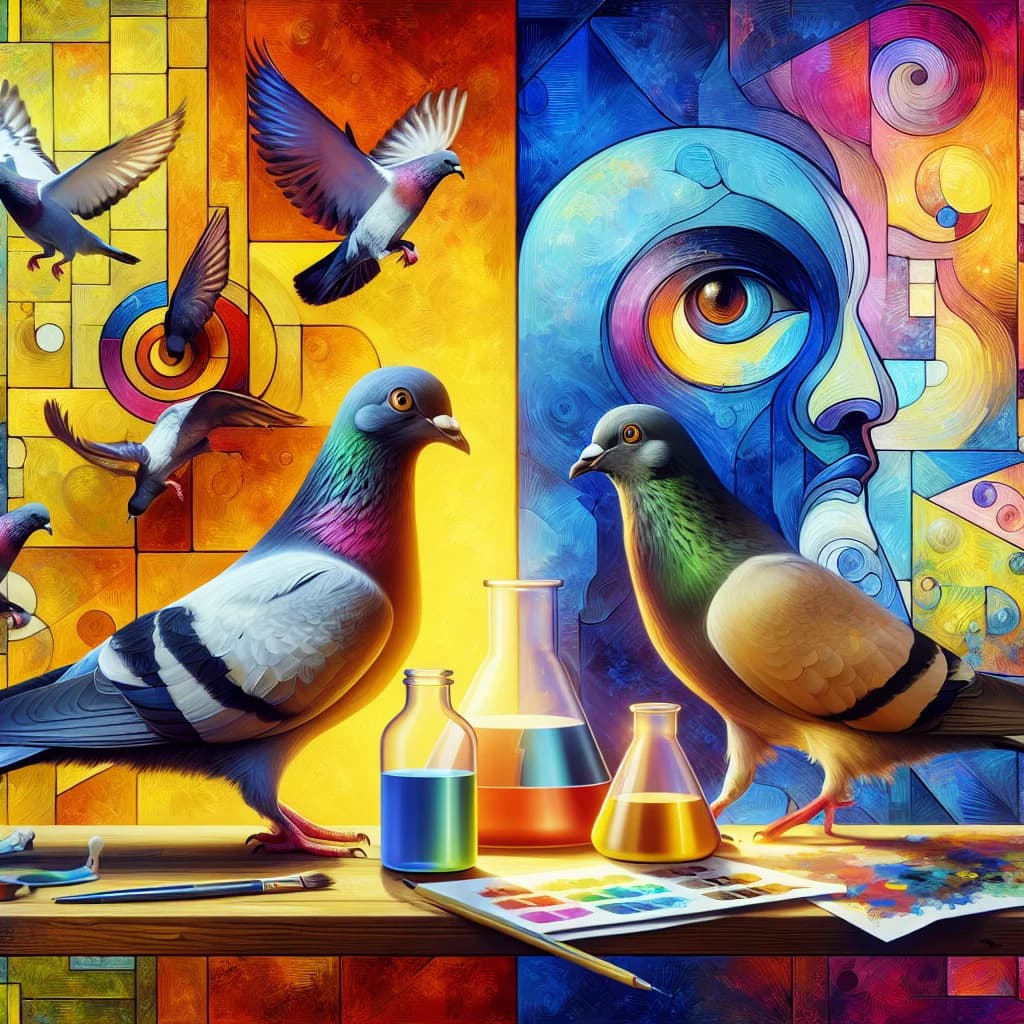
Researchers trained pigeons to distinguish between Picasso and Monet to study avian visual perception and categorization. The birds successfully learned to recognize abstract artistic styles and generalize them to new works, demonstrating that complex visual processing is not exclusive to humans.
Art Experts in Flight: Why Did Researchers Successfully Train Common Pigeons to Distinguish Between the Different Painting Styles of Picasso and Monet?
The phrase "bird-brained" has long been used as a slight against human intelligence, suggesting that a small brain equates to limited cognitive ability. However, a landmark study in avian psychology turned this stereotype on its head by proving that common pigeons can perform tasks once thought to be the exclusive domain of human art critics. In 1995, a team of researchers successfully demonstrated that these birds could categorize complex visual stimuli, specifically the works of Impressionist master Claude Monet and Cubist pioneer Pablo Picasso. But why did researchers successfully train common pigeons to distinguish between the different painting styles of Picasso and Monet? This post explores the fascinating mechanics of avian vision and the sophisticated cognitive processes that allow pigeons to navigate the nuances of fine art.
The Keio University Experiment: A Masterclass in Operant Conditioning
The study, conducted by Shigeru Watanabe, Junko Sakamoto, and Masumi Wakita at Keio University, sought to understand the limits of animal categorization. To achieve this, researchers used a method known as operant conditioning. The process involved several distinct phases:
- Positive Reinforcement: Pigeons were placed in a chamber and shown slides of various paintings. One group was rewarded with hemp seeds for pecking at a switch when shown a Picasso, while another group was rewarded for pecking at a Monet.
- Discrimination Training: If a pigeon pecked at the "wrong" artist (e.g., pecking at a Picasso when they were trained on Monet), no food was provided.
- The Result: Over time, the pigeons learned to associate specific visual characteristics with a reward, achieving an accuracy rate of over 90%.
The most striking discovery was not just that they could recognize specific paintings they had seen before, but that they could generalize. When presented with paintings by Picasso and Monet that they had never encountered during training, the birds still correctly identified the artist's style.
Why Pigeons? Evolution and Visual Processing
The success of this experiment stems from the unique evolutionary history of pigeons. As creatures that must navigate complex environments at high speeds, pigeons have developed visual systems that are, in some ways, superior to our own.
Tetrachromatic Vision
Unlike humans, who are trichromatic (possessing three types of color receptors), pigeons are tetrachromatic. They possess a fourth cone type that allows them to see ultraviolet light. This expanded spectrum provides them with a much richer "data set" when viewing a canvas, allowing them to detect subtle variations in hue and contrast that a human eye might overlook.
Feature Detection and Categorization
Researchers believe pigeons distinguish between Picasso and Monet by identifying specific "features" rather than appreciating the "art" in a human sense. According to the study published in Archives of Psychology, the pigeons utilized several visual cues:
- Contour and Shape: Picasso’s Cubist works are defined by sharp edges, geometric shapes, and clear boundaries.
- Color and Texture: Monet’s Impressionist works rely on soft, blurred edges and a specific palette of colors.
When researchers showed the pigeons black-and-white versions of the paintings, the birds could still distinguish the styles, suggesting that while color is a factor, they also rely heavily on spatial frequency and pattern recognition.
Challenging the "Bird-Brain" Narrative
The ability to categorize Monet and Picasso suggests that pigeons possess a high level of "concept formation." They aren't just memorizing images; they are forming a mental category for "Impressionism" versus "Cubism." This ability is vital for survival in the wild, as it allows birds to categorize different types of seeds, predators, or nesting sites even if they look slightly different from one another.
Further tests showed that the pigeons could even distinguish between other artists within similar movements. For instance, pigeons trained on Monet could correctly identify works by Renoir (another Impressionist) but struggled more with works by Braque (a Cubist). This proves that the birds were responding to the overarching stylistic "rules" of the artistic movements.
Conclusion
The reason why researchers successfully train common pigeons to distinguish between the different painting styles of Picasso and Monet lies in the bird’s extraordinary visual-spatial intelligence. Through a combination of advanced color vision and highly developed feature-detection skills, pigeons can process complex imagery and form abstract categories that mirror human classification.
This research highlights that intelligence is not a linear scale with humans at the top, but rather a diverse set of tools evolved for specific environmental needs. By understanding how a pigeon "sees" a Picasso, we gain deeper insights into the evolution of cognition and the universal nature of visual organization. For those interested in animal behavior, this study remains a powerful reminder that there is often much more going on behind a bird's eyes than meets the human gaze.