
Why do bananas grow in a curved shape pointing upward instead of hanging straight down toward the ground
While most fruits surrender to gravity, bananas perform a daring botanical U-turn to grow toward the sky. Discover the fascinating scientific phenomenon that forces these yellow favorites to defy the ground and reach for the sun.

Too Long; Didn't Read
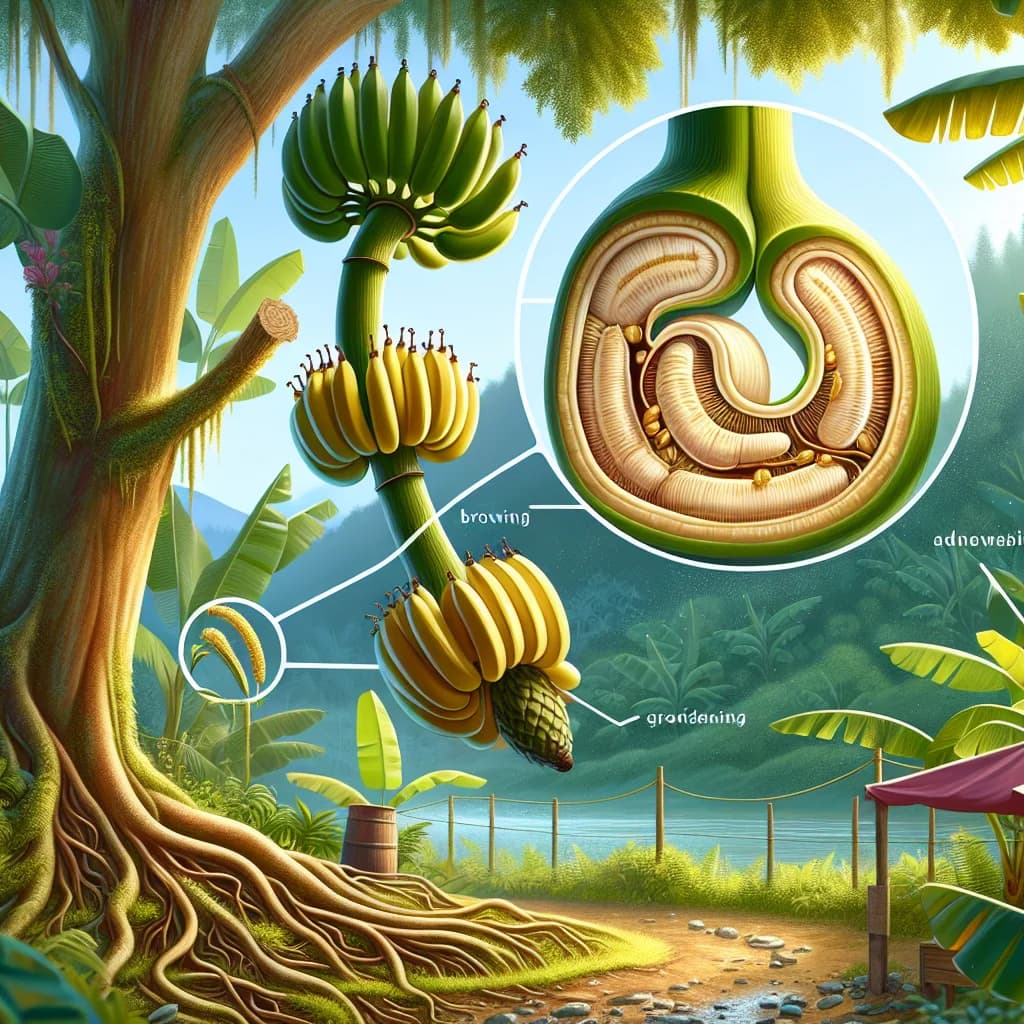
Bananas experience negative geotropism, meaning they grow against gravity. While they initially start growing downward, they eventually turn upward toward the sun to reach light through the rainforest canopy, resulting in their signature curved shape.
Why Do Bananas Grow in a Curved Shape Pointing Upward Instead of Hanging Straight Down Toward the Ground?
Have you ever stopped to look at a bunch of bananas and wondered why they resemble a cluster of yellow smiles rather than hanging straight down like most other fruits? While we often take the banana's distinctive crescent shape for granted, this curve is actually the result of a fascinating biological tug-of-war. Unlike apples or pears that succumb to the pull of gravity, bananas perform a unique botanical U-turn during their development. This phenomenon is not an evolutionary accident; it is a sophisticated survival strategy known as "negative geotropism." This blog post will explore the botanical mechanics and environmental factors that cause bananas to grow upward against the pull of gravity.
The Science of Negative Geotropism
To understand why bananas curve, we must first look at how plants respond to their environment. Most plants exhibit geotropism (or gravitropism), which is a growth movement in response to gravity. Roots show positive geotropism by growing downward into the soil, while most stems show negative geotropism by growing upward.
In the case of the banana plant, the fruit undergoes a two-stage growth process:
- The Initial Descent: Bananas grow from a large heart-shaped bud on a heavy stalk. Initially, the small "fingers" grow downward toward the ground, following the natural pull of gravity.
- The Upward Turn: As the fruit matures and the protective petals of the bud fall away, the banana begins to shift its direction. Instead of continuing toward the earth, the fruit starts growing upward against gravity.
This happens because of plant hormones called auxins. These hormones are responsible for cell elongation. In a developing banana, auxins concentrate on the side of the fruit facing the ground. This causes the bottom side to grow faster than the top side, forcing the fruit to curve and point toward the sky.
The Evolutionary Role of the Rainforest
The reason bananas developed this unique growth habit is rooted in their ancestral home: the tropical rainforest. Bananas originated in the middle layer of the jungle, a high-competition environment where sunlight is a precious commodity.
- Seeking Sunlight: In the dense canopy, light often filters through unevenly. If bananas grew straight out or hung directly downward, they would likely be shaded by the plant’s own massive, broad leaves. By curving upward, the fruit finds "gaps" in the foliage, maximizing the amount of sunlight it receives.
- Structural Integrity: Banana plants are not trees; they are actually the world’s largest perennial herbs. Their "trunks" are succulent pseudostems made of tightly wrapped leaf sheaths. If the heavy bunches of fruit—which can weigh over 100 pounds—grew straight out, they could easily unbalance or break the plant. The upward curve helps distribute the weight more centrally toward the main stem.
Comparisons with Other Fruits
Most common fruits, such as oranges or peaches, are heavy and fleshy. They hang straight down because their weight overpowers any geotropic response, and they do not require the same level of direct sunlight for the fruit itself to develop. However, the banana's unique "berry" structure (botanically speaking, a banana is a berry) and its specific hormonal makeup allow it to defy the standard "hanging" look.
Interestingly, not all banana varieties curve to the same degree. Some wild varieties and specific cultivars that produce smaller, lighter fruit may appear straighter, but the commercial Cavendish banana we find in grocery stores is a prime example of negative geotropism in action.
Conclusion
The curved shape of a banana is much more than a convenient handle for peeling; it is a testament to the plant’s ability to adapt to its environment. Through the process of negative geotropism, the banana defies gravity to seek out the sunlight necessary for its growth in the competitive rainforest. This biological "U-turn" ensures that the fruit can mature without being shaded by its own leaves or toppling its parent plant.
Understanding the science behind the banana’s shape helps us appreciate the complexity of the natural world and the hidden mechanisms that dictate how our food grows. The next time you reach for a banana, you can look at that famous curve as a clever piece of botanical engineering designed to capture every possible ray of sun.


