
Why do buttons on men's and women's clothing fasten on opposite sides due to historical aristocratic dressing habits
Ever wonder why your buttons seem to have a mind of their own? Discover how centuries-old sword fights and the secret rituals of aristocratic servants still dictate the way you get dressed every single morning.

Too Long; Didn't Read
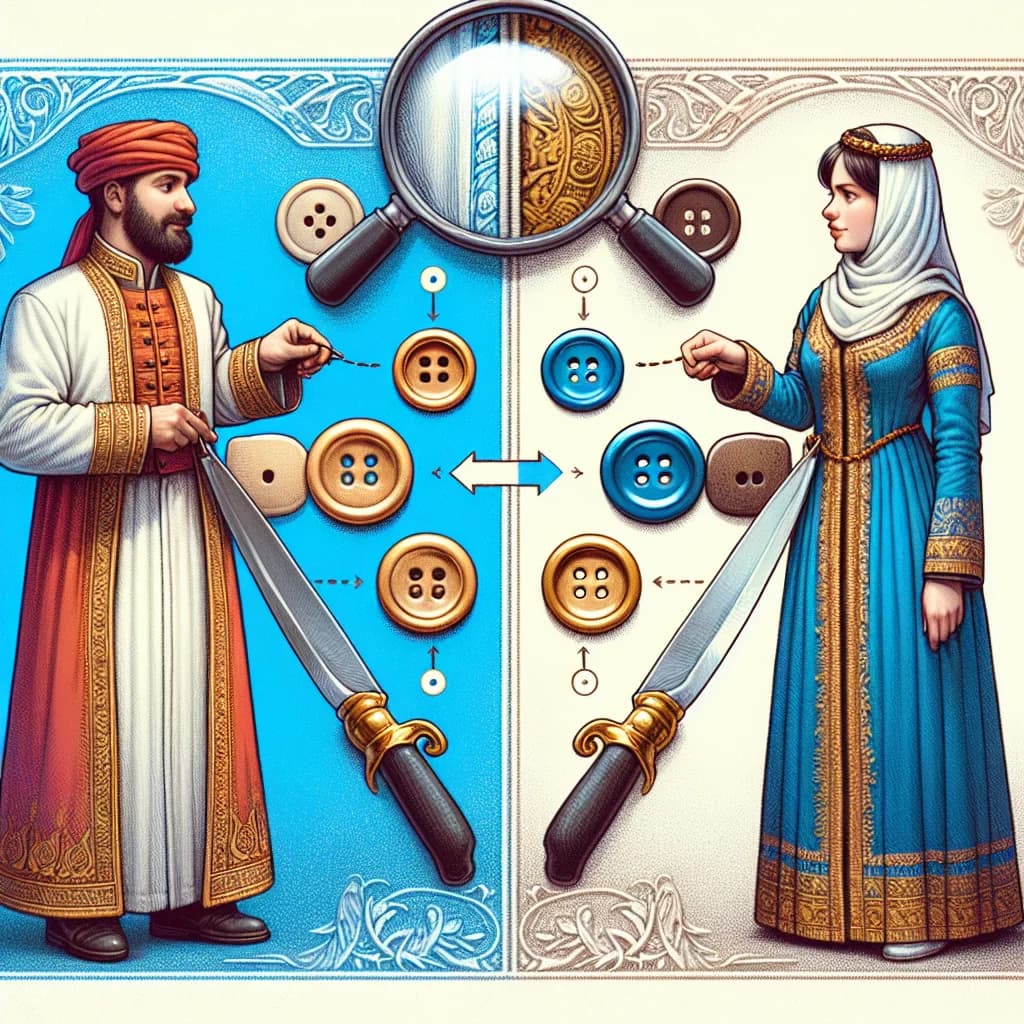
Men’s buttons are on the right to accommodate easy sword-drawing with the right hand, while women’s buttons are on the left because aristocratic women were historically dressed by right-handed servants.
The History of the Hemline: Why Do Buttons on Men’s and Women’s Clothing Fasten on Opposite Sides Due to Historical Aristocratic Dressing Habits?
Have you ever stood in front of a mirror, struggling with a stubborn button, and realized that your partner’s shirt fastens in the complete opposite direction? It is one of those subtle quirks of daily life that we often overlook, yet it represents a deep-seated historical divide. While modern fashion emphasizes gender neutrality in many areas, the placement of buttons—on the right for men and the left for women—remains a rigid standard. This distinction is not a random design choice or a modern stylistic whim; rather, it is a "fossilized" tradition. To understand why do buttons on men's and women's clothing fasten on opposite sides due to historical aristocratic dressing habits, we must look back to the 17th century, where social status, weaponry, and the logistics of being dressed by others dictated the rules of the wardrobe.
The Warrior’s Advantage: Why Men’s Buttons Are on the Right
For centuries, the design of men’s clothing was heavily influenced by the requirements of the military and personal defense. In the era when buttons were first introduced as functional fasteners (roughly the 13th to 17th centuries), men of the upper classes frequently carried swords. Because most men are right-handed, a sword was typically worn on the left hip and drawn across the body with the right hand.
Historical fashion experts often point to the "left-over-right" closure as a practical solution for the following reasons:
- Preventing Snags: If a jacket fastened right-over-left, the hilt of a sword could easily catch in the opening of the garment as it was drawn, potentially proving fatal in a duel.
- Ease of Access: A left-over-right closure ensured that the right hand could slip easily inside the coat or waistcoat to access a weapon or personal items without being obstructed by the fabric fold.
- The "Shield" Effect: In combat, particularly during the 17th century, the left side of the body was often turned toward the opponent. Having the flap open toward the back (left-over-right) prevented an opponent's blade or bayonet from catching on the edge of the coat and slipping through to the chest.
The Chambermaid’s Influence: Why Women’s Buttons Are on the Left
While men’s clothing was designed for the wearer to manipulate themselves, the clothing of aristocratic women was designed with the assistant in mind. During the Renaissance and Victorian eras, buttons were expensive luxury items, often made of precious metals or ivory. Consequently, they were primarily found on the garments of wealthy women.
Unlike the men of the house, noblewomen rarely dressed themselves. They relied on chambermaids to navigate the complex layers of corsets, petticoats, and elaborate gowns. Because most chambermaids were right-handed, dressmakers placed the buttons on the wearer’s left. This meant that, from the perspective of the servant standing in front of the lady, the buttons were on the servant’s right side, making the fastening process much faster and more efficient.
According to fashion historians at the Smithsonian Institution, this practice became a marker of status. Having buttons on the left signaled to the world that the wearer was wealthy enough to afford servants to help her dress every morning.
Beyond the Aristocracy: Cultural and Practical Factors
While the "servant theory" is the most widely accepted explanation for why do buttons on men's and women's clothing fasten on opposite sides due to historical aristocratic dressing habits, other historical factors may have reinforced the trend:
The Sidesaddle Theory
In the 18th and 19th centuries, women typically rode horses sidesaddle, sitting with their legs positioned to the right. To prevent the wind from blowing into the front of their riding habits and chilling them, buttons were placed on the left. This ensured the overlapping fabric flap faced away from the direction of travel.
The Nursing Theory
Some historians suggest that because most women are right-handed and tend to hold their babies with their left arm to keep their dominant hand free, having the opening of a shirt on the right side (lapping right-over-left) made it easier to unbutton the garment with the right hand while breastfeeding.
The Rise of Mass Production
By the time the Industrial Revolution standardized clothing sizes and manufacturing, these gendered button placements were already deeply entrenched in social norms. Manufacturers simply adopted the existing aristocratic standards for the growing middle class to maintain a sense of "proper" attire, ensuring that even as clothing became more accessible, the historical distinction remained.
Conclusion
The persistence of the left-right button divide is a fascinating example of how historical necessity can transform into permanent tradition. What began as a practical solution for sword-wielding men and a logistical convenience for the servants of noblewomen has survived centuries of social change and technological advancement. Understanding why do buttons on men's and women's clothing fasten on opposite sides due to historical aristocratic dressing habits allows us to see our modern wardrobes as living museums of a bygone era. The next time you button your coat, you aren't just getting ready for the day—you are participating in a ritual shaped by the duels and dressing rooms of the 17th-century aristocracy. For those interested in the intersections of history and design, this small detail serves as a reminder that even the simplest objects carry the weight of the past.


