
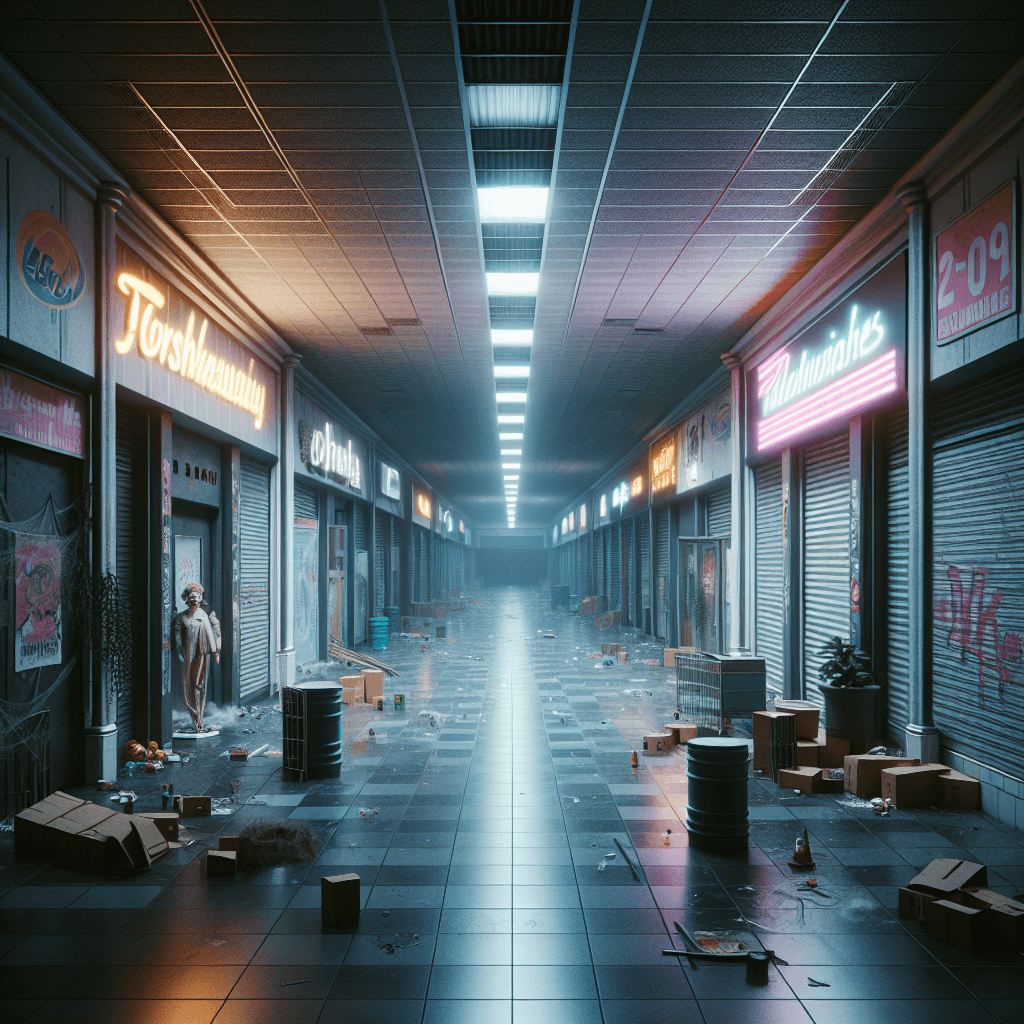
Why do empty hallways and abandoned malls give us such a creepy feeling
These spaces, designed for people but left unnervingly empty, create a glitch in our perception that triggers a primal, evolutionary alarm.

Too Long; Didn't Read
TLDR: Empty places built for crowds feel creepy because our brains expect noise and people. The silence and emptiness subvert these expectations, creating a sense of wrongness and making us feel exposed and vulnerable to unseen threats, which puts our survival instincts on high alert.
Echoes in the Void: The Psychology Behind Why Empty Hallways and Abandoned Malls Give Us Such a Creepy Feeling?
Have you ever walked down a school hallway after hours, or seen a photo of a once-bustling shopping mall now silent and deserted? The echo of your own footsteps seems too loud, and a strange sense of unease prickles at the back of your neck. This feeling is incredibly common, a shared human reaction to places that are meant to be full of life but are now devoid of it. It’s not just your imagination; there are deep-seated psychological and evolutionary reasons for this distinct brand of creepiness. This post will explore the fascinating science behind why these empty spaces feel so profoundly unsettling.
The Violation of Expectation: When a Space Breaks the Rules
Our brains are powerful prediction machines. Based on a lifetime of experience, we build mental blueprints, or "schemata," for how certain places should look, sound, and feel. A mall's schema includes the murmur of crowds, the chime of cash registers, upbeat music, and the aroma of the food court. A hallway during the day is filled with the sounds of movement and conversation.
When we encounter one of these spaces completely empty and silent, it creates a powerful sense of cognitive dissonance. The reality in front of us clashes violently with our brain's expectations. This mismatch sends a subconscious signal that something is wrong. The absence of people and noise isn't just an absence; it's a glaring void where life should be, and our minds struggle to reconcile this discrepancy, often interpreting it as a threat or a sign of danger.
Welcome to the Liminal Space
Many of these unsettling places fall into a category known as liminal spaces. The word "liminal" comes from the Latin limen, meaning "threshold." Liminal spaces are transitional or in-between places. They are the waiting rooms, stairwells, airports at 3 a.m., and, of course, empty hallways and abandoned malls.
These are not destinations but pathways to somewhere else. We are meant to pass through them, not linger. When we find ourselves stuck in a liminal space, it can evoke feelings of being out of place, in suspense, or disconnected from reality. The normal rules don't seem to apply. This inherent strangeness is a key ingredient in the creepy feeling they produce. An abandoned mall is a perfect example—a place of pure transition, now frozen in a permanent state of in-between.
Our Ancient Brain on High Alert
From an evolutionary perspective, our survival has long depended on our ability to detect threats. Empty, large, and complex environments trigger our brain's most ancient safety protocols. Think of it from the perspective of our early ancestors:
- Vulnerability: A vast, open space with many potential hiding spots (doorways, dark corners, empty storefronts) makes us feel exposed and vulnerable. Our brains are hardwired to scan for predators, and in these environments, a threat could come from anywhere.
- The Unnatural Silence: In the natural world, complete silence often means a predator is nearby, causing all other animals to freeze. We are biologically conditioned to interpret a sudden, profound quiet not as peace, but as a warning. The dead air of an abandoned mall is the urban equivalent of that predatory silence.
- Lack of Social Proof: Humans are social creatures. We look to others to gauge whether a situation is safe. In a bustling mall, the presence of hundreds of other relaxed people tells our subconscious that everything is okay. In an empty one, the total lack of "social proof" leaves our threat-detection system on high alert with no "all-clear" signal.
The Uncanny Valley of Places
The "uncanny valley" is a term often used to describe near-humanoid robots that are almost, but not quite, human, making them feel deeply unsettling. This concept can also be applied to places. An abandoned mall is a perfect example of the architectural uncanny valley. It is so familiar—we recognize the layout, the storefronts, the benches—but it's fundamentally wrong. The decay, the dust, the silence, and the darkness transform it from a known, safe space into a zombie version of itself. This eerie familiarity is profoundly disturbing because it takes something we understand and twists it into a grotesque imitation.
In conclusion, the creepy feeling we get from empty hallways and abandoned malls is far from irrational. It is a complex emotional and physiological response born from a perfect storm of psychological triggers. It’s the result of our predictive brains being confused by a violation of expectations, the unsettling nature of transitional "liminal" spaces, and our ancient survival instincts screaming that something is amiss. So, the next time you feel a shiver in a silent, empty space, know that you are not just being spooked—you are experiencing a profound and ancient human reaction to a world turned just slightly, and unnervingly, inside out.


