
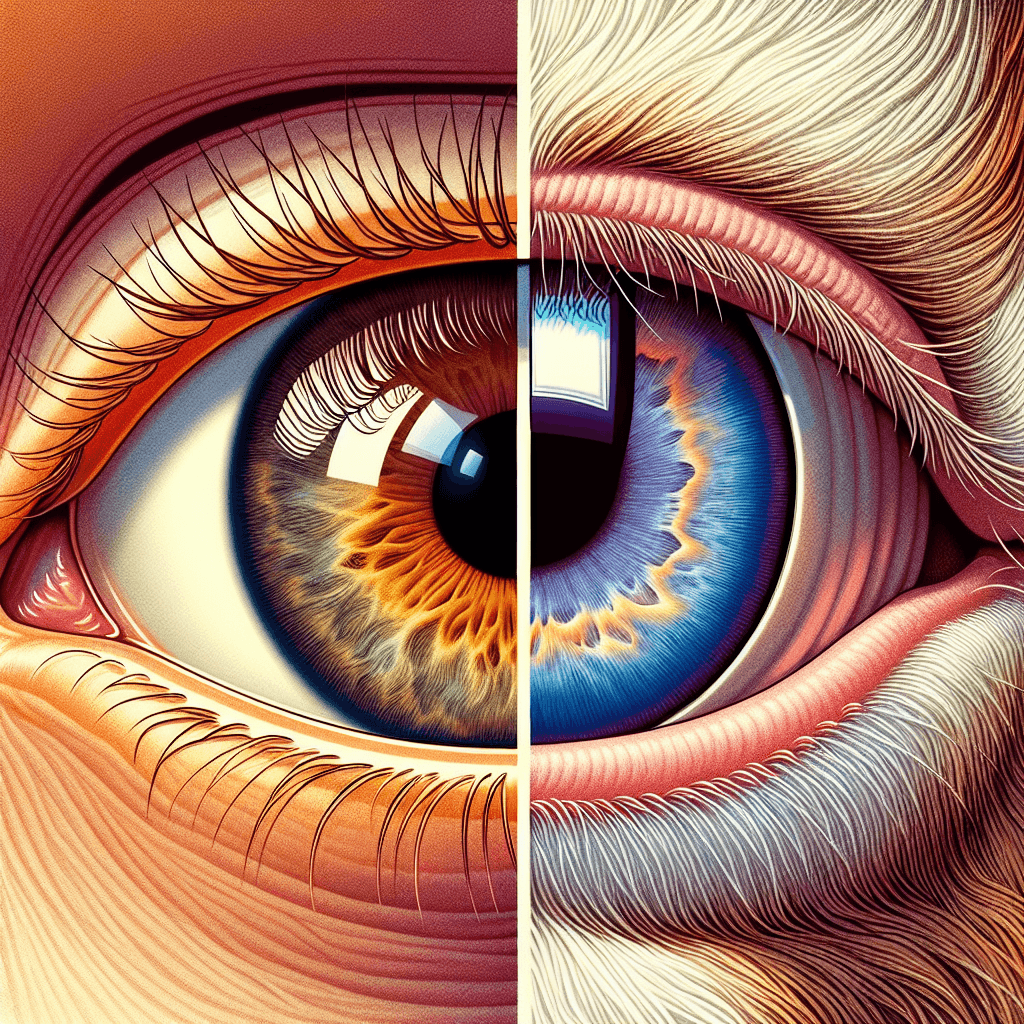
Why do goats have bizarre horizontal rectangular pupils instead of the round ones humans have
Those eerie, horizontal slits aren’t just for show—they’re a high-tech survival tool that gives goats a near-panoramic view of their surroundings. Dive into the fascinating science behind nature’s most bizarre eyes and discover why these "alien" pupils are actually a masterpiece of evolutionary engineering.

Too Long; Didn't Read
Goats have horizontal rectangular pupils to provide a wide panoramic view of their surroundings, which helps them detect predators from almost any angle. This unique shape also improves image quality of the terrain and allows them to maintain a clear view of the ground while grazing.
The Biological Vantage Point: Why Do Goats Have Bizarre Horizontal Rectangular Pupils Instead of Round Ones?
If you have ever spent time on a farm or at a petting zoo, you may have noticed something deeply unsettling about the gaze of a goat. Unlike the circular pupils of humans or the vertical slits of domestic cats, goats possess bizarre, horizontal rectangular pupils. This unique feature often gives them an "alien" appearance, but in the natural world, form always follows function.
The question of why do goats have bizarre horizontal rectangular pupils instead of the round ones humans have comes down to a fundamental struggle for survival. These pupils are not a biological fluke; they are a highly specialized evolutionary adaptation designed to provide a panoramic view of the world. For a prey animal that spends its day with its head down, these strange eyes are the ultimate security system. This blog post explores the science behind this ocular anatomy and how it grants goats a distinct advantage in the wild.
The Science of Panoramic Vision
The primary reason goats evolved horizontal pupils is to maximize their field of vision. According to a landmark 2015 study conducted by researchers at the University of California, Berkeley, and Durham University, the shape of a species' pupil is closely linked to its place in the food chain.
For a prey animal like a goat, the priority is detecting predators coming from any direction. Horizontal pupils create a wide, panoramic view that allows goats to see between 320 and 340 degrees around their bodies. In contrast, humans generally have a field of vision of about 120 degrees.
Key Benefits of the Horizontal Orientation:
- Wide-Angle Coverage: The rectangular shape captures more light from the left and right while limiting light from above and below. This reduces glare from the sun and focuses the animal's attention on the horizon.
- Enhanced Image Quality: By stretching the pupil horizontally, the goat can capture more detail of the surrounding terrain, making it easier to spot subtle movements in the distance.
- Ground Focus: While the goat scans for predators, the horizontal orientation helps maintain a sharp image of the ground, which is vital for a quick escape over rocky or uneven terrain.
The Grazier’s Dilemma: Maintaining the Horizon
One of the most fascinating aspects of goat ocular anatomy is how they maintain this panoramic view while eating. Most of a goat's life is spent grazing with its head lowered toward the ground. If their eyes were fixed in place, lowering their head would turn their horizontal pupils vertical, destroying their defensive advantage.
To combat this, goats have evolved the ability to rotate their eyes within their sockets. This biological phenomenon is known as cyclovergence. When a goat lowers its head to graze, its eyeballs rotate in opposite directions to stay parallel with the ground. Regardless of the angle of the goat's head, the pupils remain horizontal to the horizon, ensuring the animal never stops scanning for threats.
Comparing Pupil Shapes: Hunters vs. Hunted
To understand why goats have rectangular pupils, it is helpful to compare them to other eye shapes found in nature. Nature generally utilizes three main pupil shapes based on ecological niches:
- Round Pupils (Humans, Lions, Wolves): Found typically in "active foragers" or taller predators. These are ideal for depth perception and focusing on a specific target at eye level.
- Vertical Slits (Domestic Cats, Vipers, Crocodiles): These are common in ambush predators that operate close to the ground. The vertical slit allows for incredible depth perception and the ability to judge distances accurately without moving the head, which would give away their position.
- Horizontal Rectangles (Goats, Sheep, Deer): These are the hallmarks of the "hunted." Their goal is not to focus on a single point, but to take in as much of the horizon as possible to avoid being ambushed.
Conclusion
The mystery of why do goats have bizarre horizontal rectangular pupils instead of the round ones humans have is solved by looking through the lens of evolutionary necessity. These horizontal windows provide a wide-angle, high-definition view of the landscape, serving as an early warning system against predators. Combined with the incredible ability of their eyes to rotate while grazing, goats possess one of the most effective defensive visual systems in the animal kingdom.
Understanding these biological nuances allows us to appreciate the complexity of the natural world. The next time you find yourself locked in a "creepy" stare with a goat, remember: they aren't just looking at you—they are looking at almost everything else around them, too. For more insights into the fascinating world of animal biology, continue exploring the latest research in evolutionary optics.


