
Why do sliced grapes create a dazzling show of glowing plasma when heated inside a standard kitchen microwave
Ever wondered why two simple grape halves can ignite a miniature lightning storm in your kitchen? Dive into the high-octane physics behind this dazzling phenomenon and discover how ordinary fruit transforms into a brilliant ball of glowing plasma.

Too Long; Didn't Read
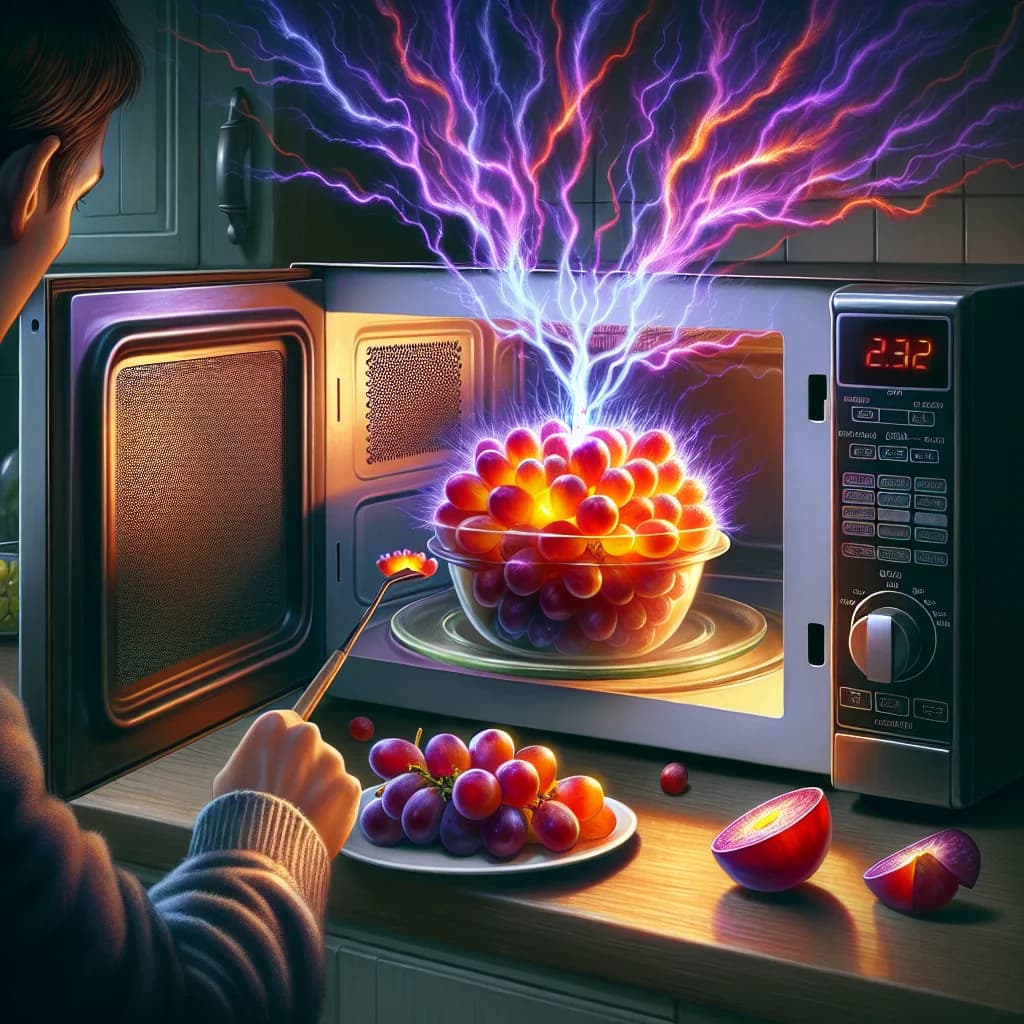
When two grape halves are placed close together, they act as a resonant cavity that traps and concentrates microwave energy at the point of contact. This creates an intense electromagnetic field that ionizes the air and minerals in the fruit, producing a glowing burst of plasma.
Sparking Science: Why Do Sliced Grapes Create a Dazzling Show of Glowing Plasma When Heated Inside a Standard Kitchen Microwave?
If you have spent any time exploring the "weird science" corners of the internet, you have likely seen the footage: two grape halves placed side-by-side in a microwave, erupting into a terrifyingly beautiful ball of fire. For decades, this kitchen experiment was a viral mystery, often explained away by armchair scientists as a simple quirk of electricity. However, the truth behind this phenomenon is far more complex and fascinating than a simple "short circuit."
Why do sliced grapes create a dazzling show of glowing plasma when heated inside a standard kitchen microwave? While it looks like a magic trick, it is actually a masterclass in resonant physics. Understanding this process requires us to look past the fruit itself and examine how microwaves interact with water-rich spheres to trap electromagnetic energy. This post explores the transition from a piece of fruit to a miniature lightning storm.
Moving Beyond the "Skin Bridge" Myth
For many years, the prevailing theory was that the thin strip of skin connecting two halves of a sliced grape acted as an electrical fuse. The idea was that the microwave’s radiation induced a current in the grape, and because the skin bridge was so thin, it would overheat, catch fire, and ignite a plasma burst.
However, a landmark 2019 study published in the journal Proceedings of the National Academy of Sciences (PNAS) debunked this theory. Using thermal imaging and high-speed cameras, researchers demonstrated that the "bridge" is entirely unnecessary. In fact, two whole, uncut grapes touching each other will produce the exact same plasma display. The phenomenon isn't driven by the skin acting as a wire, but by the way the grapes act as resonators.
The Role of Water and Refraction
To understand the plasma, we must first understand how microwaves interact with water. Grapes are roughly 90% water. In the context of microwave radiation, water has a very high refractive index. This means that when microwaves enter a grape, they slow down significantly and begin to bend.
Because of the grape’s size and its high water content, it acts as a "spherical dielectric resonator." Essentially, the grape is the perfect size to trap microwave energy. Instead of passing through the fruit, the waves bounce around inside it, becoming trapped.
The Creation of the "Hot Spot"
When you place two grapes (or two halves) next to each other, something remarkable happens at the point of contact:
- Constructive Interference: The waves trapped inside both grapes overlap at the junction where the fruits touch.
- Field Concentration: This overlap creates an incredibly intense electromagnetic field—a "hot spot"—between the grapes.
- Energy Density: The energy becomes so concentrated at this tiny point of contact that it is several times stronger than the energy in the rest of the microwave.
From Heat to Plasma
Once the electromagnetic field reaches a critical intensity at the junction, it performs a feat of physics: it ionizes the surrounding air. Plasma is often called the "fourth state of matter," occurring when gas is heated so intensely that electrons are stripped from their atoms, creating a glowing, conductive cloud of ions.
In the case of the grape, the intense energy at the contact point ionizes the sodium and potassium ions naturally present in the grape's skin and juice. This creates the bright, glowing fireball that rises from the fruit. The "dazzling show" is quite literally a localized cloud of lightning fueled by the microwave's energy and the grape's mineral content.
Conclusion
The mystery of why sliced grapes create a dazzling show of glowing plasma when heated inside a standard kitchen microwave highlights the surprising complexity of everyday objects. What was once thought to be a simple electrical short is actually a sophisticated example of microwave resonance and field concentration. By acting as tiny traps for radiation, grapes demonstrate the same principles of nanophotonics used to manipulate light on a microscopic scale.
While this phenomenon is a brilliant display of physics, it is important to remember that it can be incredibly damaging to household appliances, as the plasma can scorch the microwave's interior or damage the magnetron. For those interested in the intersection of physics and food, this "fruitful" discovery serves as a reminder that science is often hiding in plain sight—even in our snacks.


