
Why do some airplane trails linger for hours while others vanish in seconds
It’s a sky-gazing mystery: why does one plane's trail vanish instantly while another lingers for hours? The answer has nothing to do with the plane, but everything to do with the invisible patch of air it's flying through.

Too Long; Didn't Read
It all depends on the humidity at high altitudes. Lingering trails form in humid air, allowing the ice crystals from the engine to survive and spread. Trails that vanish quickly form in dry air, where the ice crystals evaporate almost instantly.
Sky Science: Why Do Some Airplane Trails Linger for Hours While Others Vanish in Seconds?
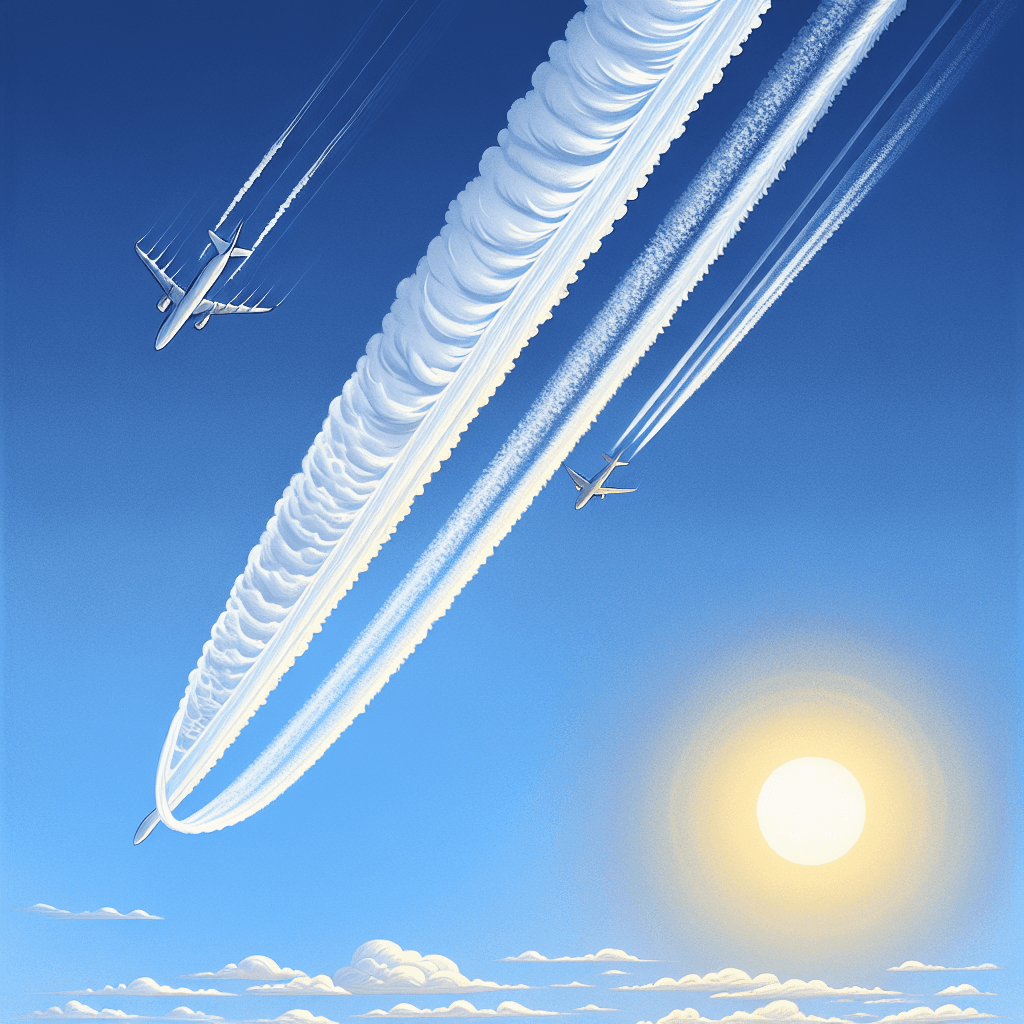
Have you ever looked up at a clear blue sky, watching a plane etch a brilliant white line across it, only to see the trail evaporate moments later? Then, on another day, a similar trail lingers, slowly spreading into a thin, wispy cloud that stretches from one horizon to the other. This common sight often sparks curiosity and confusion. It’s not a mystery related to the type of aircraft or a special fuel; the answer is written in the invisible conditions of the atmosphere itself. This post will demystify the science behind these airplane trails, revealing how a simple flight can act as a high-altitude weather report.
What Exactly Are Contrails?
Those white lines in the sky are called contrails, short for "condensation trails." They are essentially man-made cirrus clouds. Their formation is a straightforward process rooted in basic physics and chemistry.
Jet engines release hot, humid exhaust containing water vapor, carbon dioxide, and tiny particles (aerosols) like soot. At typical cruising altitudes of 30,000 to 40,000 feet, the surrounding air is extremely cold—often colder than -40°F (-40°C). When the hot, moist exhaust mixes with this frigid, low-pressure air, the water vapor rapidly cools, condenses, and then freezes around the aerosol particles. This process creates a visible trail composed of billions of tiny ice crystals.
The Decisive Factor: Atmospheric Humidity
The key to why some contrails persist while others fade lies not in the airplane, but in the humidity of the air it flies through. The atmosphere at that altitude dictates the fate of the ice crystals that make up the contrail.
Short-Lived Contrails: A Sign of Dry Air
When a plane flies through a very dry patch of air (low relative humidity), the contrail has a fleeting existence. The tiny ice crystals it's made of are exposed to an environment that is thirsty for moisture. They quickly undergo a process called sublimation—transforming directly from a solid (ice) back into a gas (water vapor).
Because the surrounding air can easily absorb this moisture, the trail vanishes, often just seconds or minutes after the plane has passed. Seeing a short-lived contrail is like getting a weather report telling you that the upper atmosphere is dry and stable.
Persistent Contrails: A Sign of Humid Air
The opposite happens when a plane travels through a region of the atmosphere that is already moist and close to being saturated with water vapor (high relative humidity). In this environment, the newly formed ice crystals in the contrail do not sublimate.
Instead, they are stable and can even grow larger by drawing additional moisture from the surrounding air. These are the persistent contrails that can linger for minutes or even hours. High-altitude winds can then shear and spread these trails, causing them to widen and transform into broad, thin clouds that are often indistinguishable from natural cirrus clouds. In essence, a persistent contrail indicates that the air at that altitude is humid enough to potentially form natural clouds.
Do Persistent Contrails Affect Weather and Climate?
This isn't just a fascinating visual phenomenon; it has real-world implications. Persistent contrails, which evolve into "contrail-cirrus" clouds, can impact the Earth's energy balance. According to atmospheric scientists, these man-made clouds can behave like natural high-altitude clouds.
- They reflect some incoming sunlight back into space, which has a slight cooling effect.
- More significantly, they can trap heat (longwave radiation) radiating from the Earth’s surface, preventing it from escaping into space.
Research from institutions like NASA and the German Aerospace Center (DLR) suggests that the net effect of contrail-cirrus clouds is a warming one. The extent of this impact is an active and important area of climate research, as scientists work to understand how global air traffic contributes to changes in our climate.
Conclusion
The next time you gaze at the sky, you’ll know that the longevity of an airplane's trail is a direct and visible indicator of the atmospheric conditions miles above your head. A trail that vanishes quickly signals dry, stable air, while one that lingers and spreads reveals a pocket of high humidity. What seems like a simple white line is actually a dynamic interaction between technology and nature, offering a real-time glimpse into the invisible weather patterns shaping our world and a reminder of the subtle ways human activity can influence our atmosphere.


