
Why do some cave formations grow in bizarre sideways spirals, defying gravity
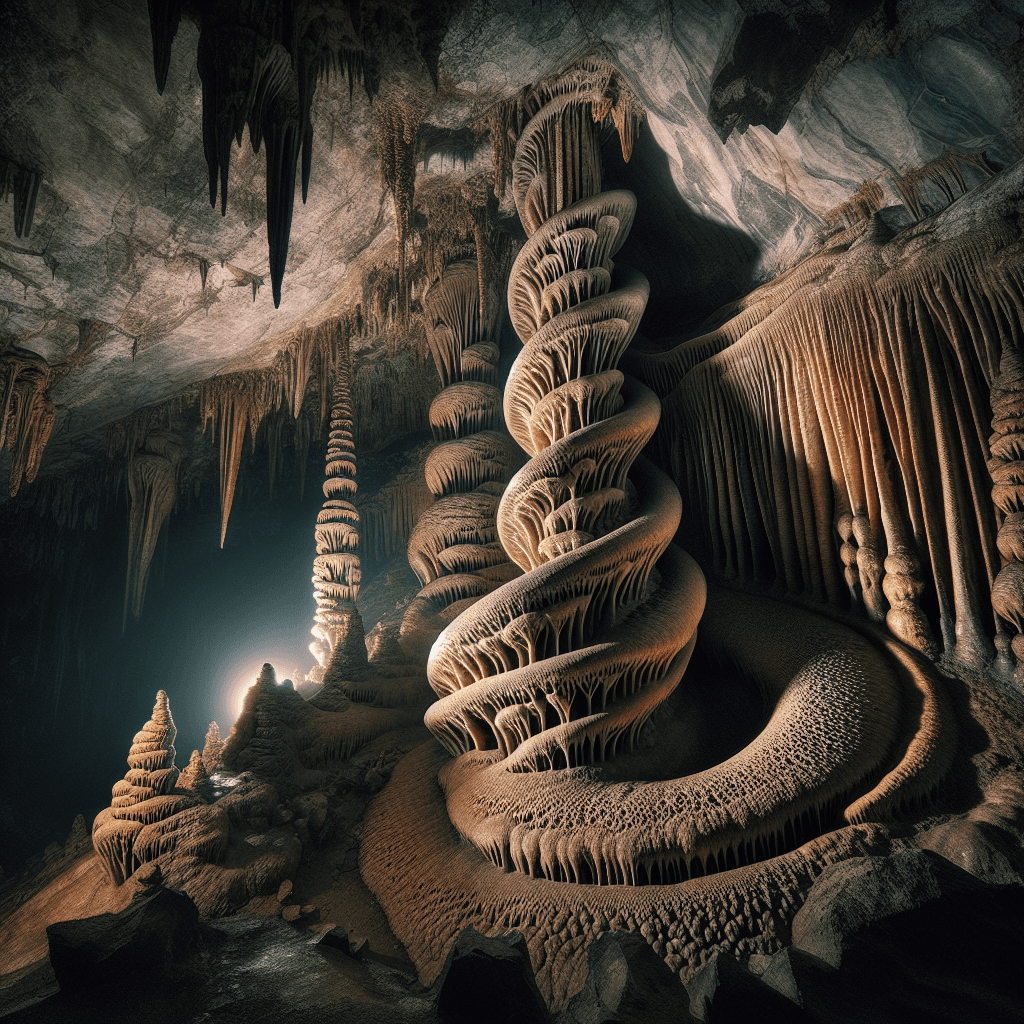
In the silent darkness of underground caves, some formations appear to break the laws of physics, twisting into delicate, sideways spirals. Discover the bizarre scientific secret that allows these crystal structures to defy gravity.

Too Long; Didn't Read
TLDR: These bizarre cave spirals, called helictites, defy gravity because they are not formed by dripping water. Instead, capillary action pulls water through tiny tubes within the rock, allowing mineral crystals to grow in any random direction determined by crystal structure, not gravity.
Unraveling the Helictite Enigma: Why Do Some Cave Formations Grow in Bizarre Sideways Spirals, Defying Gravity?
Picture a classic cave formation. You likely imagine majestic, icicle-like stalactites hanging from the ceiling or their counterparts, stalagmites, rising from the floor below. These structures are a testament to a simple, relentless force: gravity, pulling mineral-rich water downwards drip by drip over millennia. But deep within the Earth's quiet darkness, some formations play by a different set of rules. They twist and turn in delicate, spaghetti-like spirals, growing sideways, upwards, and in every direction except the one gravity dictates. These geological rebels are called helictites, and their existence is a captivating scientific puzzle. This post delves into the leading theories that explain how these bizarre, beautiful structures come to be.
What Exactly Are These Gravity-Defying Formations?
Before we explore the "why," let's clarify the "what." Helictites (from the Greek word 'helix,' meaning to twist) are a type of speleothem, the general term for cave formations. Like their more common cousins, they are typically composed of calcite or a similar mineral called aragonite.
The key difference lies in their form. While stalactites and stalagmites are built by the predictable dripping of water, helictites are formed by water that seeps, oozes, and flows under pressure. This fundamental difference in water transport is what allows them to escape the pull of gravity and grow into their famously chaotic and delicate shapes, which can range from thin, worm-like threads to complex, antler-like branches.
The Science of the Spiral: How Do They Form?
For a helictite to grow sideways or upwards, forces must be at play that are stronger than gravity's downward pull on a tiny water droplet. While no single theory explains every helictite, scientists generally agree that their formation is driven by a combination of the following mechanisms.
The Primary Driver: Capillary Action
The most widely accepted explanation for helictite growth is capillary action. This is the same phenomenon that allows a paper towel to soak up a spill or water to travel up a plant's stem. In simple terms, it's the ability of a liquid to flow through narrow spaces in opposition to gravity.
Helictites are believed to have a minuscule, hollow central canal, often thinner than a human hair. Water is forced through this tiny tube by hydrostatic pressure (the pressure of the water source behind it). When the water reaches the tip of the helictite, it deposits its dissolved calcite before evaporating. Because the water isn't dripping but is instead being delivered precisely to the tip, the direction the helictite grows is determined by the orientation of the crystals at that tip, not by gravity.
A Supporting Role: Wind and Air Currents
Even in the seemingly still environment of a cave, very slight and consistent air currents exist. These drafts can influence a helictite’s growth. As water seeps out at the tip, a gentle breeze on one side will cause the water to evaporate slightly faster there. This encourages more calcite to be deposited on that side, causing the formation to bend and curve gently in that direction. Over thousands of years, these subtle influences can contribute to the helictite’s twisting, corkscrew-like appearance.
The Crystal's Own Blueprint
On a microscopic level, the calcite crystals themselves play a part. The way mineral crystals stack upon one another is not random. Sometimes, imperfections in the crystal lattice or the presence of impurities can cause the primary axis of crystal growth to shift slightly. As new layers of calcite are added, this tiny, built-in "twist" is repeated over and over, forcing the entire structure to spiral as it grows longer. This effect, combined with capillary action delivering the building blocks, provides a powerful explanation for the most intricate spiral shapes.
A Perfect Combination of Forces
In reality, a helictite's bizarre shape is rarely the result of just one of these factors. It is the product of a delicate and complex interplay of forces. The journey begins with capillary action providing a steady, gravity-independent supply of mineral-rich water to the tip. From there, its path may be gently nudged by imperceptible air currents and guided by the fundamental growth pattern of its own calcite crystals. The result is a unique and beautiful sculpture, sculpted by physics and chemistry in the silent theater of a cave.
These strange formations are a powerful reminder that the natural world is full of wonders that challenge our everyday assumptions. Helictites show that even a force as fundamental as gravity can be overcome by the subtle, persistent power of water, wind, and chemistry. So, the next time you see an image of these cavernous curiosities, you’ll know you’re not just looking at a rock, but at a slow-motion dance of scientific principles that has unfolded over eons.


