
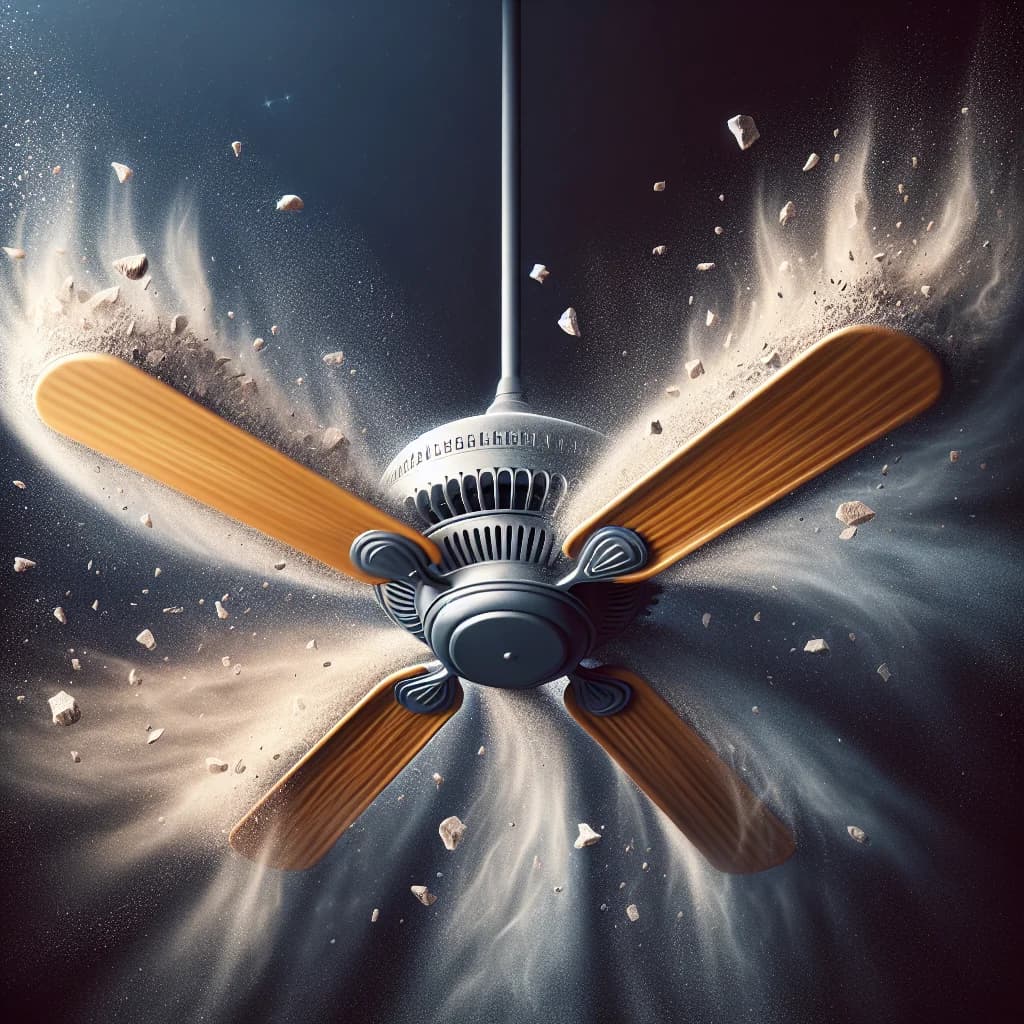
Why do the blades of a spinning ceiling fan still collect dust despite the constant movement through the air
It seems like a scientific paradox: how can a fan blade slicing through the air at high speeds still end up covered in thick layers of grime? The answer lies in a hidden layer of physics that turns your cooling breeze into a literal dust magnet.

Too Long; Didn't Read
Ceiling fan blades collect dust due to a combination of static electricity and fluid dynamics. As the blades move, friction with air molecules creates a static charge that attracts dust particles. Additionally, a thin layer of stagnant air called the boundary layer sits directly on the blade surface, shielding the dust from the wind and allowing it to settle and stick.
The Physics of Filth: Why Do the Blades of a Spinning Ceiling Fan Still Collect Dust Despite Constant Movement?
Have you ever climbed a ladder to clean your home and been shocked by the thick, velvety layer of grime coating the top of your ceiling fan blades? It seems to defy the laws of physics. We naturally assume that the high-speed rotation of the blades and the resulting downdraft should act as a self-cleaning mechanism, blowing away any stray particles. Yet, the faster the fan spins, the more it seems to attract dust. This common household mystery is not a result of poor ventilation or rare dust; it is a fascinating demonstration of fluid dynamics and electromagnetic forces. This blog post explores the scientific reasons why your ceiling fan remains a dust magnet despite its perpetual motion.
The Role of Static Electricity: The Triboelectric Effect
One of the primary reasons dust clings to fan blades is static electricity. As the fan blades move rapidly through the air, they frictionally interact with air molecules and suspended particles. This process is known as the triboelectric effect.
When the blades—typically made of wood, plastic, or composite materials—rub against the air, they build up a localized static charge. Most dust particles in a home also carry a slight electrical charge. Because opposite charges attract, the fan blades act like a giant magnet, pulling dust out of the air and bonding it to the surface. Unlike loose debris that might blow away, these statically charged particles are held in place by an invisible "electric glue." Once the first layer of dust adheres, it creates an even more textured surface, making it easier for subsequent layers to latch on.
Fluid Dynamics and the "Boundary Layer"
While static electricity explains how dust gets there, fluid dynamics explains why the wind doesn't blow it off. To understand this, we must look at a concept in physics called the Boundary Layer.
When a fluid (like air) moves over a surface (like a fan blade), the air molecules directly in contact with the surface are actually stationary relative to that surface. This occurs due to the viscosity of the air and the friction of the blade’s material.
Understanding the Layers:
- The Free Stream: This is the fast-moving air we feel as a breeze.
- The Transition Layer: Air begins to slow down as it nears the blade.
- The Boundary Layer: This is a microscopic pocket of "dead air" right against the surface of the blade.
Even when the fan is on its highest setting, this thin layer of stagnant air remains undisturbed. Because the air in this boundary layer isn't moving, the dust trapped within it is shielded from the wind generated by the rest of the fan. Consequently, the dust sits in a pocket of calm, protected from the very centrifugal force that we expect would fling it away.
Why Dust Accumulates on the Leading Edge
If you observe a dirty fan, you will notice that the thickest accumulation usually occurs on the "leading edge"—the side of the blade that cuts through the air first. This is due to a combination of mechanical impact and pressure. As the blade slices through the air, it physically collides with dust particles. The force of this impact can wedge particles into the microscopic imperfections of the blade material.
Furthermore, the leading edge experiences the highest air pressure. This pressure helps compress the dust against the blade, while the oils often found in household air (from cooking or skin) act as a binder, turning the dry dust into a sticky, resilient coating that resists the effects of centrifugal force.
Factors That Accelerate Dust Buildup
Several environmental factors can make this physical process happen even faster:
- Humidity: Higher moisture levels in the air can increase the "stickiness" of dust particles.
- Airborne Oils: In homes where frying occurs frequently, aerosolized oils settle on the blades, creating a literal adhesive for dust.
- Blade Material: Plastic and painted wood blades tend to build up static charges more easily than metal blades.
Conclusion
The mystery of the dusty ceiling fan is a perfect example of how complex physics operates in our everyday lives. It is the combination of the triboelectric effect creating an attractive charge and the fluid boundary layer providing a safe harbor for particles that allows dust to accumulate in the middle of a whirlwind.
While it may be frustrating to see grime on a moving object, understanding these principles helps us realize that it isn't a failure of the machine, but rather an inevitable result of how matter interacts with air. Since we cannot switch off the laws of physics, the best solution remains the simplest one: a damp microfiber cloth and a sturdy ladder. Knowing the "why" behind the dust might not make the cleaning easier, but it certainly makes the chore more intellectually stimulating.


