
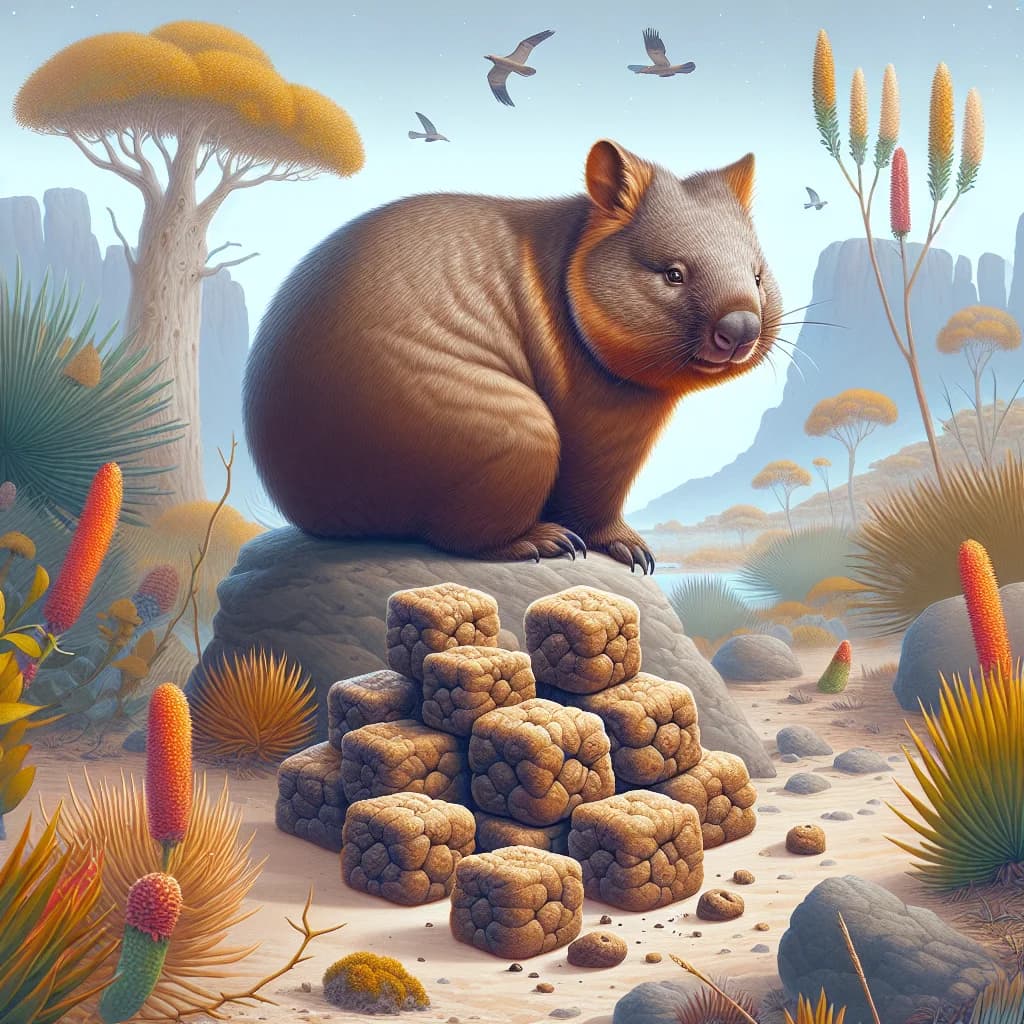
Why do wombats produce cube-shaped poop to keep it from rolling off the rocks they use to mark territory
Nature rarely works in straight lines, but the wombat’s cube-shaped poop is a biological masterpiece designed for one ingenious, territorial purpose. Discover the fascinating science behind how these marsupials produce the world’s only stackable droppings to claim their high ground.

Too Long; Didn't Read
Wombats produce cube-shaped droppings through specialized intestinal contractions. This unique shape prevents their waste from rolling off the rocks and logs they use as scent markers to define territory and communicate with others.
The Mystery of the Square Scat: Why Do Wombats Produce Cube-Shaped Poop to Keep It From Rolling Off the Rocks They Use to Mark Territory?
In the vast and varied landscapes of Australia, few creatures are as endearing or as enigmatic as the wombat. These sturdy, burrowing marsupials are famous for their adorable appearance, but they hold a unique biological distinction that has baffled scientists for decades: they are the only known species in the world to produce cube-shaped feces. While it might seem like a quirky anatomical fluke, this geometric phenomenon serves a vital evolutionary purpose.
The primary reason behind this unusual shape is communication. Specifically, researchers have discovered that wombats produce cube-shaped poop to keep it from rolling off the rocks they use to mark territory. By defying the traditional spherical or cylindrical shapes found elsewhere in the animal kingdom, wombats ensure their "scat signals" stay exactly where they are placed. This blog post explores the fascinating biological mechanics and behavioral necessity behind nature’s only square droppings.
The Purpose of the Cube: Territorial Signposting
Wombats are solitary and highly territorial animals. Because they have poor eyesight but an incredibly keen sense of smell, they rely on olfactory communication to interact with other members of their species. Feces act as a "biological business card," conveying information about the individual's health, sex, and presence in the area.
To ensure these messages are received, wombats prefer to deposit their scat on elevated surfaces, such as:
- Large flat rocks
- Fallen logs
- Small mounds of dirt outside their burrows
By placing their droppings on high ground, the scent disperses more effectively in the wind. This is where the cubic shape becomes essential. According to research published by the American Physical Society, a round or oval dropping would easily roll off a jagged rock or sloped log. The flat sides of the cube provide stability, ensuring the scat remains perched on its pedestal to serve as a long-lasting territorial marker.
The Mechanics: How Does a Wombat Make a Cube?
For years, many mistakenly believed that wombats possessed a square-shaped anus. However, biological studies have proven that the transformation occurs in the final stages of the digestive process. A landmark study led by Patricia Yang at the Georgia Institute of Technology, which earned an Ig Nobel Prize, revealed that the secret lies within the wombat’s intestines.
Intestinal Wall Elasticity
While most mammals have intestines that expand and contract uniformly, the last 8% of a wombat’s intestine possesses varying levels of stiffness. Researchers discovered two stiff zones and two flexible zones. As the intestine undergoes rhythmic contractions (peristalsis) to move waste, the stiffer sections resist deformation, while the softer sections stretch. This differential pressure molds the waste into a distinct hexagonal-to-cubic shape before it exits the body.
Extreme Dehydration
The wombat’s metabolism is famously slow; it can take anywhere from 8 to 14 days for a meal to pass through its system. During this time, the body absorbs every possible drop of moisture. By the time the waste reaches the end of the colon, it is significantly drier and more rigid than the waste of most other mammals. This lack of moisture allows the feces to retain its sharp edges and flat faces even after it is expelled.
Evolutionary Advantages and Environmental Adaptation
The ability to produce "stackable" scat offers the wombat a significant survival advantage. In the competitive environment of the Australian bush, clearly defined boundaries reduce the likelihood of physical confrontations between wombats, which can be energy-consuming and dangerous.
Furthermore, this unique adaptation highlights how evolution finds creative solutions to environmental challenges. In a habitat where high-visibility "signposts" are made of uneven stones and fallen timber, the development of non-rolling waste was a practical necessity.
Conclusion
The natural world rarely produces straight lines or right angles, making the wombat’s cubic scat a true biological marvel. As we have seen, wombats produce cube-shaped poop to keep it from rolling off the rocks they use to mark territory, utilizing a complex combination of intestinal physics and slow digestion to achieve this feat. This adaptation ensures that their scent markers remain stationary, effectively communicating boundaries to rivals and neighbors alike.
Understanding the "why" and "how" behind this phenomenon does more than satisfy our curiosity; it illustrates the incredible ways in which animals adapt to their environments. Next time you think of the wombat, remember that their famous square poop isn't just a quirk of nature—it is a masterpiece of evolutionary engineering. To learn more about Australia's unique wildlife, consider supporting local conservation efforts that protect the habitats of these extraordinary marsupials.


