
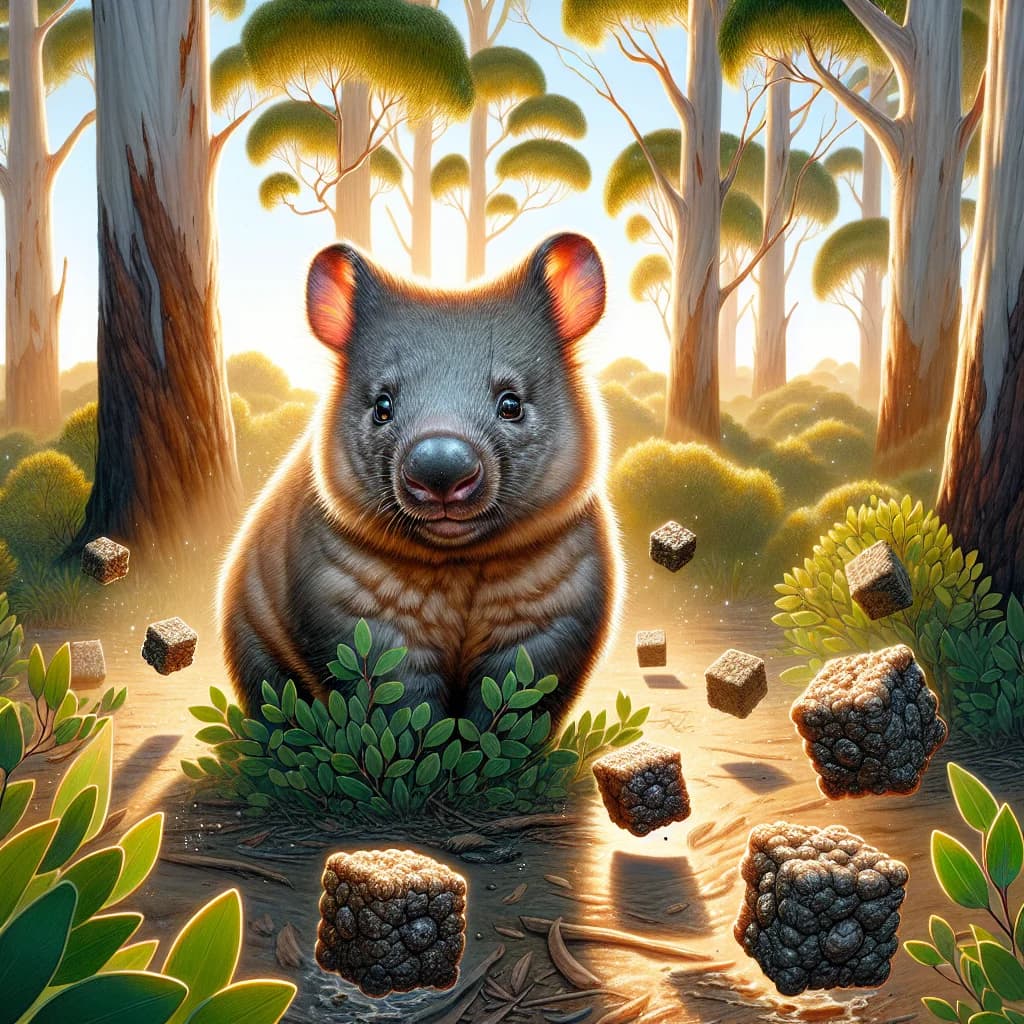
Why do wombats produce cube-shaped poop to prevent it from rolling away while marking their territory
Ever wondered how a wombat keeps its "business" from rolling away on rugged terrain? Discover the ingenious evolutionary secret behind nature’s only cube-shaped poop and why it’s the ultimate survival tool for marking territory.

Too Long; Didn't Read
Wombats produce cube-shaped droppings thanks to unique intestinal contractions. This structural adaptation prevents their waste from rolling away, allowing them to effectively stack it on elevated surfaces to mark territory and communicate with other wombats.
The Science of Squares: Why Do Wombats Produce Cube-Shaped Poop to Prevent It from Rolling Away While Marking Their Territory?
In the rugged landscapes of Australia, nature has engineered a biological oddity that has baffled scientists for decades. While most animals produce cylindrical or spherical waste, the wombat—a sturdy, burrowing marsupial—is the only creature in the world known to produce distinct, six-sided, cube-shaped scat. This peculiar trait is far from a biological accident; it is a sophisticated evolutionary adaptation. So, why do wombats produce cube-shaped poop to prevent it from rolling away while marking their territory? This blog post explores the fascinating intersection of fluid dynamics, intestinal biology, and social communication that allows the wombat to master the art of the geometric bowel movement.
The Purpose of the Cube: Territory and Communication
For a wombat, poop is more than just waste; it is a primary method of social networking. Wombats are solitary, nocturnal animals with relatively poor eyesight but an exceptionally keen sense of smell. They use their scent-heavy scat to signal their presence to other wombats, establish dominance, and define the boundaries of their home ranges.
The placement of this scat is critical. To ensure their scent carries as far as possible, wombats prefer to leave their droppings on elevated surfaces, such as flat rocks, fallen logs, or the mounds of dirt outside their burrows. If their waste were spherical, it would easily roll off these high-vantage points and disappear into the grass or leaf litter. By producing cubes, wombats ensure their "biological signposts" stay exactly where they are placed. This stability allows them to stack their droppings—sometimes up to 100 cubes in a single night—creating a prominent olfactory signal that remains visible and detectable to rivals or potential mates.
The Biological Machinery: How Cubes are Formed
The mystery of how a round anus produces a square shape was solved through a series of groundbreaking studies. According to research led by Patricia Yang and a team from the University of Tasmania and Georgia Tech, which earned an Ig Nobel Prize, the secret lies within the final section of the wombat’s intestine.
Unlike human intestines, which have a relatively uniform elasticity throughout, the last 17% of a wombat’s gut possesses unique mechanical properties. Researchers discovered two distinct stiff zones and two more flexible zones around the circumference of the intestine. As the waste moves through the distal colon, the wombat’s body absorbs massive amounts of water—wombats have an incredibly slow metabolism, and digestion can take up to 14 days. This dehydration process turns the waste into a dry, rigid mass.
The rhythmic contractions of the intestine then apply pressure:
- The stiff sections resist deformation, creating the flat faces of the cube.
- The flexible sections stretch more easily, allowing the corners to form.
This internal "molding" process is vastly different from human manufacturing, where we typically create squares by cutting or using rigid molds. The wombat achieves this through varying levels of muscle tension and tissue thickness.
Evolutionary Advantages and Efficiency
Beyond territorial marking, the production of cube-shaped scat highlights the wombat’s incredible efficiency in harsh environments. Because they live in arid or semi-arid regions of Australia, moisture conservation is vital. The intense pressure required to form these dry cubes ensures that the animal retains as much water as possible.
Furthermore, the "anti-roll" design of the cubes serves as a low-energy way to maintain social order. By leaving a permanent and stable scent mark, wombats can avoid direct physical confrontations with other males. A well-placed stack of cubes communicates that a territory is occupied, reducing the need for energy-consuming and potentially dangerous fights.
Conclusion
The question of why do wombats produce cube-shaped poop to prevent it from rolling away while marking their territory reveals a stunning example of evolutionary ingenuity. These marsupials have developed a specialized intestinal structure that turns a routine biological function into a vital tool for survival and communication. By combining complex fluid dynamics with territorial strategy, the wombat ensures its message stays put, even on the steepest of rocks. Understanding this process does more than satisfy our curiosity about animal waste; it provides engineers and biologists with new insights into how soft tissues can create complex, geometric structures—a lesson from nature that is as practical as it is peculiar.


