
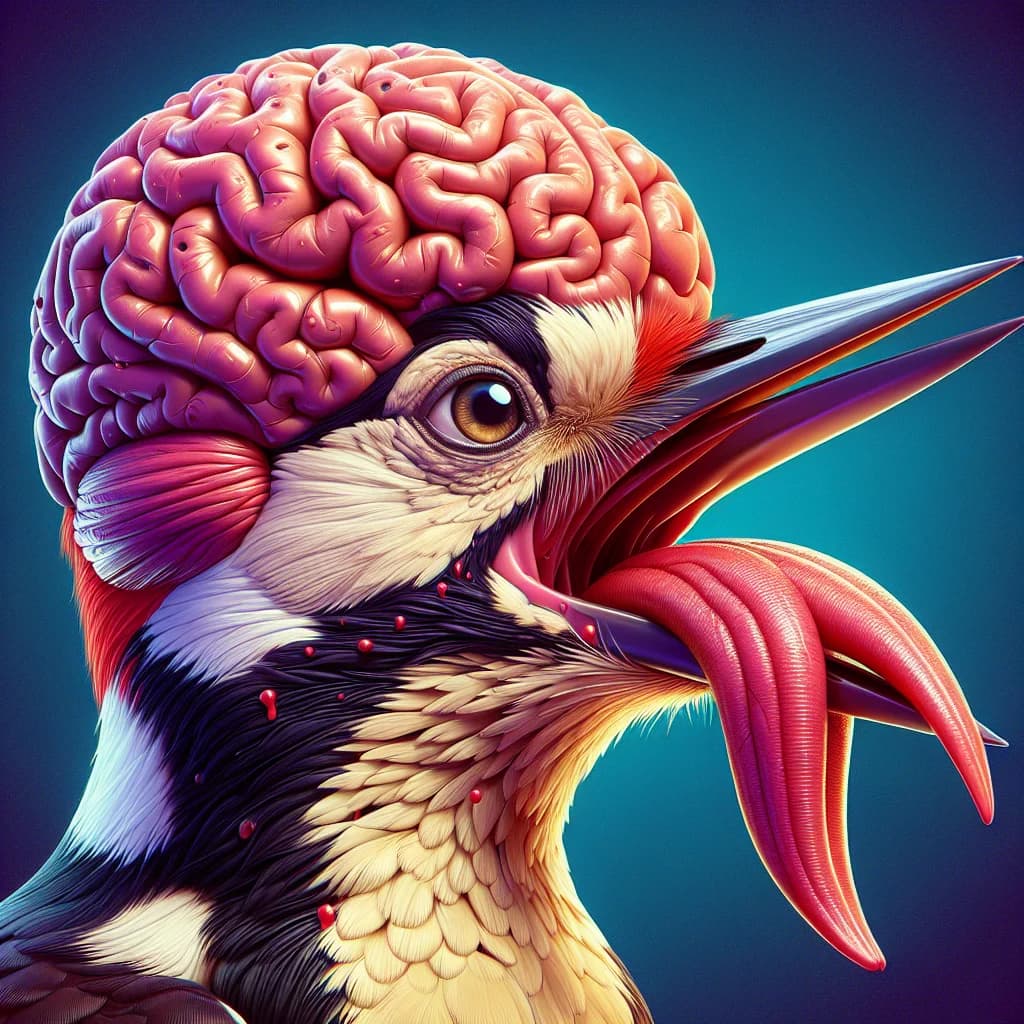
Why do woodpeckers wrap their long tongues around their brains to act as a biological shock absorber while drumming
Imagine slamming your head into a tree 20 times a second without a single headache. Discover the mind-bending biological "seatbelt" woodpeckers use to shield their brains from high-speed impact—and it’s far stranger than you’d ever expect.

Too Long; Didn't Read
Woodpeckers possess exceptionally long tongues that wrap around the back of their skulls to function as a natural safety belt. This unique anatomical structure distributes the intense impact forces generated during drumming, acting as a biological shock absorber to protect the brain from trauma and concussion.
Nature’s Internal Helmet: Why do woodpeckers wrap their long tongues around their brains to act as a biological shock absorber while drumming?
Imagine striking a solid oak tree with your forehead at 15 miles per hour, repeating the motion twenty times per second. For a human, this would result in immediate catastrophic brain injury. Yet, for the woodpecker, this is simply a standard morning of foraging and communication. These birds endure decelerations of up to 1,200 to 1,400g—forces that would leave any other land animal incapacitated. How do they survive such repeated trauma? The answer lies in one of the most bizarre and brilliant evolutionary adaptations in the animal kingdom: a tongue that doubles as a safety harness. This post explores why do woodpeckers wrap their long tongues around their brains to act as a biological shock absorber while drumming and how this unique anatomy protects them from high-velocity impacts.
The Engineering of an Impact: The 1,200g Challenge
To understand why the woodpecker’s tongue is so vital, one must first understand the sheer physics of "drumming." When a woodpecker strikes a tree, the impact duration is less than one millisecond. According to research published in the journal Bioinspiration & Biomimetics, the bird’s head experiences forces nearly 14 times greater than what would cause a concussion in a human.
Without a mechanism to dissipate this energy or stabilize the brain, the organ would collide with the interior of the skull, leading to internal bleeding and cellular death. Evolution’s solution was to develop a multi-part suspension system, with the hyoid apparatus—the structure supporting the tongue—playing the starring role.
The Hyoid Apparatus: A Tongue Like No Other
In most animals, the tongue is a muscular organ rooted in the throat. In the woodpecker, the tongue is attached to a complex structure of bone and elastic tissue called the hyoid apparatus. This structure is remarkably long, sometimes extending three times the length of the bird's bill.
How the "Wrap" Works
The hyoid bones do not stay confined to the mouth. Instead, they follow a path that seems like science fiction:
- The bones start at the base of the lower mandible (beak).
- They split into two "horns" that pass under the jaw.
- They curve upward, wrapping around the back of the skull.
- They meet again at the forehead or, in some species, even enter the nostril cavity.
This creates a literal "sling" that cradles the skull. When the woodpecker prepares to strike, the muscles associated with this apparatus contract, providing a tension-based support system for the brain case.
The Biological Shock Absorber: Mechanism of Action
The primary reason why woodpeckers wrap their long tongues around their brains to act as a biological shock absorber while drumming is to facilitate the even distribution of mechanical stress.
- Vibration Dampening: The hyoid apparatus is composed of both bone and highly flexible, elastic tissue. This combination allows it to act as a spring. When the beak hits the wood, the hyoid sling absorbs a portion of the initial vibration, preventing the full force from reaching the brain.
- Structural Stabilization: By "wrapping" the brain, the tongue and hyoid bones act like a high-performance seatbelt. They minimize the "sloshing" of the brain within the cerebrospinal fluid. Because the woodpecker’s brain is packed tightly within the skull and oriented to maximize surface area contact, the hyoid helps keep the brain's position fixed during high-speed deceleration.
- Energy Diversion: A study by researchers at Beihang University suggested that the hyoid apparatus helps divert the "shock wave" of the impact away from the most sensitive areas of the cranium, channeling the energy down toward the body instead.
Beyond the Tongue: A Complementary System
While the tongue is a critical component, it does not work in isolation. To act effectively as a biological shock absorber, it functions alongside other anatomical features:
- The Spongy Bone: Woodpeckers possess a specialized, plate-like spongy bone at the front of the skull that acts as a secondary buffer.
- Unequal Beak Length: The upper and lower parts of the beak are often slightly different lengths, which helps shear the impact forces away from the direct line of the brain.
- The "Hammer" Paradox: Interestingly, recent research from the University of Antwerp suggests that woodpecker heads are actually designed to be stiff rather than soft, to ensure they can penetrate wood efficiently. In this context, the hyoid apparatus is less about "softening" the blow and more about stabilizing the skull to ensure the brain moves in perfect synchronization with the rest of the head.
Conclusion
The question of why do woodpeckers wrap their long tongues around their brains to act as a biological shock absorber while drumming reveals a masterclass in natural engineering. By evolving a hyoid apparatus that serves as a protective sling, woodpeckers have managed to bypass the physical limitations that would otherwise cause fatal brain trauma. This unique anatomy—combining the tongue, spongy bone, and precision-engineered skull structures—allows these birds to perform feats of endurance that continue to inspire human technology, from better sports helmets to more durable aerospace components. Understanding these feathered marvels reminds us that nature often finds the most creative solutions to the most violent challenges.


