
Why do woodpeckers wrap their long tongues entirely around their skulls to act as a biological shock absorber
To survive high-speed impacts that would leave any other creature dazed, woodpeckers utilize a secret weapon literally wrapped around their brains. Discover the mind-bending biology behind nature’s most effective—and bizarre—shock absorber.

Too Long; Didn't Read
Woodpeckers possess exceptionally long tongues that wrap around their skulls to serve as a biological shock absorber, cushioning the brain and distributing impact forces to prevent injury during high-speed pecking.
Nature’s Helmet: Why Do Woodpeckers Wrap Their Long Tongues Entirely Around Their Skulls to Act as a Biological Shock Absorber?
Imagine striking a solid oak tree with your forehead at fifteen miles per hour, repeating the motion twenty times per second. For a human, this would result in catastrophic brain injury or death. Yet, for the woodpecker, this high-impact lifestyle is a daily routine necessary for foraging and communication. These birds endure decelerations of up to 1,200g—over a hundred times what a fighter pilot experiences—without so much as a headache.
The secret to this incredible resilience lies in a specialized anatomical feature: the hyoid apparatus. This blog post explores the fascinating biological engineering behind this bird's anatomy and answers the question: why do woodpeckers wrap their long tongues entirely around their skulls to act as a biological shock absorber? By understanding this unique evolutionary trait, we gain insight into one of nature’s most sophisticated internal safety systems.
The Anatomy of the Hyoid Apparatus
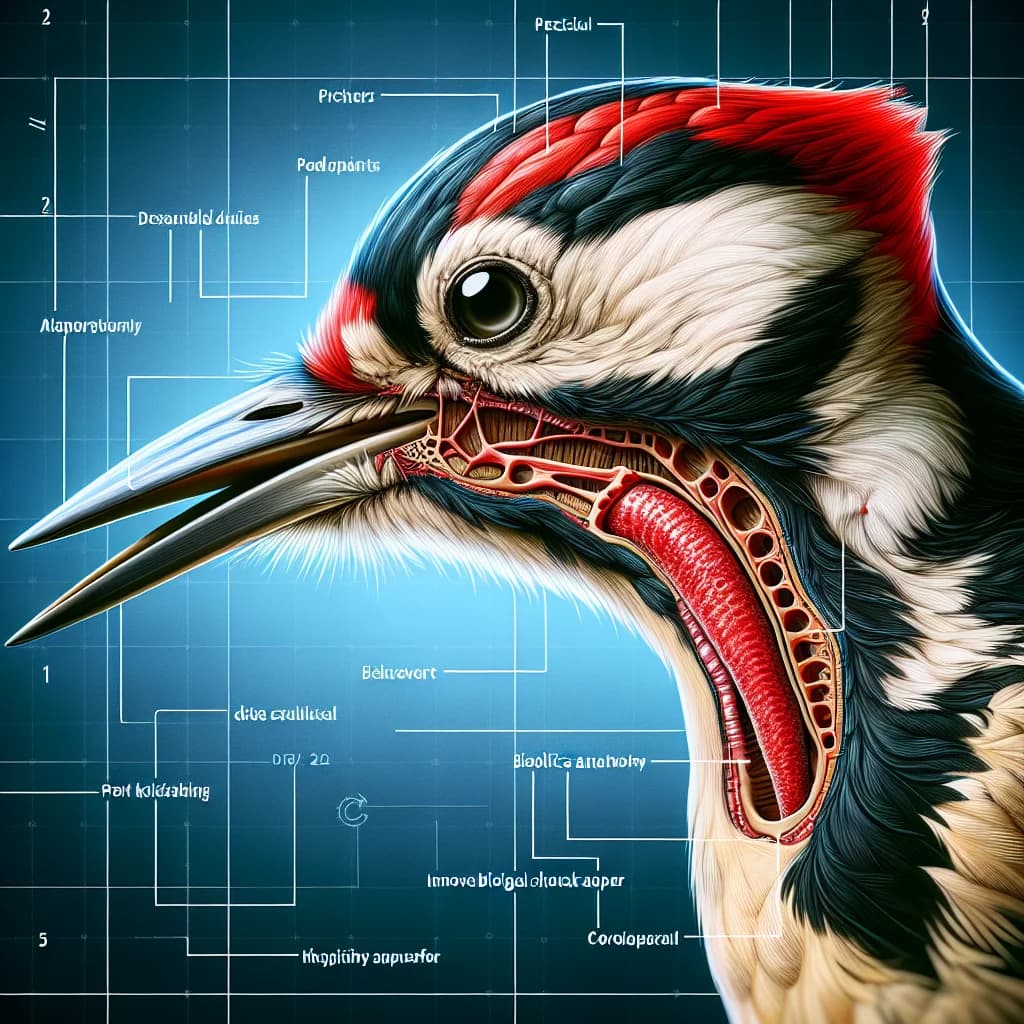
To understand why the tongue wraps around the skull, we must first look at the hyoid apparatus. In most animals, the hyoid is a small bone at the base of the tongue. However, in woodpeckers, this structure is dramatically elongated. It consists of bone and elastic muscle that begins at the base of the beak, passes through the right nostril, splits into two branches that travel over the top of the skull, loops around the back, and meets again under the jaw.
This configuration allows the tongue to be exceptionally long—sometimes extending up to a third of the bird’s total body length. While this length is vital for reaching deep into tree cavities to extract insects, its storage method serves a secondary, equally vital purpose: cranial protection.
How the Tongue Acts as a Safety Harness
The primary reason why woodpeckers wrap their long tongues entirely around their skulls to act as a biological shock absorber is to stabilize the cranium during impact. When the beak strikes wood, the impact creates a massive surge of kinetic energy. According to researchers at the Beijing University of Aeronautics and Astronautics, the hyoid apparatus acts like a "safety belt" for the brain.
- Force Distribution: Because the hyoid bone is wrapped tightly around the skull, it helps distribute the impact forces. Instead of the vibration being concentrated solely on the frontal bone of the skull, the energy is diverted along the path of the hyoid.
- Muscular Dampening: The muscles surrounding the hyoid bone are highly specialized. Just before the moment of impact, these muscles contract, bracing the skull and holding the brain firmly in place.
- The "Slingshot" Effect: This wrapping mechanism ensures that the tongue is held under tension, providing a counter-balance to the forward motion of the head.
Synergistic Shock Absorption
While the tongue is a critical component, it does not work in isolation. The reason the wrapped tongue is so effective as a biological shock absorber is that it works in tandem with other anatomical features:
- Spongy Bone Structure: Woodpeckers possess a plate-like "spongy" bone at the front of their skulls. This bone is porous and uneven, which helps dissipate vibrations before they reach the brain case.
- Unequal Mandibles: Often, the lower half of a woodpecker's beak is slightly longer than the top. This anatomical mismatch directs a significant portion of the impact force toward the lower jaw rather than the brain-protecting upper skull.
- The Third Eyelid: Just milliseconds before impact, a woodpecker closes its nictitating membrane (a translucent third eyelid). This prevents the bird’s eyes from literally popping out of their sockets due to the high pressure.
Evolutionary Advantage and Foraging
Beyond protection, this wrapping mechanism facilitates the woodpecker’s unique foraging style. Since the tongue is stored around the skull, it can be projected rapidly. The same hyoid structure that absorbs shock also provides the mechanical leverage needed to flick the tongue deep into beetle galleries. The combination of shock absorption and extreme reach allows woodpeckers to exploit a food source—wood-boring larvae—that few other birds can access.
Conclusion
The woodpecker is a marvel of evolutionary biomechanics. By evolving a system where they wrap their long tongues entirely around their skulls to act as a biological shock absorber, these birds have solved a physics problem that still challenges human engineers. This "internal helmet" allows them to withstand forces that would be lethal to almost any other vertebrate.
Understanding these natural mechanisms does more than satisfy our curiosity; it informs modern science. Currently, sports equipment designers and aerospace engineers study the woodpecker’s hyoid apparatus to develop better helmets and impact-resistant materials. By looking closely at how nature protects its own, we can find better ways to protect ourselves from high-impact injuries. For those interested in the intersection of biology and engineering, the woodpecker remains one of the most compelling case studies in the natural world.


