
Why do your fingers contain zero muscles, with all movement controlled like a puppet by tendons in your forearms
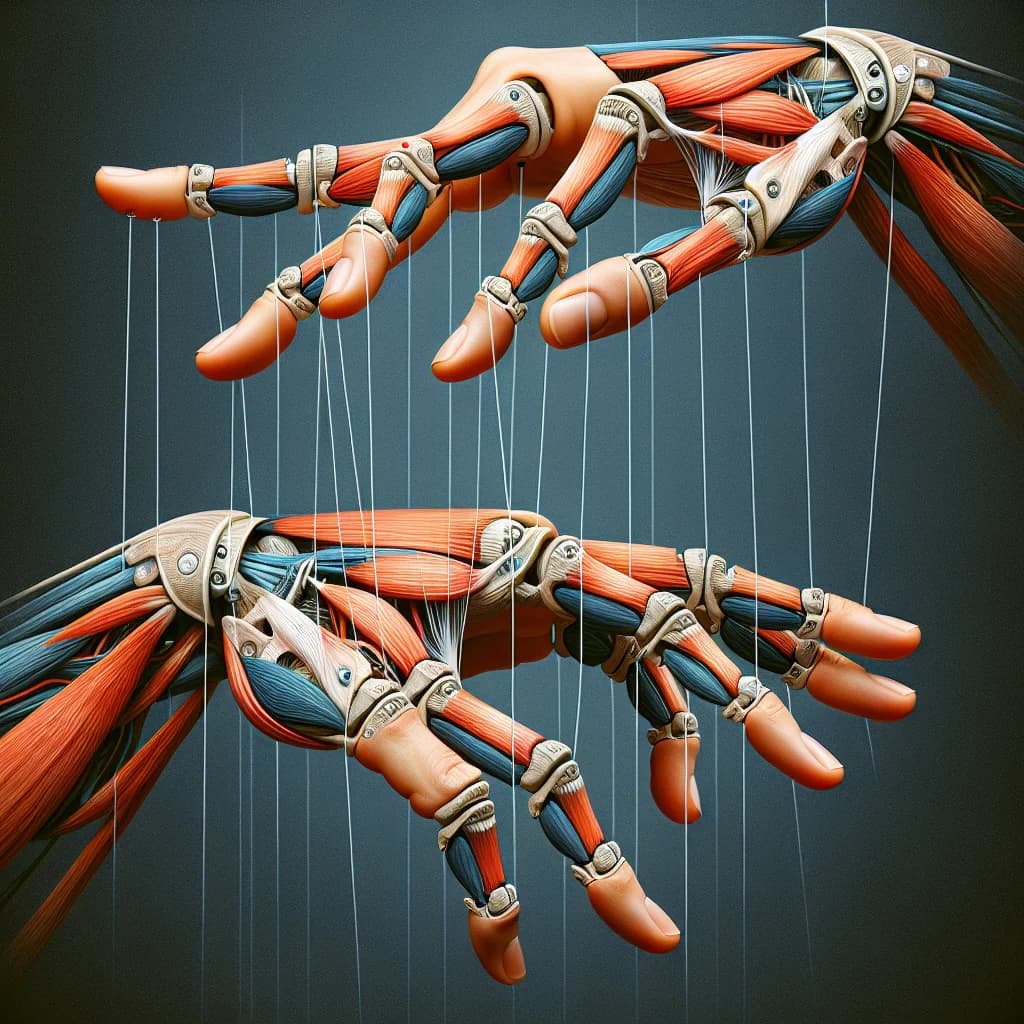
Your fingers don’t contain a single muscle; instead, they function like biological marionettes pulled by "strings" tucked away in your forearms. Discover the fascinating, remote-controlled engineering behind your every move and why your hands are more like high-tech puppets than you ever imagined.

Too Long; Didn't Read
Fingers lack muscles to remain slim and agile for complex tasks. Instead, they operate like puppets, with powerful muscles in the forearm and palm pulling long tendons to move the joints. This design provides maximum dexterity and strength without making the hands too bulky.
The Invisible Puppet Master: Why Do Your Fingers Contain Zero Muscles, With All Movement Controlled Like a Puppet by Tendons in Your Forearms?
Take a moment to wiggle your fingers. It feels as though the power for that movement is generated right there in your digits. However, in a fascinating twist of biological engineering, your fingers are actually "remote-controlled." Why do your fingers contain zero muscles, with all movement controlled like a puppet by tendons in your forearms? This anatomical setup is one of the most efficient designs in the human body.
While we often associate movement with local muscle contraction, the fingers are a notable exception. They consist of bone, skin, nerves, and blood vessels, but they lack the bulky muscle tissue found in your arms or legs. Understanding this unique structure reveals how humans achieved the high-level dexterity required for everything from playing a piano to performing complex surgery. This post explores the mechanics of the hand and the evolutionary advantages of being a biological puppet.
The Anatomy of a Muscle-Free Digit
To understand why your fingers lack muscles, we first have to look at what they do contain. A finger is composed of three phalanges (bones), while the thumb has two. Connecting these bones are tough, fibrous bands called tendons.
According to anatomical research from institutions like the Mayo Clinic, the primary muscles responsible for moving these bones are located elsewhere. Specifically, they are divided into two categories:
- Extrinsic Muscles: Located in the forearm. These provide the "raw power" for gripping and extending.
- Intrinsic Muscles: Located in the palm of the hand. These assist with fine motor skills and lateral movements.
Because the fingers themselves contain no muscle bellies, they remain slender. This allows for a range of motion and a level of precision that would be impossible if the fingers were thick with muscle tissue.
How the "Puppet" Mechanism Works
The movement of your fingers is a masterclass in mechanical engineering. Imagine a puppet controlled by strings; your forearm muscles are the puppeteer, and your tendons are the strings.
The Role of Tendons
Tendons are incredibly strong cords of connective tissue that attach muscle to bone. In the hand, these are categorized into two main groups:
- Flexor Tendons: These run along the palm side of your hand. When the muscles in your forearm contract, these tendons pull on the finger bones, causing them to curl into a fist.
- Extensor Tendons: These run along the back of the hand. When these contract, they pull the fingers straight.
The Pulley System
To keep these "strings" from snapping or bowing out away from the bone (a condition known as bowstringing), the body uses a system of ligaments called pulleys. These sheaths hold the tendons close to the bone, ensuring that the force from the forearm is translated efficiently into the bending of the finger joints.
The Evolutionary Advantage: Why Is This Design Necessary?
One might wonder why evolution didn’t simply place small muscles inside the fingers. The answer lies in the trade-off between power and precision.
- Dexterity and Space: If the fingers contained the muscles necessary to move them, they would be incredibly bulky. Large fingers would make it impossible to perform fine motor tasks, such as threading a needle or typing on a keyboard.
- Strength and Leverage: By housing the muscles in the forearm, the body can utilize larger, more powerful muscle groups without sacrificing the hand's slim profile. This allows humans to have a "power grip" (like holding a hammer) and a "precision grip" (like holding a pen) simultaneously.
- Temperature Regulation: Because fingers have a high surface-area-to-volume ratio, they lose heat quickly. Muscles require significant blood flow and warmth to function optimally. By keeping the "engine" (the muscles) in the insulated forearm, the hand can continue to function in colder temperatures where internal finger muscles might seize.
Conclusion
The human hand is a testament to the brilliance of biological "remote control." Why do your fingers contain zero muscles, with all movement controlled like a puppet by tendons in your forearms? The answer is a sophisticated balance of space-saving anatomy and mechanical efficiency. By offloading the bulk of the muscular work to the forearm, our hands remain light, agile, and capable of the intricate tasks that define human capability.
Understanding this puppet-like mechanism not only highlights the complexity of our musculoskeletal system but also explains why injuries to the forearm or wrist can have such a profound impact on hand function. The next time you perform a delicate task, remember the invisible "strings" in your forearm that make it all possible. For those interested in maintaining hand health, focusing on forearm flexibility and tendon gliding exercises is the best way to keep your biological puppet strings in peak condition.


