Why do your fingers wrinkle in water to create a biological tread for better grip on wet surfaces
Your wrinkled fingertips aren't just soggy skin; they're a high-tech evolutionary masterstroke designed to give you a superhuman grip. Discover the fascinating science behind how your body activates its own "rain tires" the moment things get slippery.

Too Long; Didn't Read
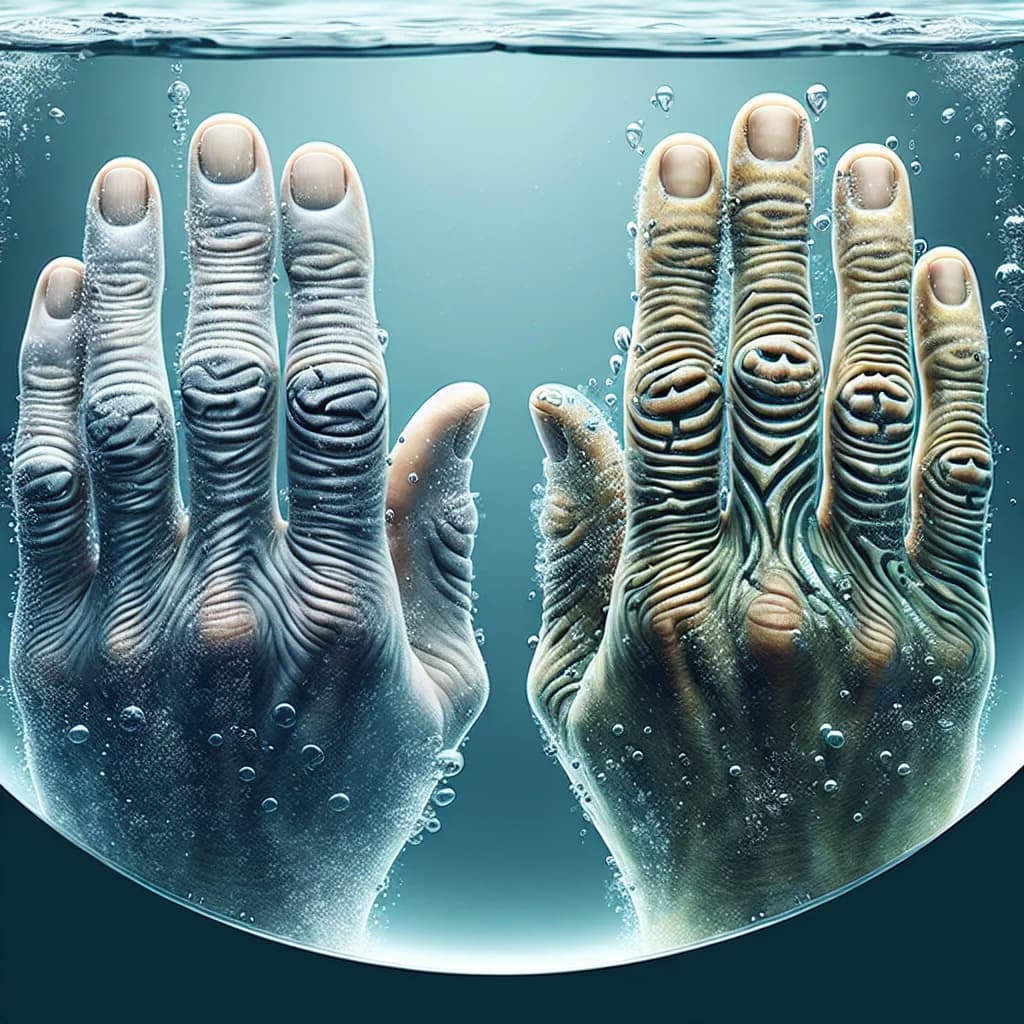
Fingers wrinkle in water due to an active nervous system response that creates biological treads. Similar to car tires, these ridges channel water away from the skin to significantly enhance grip and stability when handling wet objects.
The Science of Pruning: Why Do Your Fingers Wrinkle in Water to Create a Biological Tread for Better Grip on Wet Surfaces?
Have you ever emerged from a long soak in the tub or a session at the local pool only to find your fingertips and toes transformed into shriveled, prune-like textures? For decades, the common consensus was that this was a simple physical reaction—water seeping into the outer layer of the skin and causing it to swell. However, scientists have discovered that this phenomenon is far more complex and intentional than a simple soak.
Rather than a passive side effect of osmosis, the wrinkling of our skin is an active evolutionary adaptation. Research suggests that our bodies have developed this trait to function as a "biological tread," much like the grooves on a car tire, to enhance our ability to handle submerged objects. This blog post explores the fascinating physiological mechanisms and evolutionary advantages behind why your fingers wrinkle in water to create a biological tread for better grip on wet surfaces.
Beyond Osmosis: An Active Biological Response
For many years, the leading theory was that the stratum corneum—the outermost layer of the skin—simply absorbed water, causing it to expand and fold. However, as early as the 1930s, surgeons noticed that this wrinkling did not occur in patients with certain types of nerve damage. This observation led to the realization that the "pruning" effect is actually controlled by the autonomic nervous system.
When your extremities are submerged in water for a specific period (usually around five minutes), the nervous system triggers a localized response. Specifically:
- Vasoconstriction: The nervous system sends signals to the blood vessels beneath the skin to constrict.
- Volume Reduction: As the blood vessels narrow, the volume of the soft tissue in the fingertips decreases.
- Skin Folding: Because the surface area of the skin remains the same while the volume beneath it shrinks, the skin is pulled inward, creating the characteristic ridges and valleys.
Because this is a regulated response, the "wrinkle test" is sometimes used by medical professionals as a bedside indicator to check for nerve damage or autonomic dysfunction.
The Evolutionary Advantage: A Biological Tread
The most compelling research regarding the purpose of these wrinkles was published in the journal Biology Letters in 2013. A team of researchers at Newcastle University conducted a study to determine if these wrinkles provided a functional advantage.
In the experiment, participants were asked to pick up marbles of various sizes—some dry and some submerged in a tank of water. The study found that participants with wrinkled fingers were significantly faster at moving the submerged marbles than those with smooth fingers. Interestingly, the wrinkles made no difference when handling dry objects.
How the Tread Works
The ridges created by the wrinkling process act as drainage channels. On a smooth surface, a thin film of water can act as a lubricant, making it difficult to achieve friction. The biological tread allows:
- Water Displacement: When you press your finger against a wet surface, the water is channeled away through the valleys of the wrinkles.
- Increased Surface Contact: By diverting the water, the "peaks" of the wrinkles can make better contact with the object.
- Improved Friction: This mechanism effectively increases the coefficient of friction, providing a more secure grip in slippery conditions.
Why Did Humans Evolve This Way?
Evolutionary biologists suggest that this trait provided our ancestors with a distinct survival advantage. While we now mostly notice it in the bathtub, for early humans, this "all-terrain" grip was likely essential for gathering food.
- Foraging: Our ancestors likely spent time gathering shellfish or aquatic plants from shallow streams and tide pools. Wrinkled fingers would have made it easier to grasp slippery food sources.
- Mobility: Wrinkled toes likely offered better traction when moving through wet vegetation or across mossy rocks in rainy conditions, reducing the risk of injury.
According to researchers at the University of Idaho, the specific pattern of the wrinkles—long, disconnected channels—is hydrodynamically optimized to drain water away from the contact area, suggesting a highly refined evolutionary design.
Conclusion
The transformation of our skin in water is not a sign of dehydration or a mere physical fluke; it is a sophisticated physiological reaction. By understanding why your fingers wrinkle in water to create a biological tread for better grip on wet surfaces, we gain a deeper appreciation for the human body’s ability to adapt to its environment. This autonomic response, which utilizes vasoconstriction to reshape our skin into efficient drainage systems, highlights a perfect harmony between form and function.
The next time you notice your "pruned" hands after a swim, you are witnessing a million-year-old survival mechanism in action. It is a reminder that even the smallest quirks of our biology are often the result of remarkable evolutionary engineering designed to keep us sure-footed and capable, regardless of the terrain.