
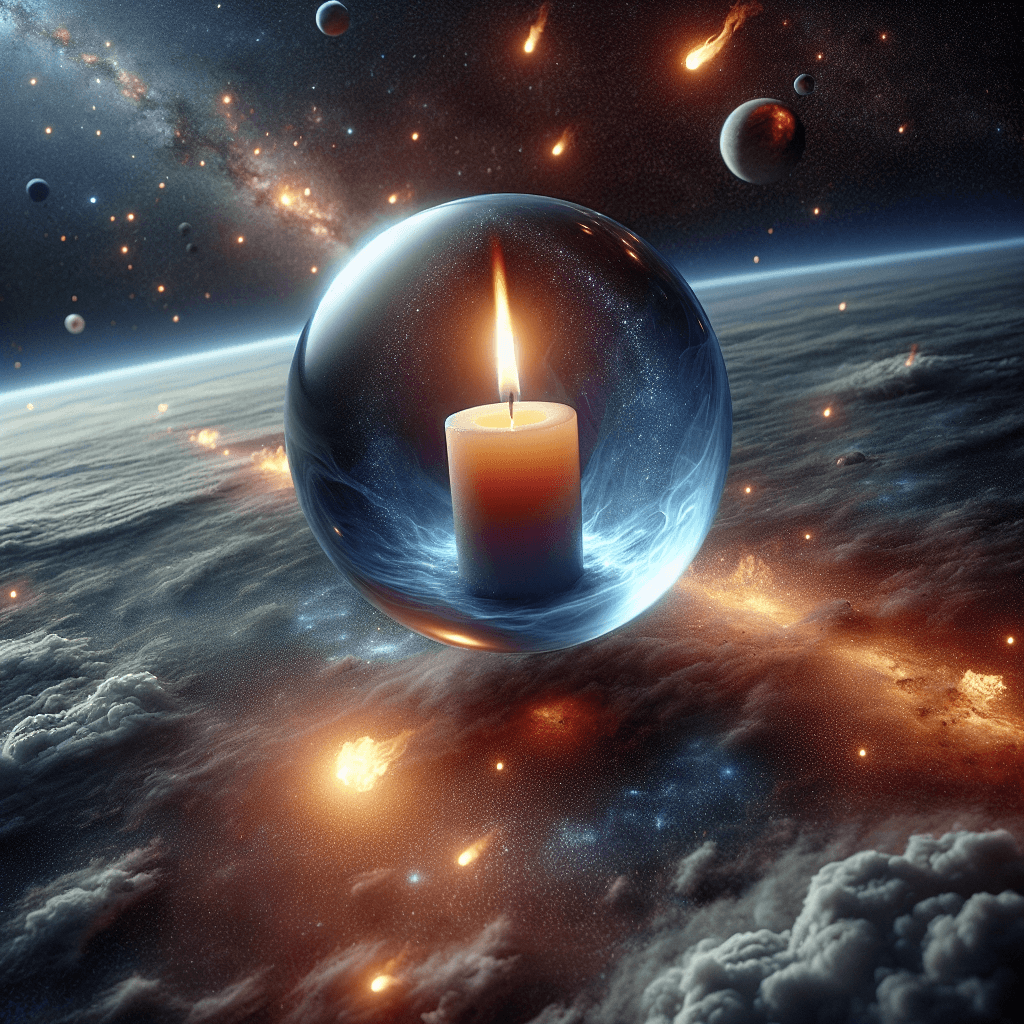
Why does a candle flame become a perfect sphere in outer space
The familiar teardrop shape of a candle flame completely vanishes in space, becoming a perfect, glowing sphere. Discover the simple force we take for granted on Earth that causes this stunning transformation.

Too Long; Didn't Read
On Earth, gravity makes hot air rise, pulling the flame upwards into a teardrop shape. In space, without gravity, the flame expands evenly in all directions to find oxygen, forming a perfect sphere.
The Fiery Sphere: Why Does a Candle Flame Become a Perfect Sphere in Outer Space?
Picture a candle flame. What do you see? Almost certainly, you’re imagining a bright, flickering, teardrop-shaped light, dancing upwards from a wick. This iconic shape is so familiar that we rarely stop to question why it looks the way it does. But what if that familiar shape is entirely a product of our environment? Take that same candle to the International Space Station, and you’ll witness a stunning transformation: the teardrop elongates, flattens, and then settles into a dim, blue, perfect sphere. This post will delve into the fascinating physics that explains why a candle flame abandons its earthly form and becomes a perfect sphere in the microgravity of outer space.
The Teardrop Shape: Gravity's Guiding Hand
To understand the spherical flame in space, we must first understand the teardrop flame on Earth. The shape of a candle flame here is not determined by the fire itself, but by the powerful, invisible force of gravity. The process is governed by a principle you might remember from science class: convection.
When a candle burns, it heats the air and the gaseous wax molecules around the wick. Here's how gravity takes over:
- Hot Air Rises: The heated gases become less dense than the cooler air surrounding them.
- Gravity Pulls Denser Air Down: Gravity pulls the cooler, denser, oxygen-rich air downwards, pushing the lighter, hotter gases upwards.
- A Current is Created: This continuous cycle creates an upward-flowing current of air, much like a tiny, invisible chimney.
This upward flow of hot gas and incoming oxygen is what stretches the flame, pulling it from a potential sphere into its characteristic elongated teardrop shape. The yellow, flickering light we see is largely due to glowing soot particles carried aloft on this convection current. Essentially, the flame you see on your birthday cake is being constantly shaped by a gravity-driven breeze of its own making.
Welcome to Microgravity: Where Convection Takes a Backseat
Now, let's remove gravity from the equation. In the microgravity environment of space, the concepts of "up" and "down" lose their meaning. A parcel of hot, less-dense air has no reason to "rise" because there is no significant gravitational force to make the cooler, denser air "sink" and displace it.
Without gravity, the convection current that defines a flame on Earth simply vanishes. The hot waste gases, like carbon dioxide, don't flow away from the wick. Instead, they linger around it, forming a static, spherical cloud. The flame is no longer being stretched upwards, so it settles into its most natural, fundamental shape.
Fuel, Diffusion, and the Perfect Sphere
With convection gone, how does the flame get the oxygen it needs to burn? It relies on a much slower and more methodical process: molecular diffusion.
Instead of a steady flow of oxygen being delivered by a convection current, oxygen molecules in the surrounding air simply move from an area of higher concentration (the air in the cabin) to an area of lower concentration (the edge of the flame where oxygen is being consumed). This movement happens randomly but evenly in all directions from the central fuel source—the wick.
Because the oxygen diffuses towards the wick equally from all sides, the combustion occurs in a uniform, spherical shell. This is why the flame becomes a perfect sphere. As NASA experiments on combustion have shown, these microgravity flames are also different in other ways:
- They are dimmer and often blue: The slower, diffusion-based process leads to more complete combustion. This produces less soot (which glows yellow on Earth) and more chemiluminescent molecules that emit a faint blue light.
- They burn at a lower temperature: Without the constant supply of fresh oxygen from convection, the rate of combustion slows, resulting in a cooler flame.
- They are more stable: The chaotic flickering we see on Earth is a result of turbulent air from convection. In space, the flame is a steady, unwavering orb.
Conclusion
The transformation of a candle flame from a teardrop to a sphere is a beautiful and direct demonstration of how fundamental forces shape our world. On Earth, gravity is the master sculptor, pulling and stretching the flame into the familiar shape we know. In the near-weightlessness of space, gravity’s influence fades, allowing the quieter, more symmetrical process of diffusion to take over, revealing the flame's true, spherical nature. Studying these cosmic flames isn't just a curiosity; it helps scientists understand the basics of combustion, leading to better fire safety on spacecraft and more efficient engine designs right here on Earth. The humble candle, it turns out, still has much to teach us about the universe.


