
Why does a crack in glass often spread out like a spiderweb
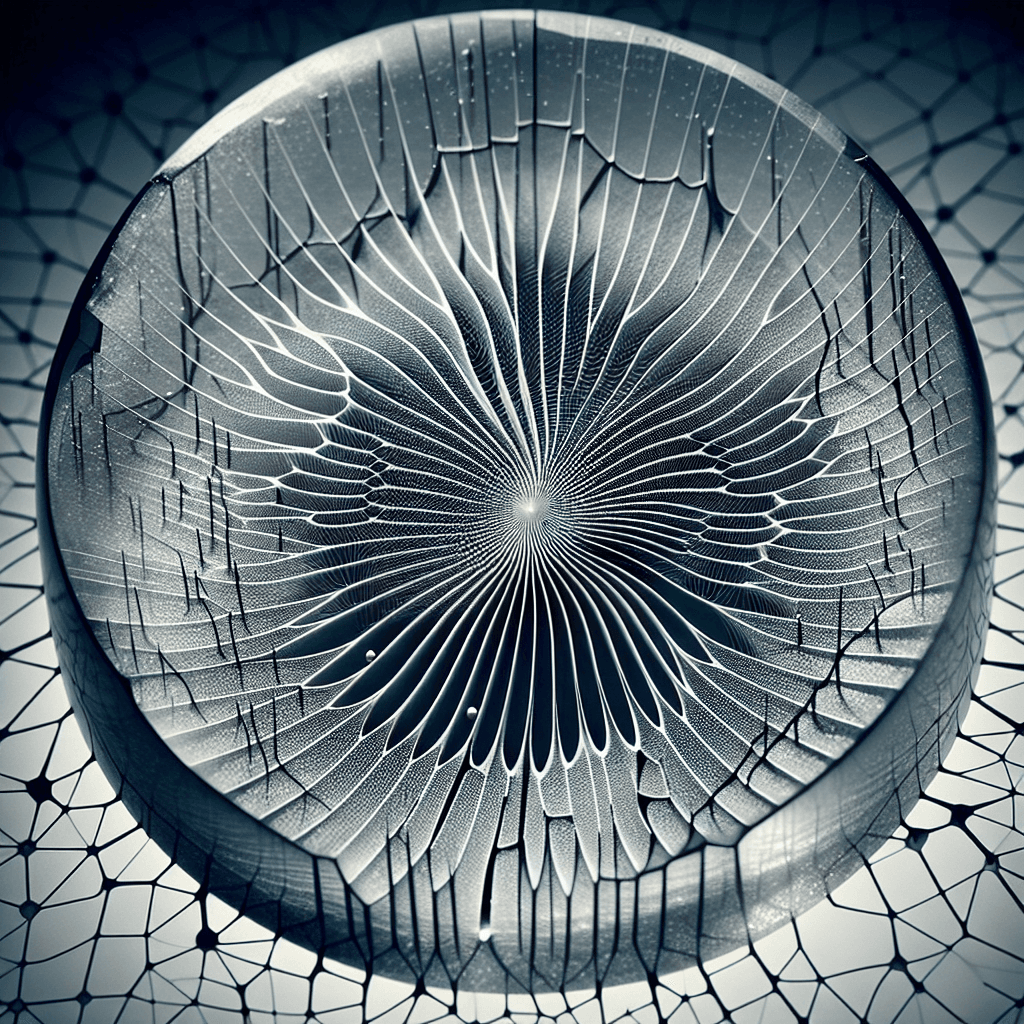
That intricate pattern isn't chaos; it's the story of fractures racing through the glass at nearly the speed of sound, desperately branching out to release a sudden burst of energy.

Too Long; Didn't Read
An impact concentrates immense energy in one spot. Since brittle glass cannot bend, it cracks to release that energy. A primary crack forms and quickly branches out into multiple paths because splitting is the fastest and most efficient way to dissipate the sudden stress, creating a spiderweb pattern.
Cracked! The Science Behind the Spiderweb: Why Does a Crack in Glass Often Spread Out Like a Spiderweb?
Have you ever dropped your phone and watched in slow-motion horror as a single point of impact blossoms into an intricate, web-like pattern across the screen? Or seen a stray pebble transform a pristine car windshield into a work of fractured art? This familiar, yet fascinating, spiderweb pattern isn't random; it's a high-speed story of physics, energy, and material science. Understanding why glass shatters this way reveals the hidden properties of a material we see through every day. This post will delve into the science of fracture mechanics to explain exactly why a crack in glass often spreads out like a spiderweb.
The Secret Life of Glass: A Brittle Giant
Before we can understand how glass breaks, we need to understand what it is. Unlike a crystalline solid like a diamond, where atoms are arranged in a neat, orderly lattice, glass is an amorphous solid. This means its atoms are jumbled together in a disordered, liquid-like arrangement, but frozen in place.
This unique structure gives glass its transparency and strength under compression (squeezing). However, it also makes it incredibly brittle. Glass has very little ability to deform or bend under stress. Instead of bending, it breaks. Furthermore, on a microscopic level, the surface of any piece of glass is covered in tiny, invisible flaws called Griffith cracks. These flaws are the starting points—the weak links—where catastrophic failure begins.
The Big Bang: Impact, Energy, and the Birth of a Crack
When an object, like a small rock, strikes a pane of glass, it transfers a tremendous amount of kinetic energy to a very small area in a fraction of a second. The glass can’t absorb this sudden shock by bending or deforming. This concentrated energy has to go somewhere, and it finds the most efficient way to release itself: by creating new surfaces. In other words, by breaking the atomic bonds that hold the glass together.
The energy radiates outwards from the point of impact, seeking out the weakest points—those microscopic surface flaws. Once it finds one, a crack is born and begins to propagate through the material at incredible speeds, sometimes reaching over 4,800 kilometers per hour (3,000 mph).
Weaving the Web: How Cracks Propagate
The iconic spiderweb pattern is formed by two distinct types of cracks that appear in a specific sequence: radial and concentric cracks.
Phase 1: Radial Cracks
The first cracks to form are radial cracks. These are the long, straight cracks that radiate outwards from the point of impact, like the spokes of a wheel. As the projectile hits the glass, the pane flexes away from the impact. This puts the opposite side of the glass under immense tension (stretching). The radial cracks initiate on this opposite, high-tension surface and race outwards, instantly relieving that stress.
Phase 2: Concentric Cracks
A single crack, however, has a "terminal velocity"—a maximum speed at which it can travel through the material. Often, the initial impact contains far more energy than a few radial cracks can dissipate, even moving at thousands of miles per hour. This excess energy needs another outlet. This leads to two phenomena:
- Branching: The main radial crack may split, or bifurcate, creating smaller branches to dissipate energy more quickly.
- Concentric Cracks: After the initial impact, the glass rebounds. This flexes the glass in the opposite direction, putting the same side as the impact under tension. This new stress causes a second set of cracks to form. These are the concentric cracks, which form in circular patterns connecting the initial radial "spokes."
It is the combination of these primary radial cracks and the secondary concentric cracks that creates the classic spiderweb pattern.
Conclusion
The spiderweb crack in a pane of glass is not a sign of chaos, but a beautiful illustration of physics in action. It’s a physical record of how energy, in a desperate race against time, finds the most efficient path to dissipate through a brittle material. From the amorphous structure of glass and its microscopic flaws to the one-two punch of radial and concentric fracturing, the entire process is a high-speed chain reaction. This understanding is not just academic; it drives the innovation behind stronger, safer materials like laminated windshields and chemically-strengthened smartphone screens, which are designed to better control and absorb this explosive release of energy. The next time you see a shattered window, you’ll know you’re not just looking at damage—you’re looking at a map of a powerful physical event.


