
Why does a piece of dry spaghetti typically break into three or more pieces instead of just two
It’s a mystery that even baffled genius Richard Feynman: why is it nearly impossible to snap a dry spaghetti noodle into just two pieces? Discover the hidden "snap-back" physics that turns a simple break into a sudden explosion of pasta shrapnel.

Too Long; Didn't Read
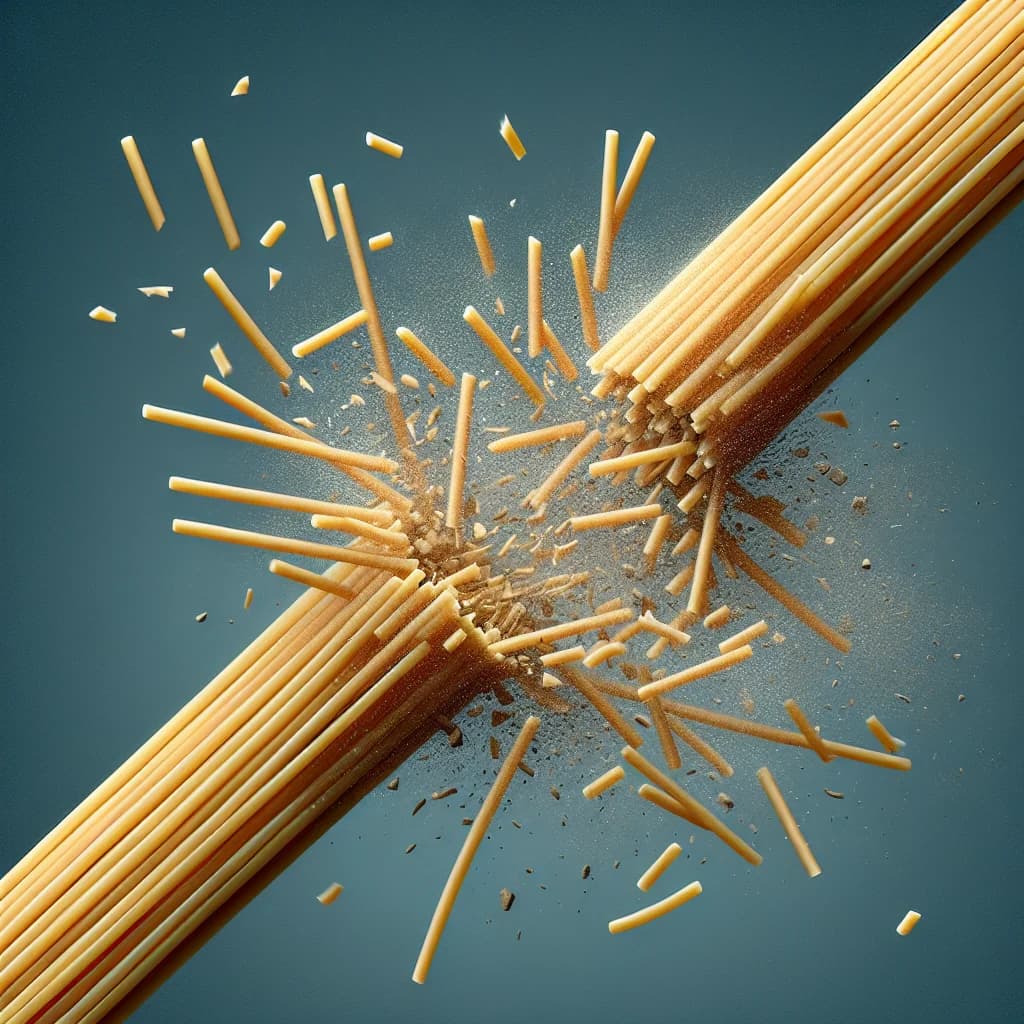
When dry spaghetti breaks, it releases stored energy that triggers powerful vibrations called flexural waves. These waves travel through the remaining segments and temporarily increase their curvature beyond the breaking point, causing secondary fractures that result in three or more pieces.
The Snap-Back Mystery: Why Does a Piece of Dry Spaghetti Typically Break into Three or More Pieces Instead of Just Two?
Have you ever stood over a pot of boiling water, snapped a handful of dry spaghetti in half to fit it into the pot, and wondered why the floor is suddenly covered in tiny shards of pasta? It seems like a simple task, yet dry spaghetti almost never breaks into just two clean halves. This curious phenomenon even stumped the legendary Nobel Prize-winning physicist Richard Feynman, who reportedly spent an entire afternoon in his kitchen snapping pasta, unable to find a theoretical explanation for why it consistently shattered into three or more fragments. This blog post explores the fascinating physics behind this kitchen conundrum, detailing the "snap-back" effect and the scientific breakthroughs that finally solved the mystery.
The Feynman Enigma: A Nobel Prize-Winning Puzzle
The mystery of the breaking spaghetti is so well-known in the scientific community that it is often referred to as a classic problem in "fragmentation physics." Richard Feynman, famous for his work in quantum electrodynamics, was famously obsessed with this puzzle. He found it counterintuitive that a uniform rod of brittle material, when bent from both ends, wouldn’t simply fail at its weakest point (the middle) and leave two equal pieces.
It wasn't until 2005 that French physicists Basile Audoly and Sebastien Neukirch provided the definitive answer. Their research, which won them an Ig Nobel Prize, used high-speed photography and complex mathematical modeling to describe the "snap-back" effect. They discovered that the initial break is only the beginning of a rapid-fire chain reaction.
The Mechanics of the "Snap-Back" Effect
To understand why the pasta shatters, we must look at what happens the millisecond after the first break occurs. When you bend a piece of dry spaghetti, you are storing elastic energy within the noodle. The more you bend it, the more tension builds up on the outer edge of the curve. Eventually, the tension exceeds the strength of the pasta, and it snaps.
If the process stopped there, you would have two pieces. However, the following sequence occurs:
- Initial Fracture: The spaghetti breaks at the point of maximum curvature.
- Elastic Recoil: The two newly formed segments suddenly want to return to their original, straight shape. They "snap back" with incredible speed.
- Flexural Waves: This sudden release of energy sends powerful vibrations, known as flexural waves, traveling through the length of the two remaining segments.
- Secondary Breaks: These waves temporarily increase the curvature (the "bendiness") in other parts of the pasta. If this localized bending exceeds the critical threshold, the spaghetti snaps again—and sometimes again—creating the characteristic "shrapnel."
The Science of Flexural Waves
According to the study published by Audoly and Neukirch in Physical Review Letters, these flexural waves travel faster than the initial break itself. As the waves ripple through the dry noodle, they create a "multiplication" effect. Because the pasta is so brittle, it cannot absorb the energy of the snap-back vibration; instead, the vibration increases the mechanical stress beyond the breaking point in multiple locations simultaneously.
This explains why you often find one long piece, one medium piece, and several tiny shards. The shards are the result of the high-frequency vibrations causing the ends to "whip" so violently that they disintegrate.
Is It Possible to Break Spaghetti into Only Two Pieces?
For years, the "two-piece break" was considered nearly impossible through simple bending. However, in 2018, researchers at MIT discovered a workaround. By using a specially designed mechanical "twister," they found that if you twist a strand of spaghetti very strongly (nearly 360 degrees) while simultaneously bending it, the noodle will indeed break into exactly two pieces.
The twist adds a different kind of energy to the system. When the pasta snaps, the "twist energy" dissipates in a way that dampens the flexural waves. Essentially, the twisting motion prevents the "snap-back" from becoming violent enough to cause secondary fractures. While this is a breakthrough for physics, it remains difficult to replicate by hand in a standard kitchen.
Conclusion
The reason why a piece of dry spaghetti typically breaks into three or more pieces instead of just two lies in the violent physics of elastic recoil. The "snap-back" effect generates flexural waves that increase the stress on the remaining fragments, causing them to fail moments after the initial break. What started as a kitchen curiosity for Richard Feynman eventually led to significant insights into how brittle materials fail under stress.
Understanding these mechanics isn't just about pasta; it helps engineers understand the structural integrity of various materials used in construction and manufacturing. The next time you see pasta shards on your counter, you can appreciate that you are witnessing a complex display of wave dynamics and energy release—one that puzzled some of the greatest minds of the 20th century.


