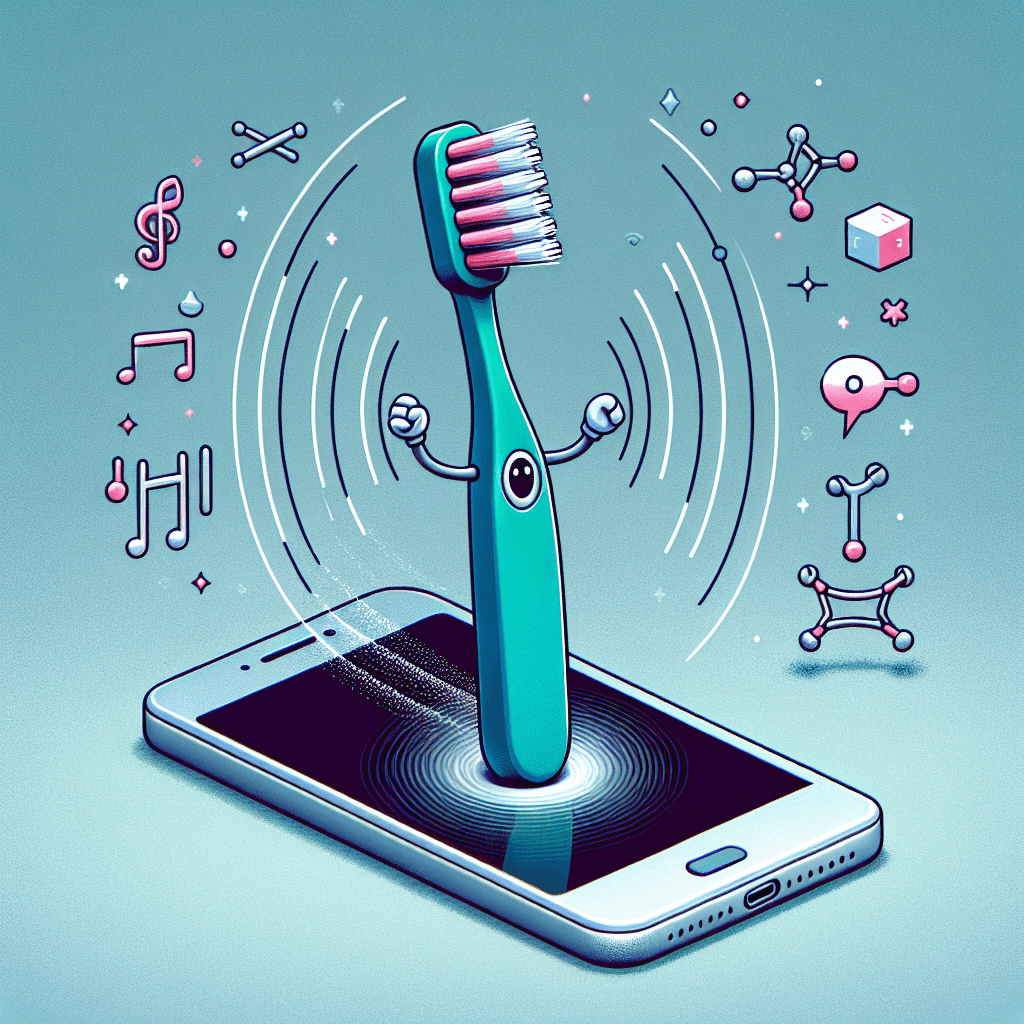
Why does a toothbrush head on a vibrating phone move like a tiny robot
Ever wondered why a simple toothbrush head scurries across your phone like a creature with a mind of its own? The answer is a fascinating trick of physics hiding in plain sight.

Too Long; Didn't Read
TLDR: The phone's vibration makes the angled bristles of the toothbrush head bend and push off the surface in one direction, turning random shaking into directed movement.
Blog Post Title: The Bristle Bot: Why Does a Toothbrush Head on a Vibrating Phone Move Like a Tiny Robot?
Have you ever seen it? A detached toothbrush head, placed on top of a vibrating smartphone, suddenly springs to life. It skitters and spins across the screen, moving with a purpose that seems almost intelligent, like a tiny, bristly robot on a mission. This isn't a magic trick or a digital illusion; it's a delightful, real-world demonstration of fundamental physics principles at work. While it may look like random chaos, the methodical movement of this makeshift "bristle bot" is the result of a perfect partnership between vibration, friction, and clever design. This post will break down the science behind this fascinating phenomenon, explaining exactly how your phone transforms a simple piece of plastic into a self-propelled machine.
The Power Source: Understanding Your Phone's Vibration
To understand why the toothbrush head moves, we first need to look at the "engine" driving it: your phone’s vibration motor. A common misconception is that a phone simply shakes back and forth. In reality, the vibration is far more complex. Most smartphones use a component called an Eccentric Rotating Mass (ERM) motor.
Imagine a tiny motor spinning a small weight that is deliberately off-center. As this weight spins rapidly, its unbalanced force causes the entire phone to wobble in a quick, circular or elliptical pattern. It’s not just moving up and down; it's executing a high-speed, three-dimensional jiggle. This complex, repetitive motion provides the energy needed to set the toothbrush head in motion. It's the constant, rapid push in multiple directions that "activates" the bot.
The Secret in the Bristles: Asymmetry is Key
If the vibration were the only factor, the toothbrush head would likely just jiggle in place or drift randomly. The secret to its directional movement lies in the design of the bristles themselves.
Take a close look at a toothbrush head. The bristles are rarely perfectly perpendicular to the base. Instead, they are almost always angled slightly. This intentional design feature, meant to help clean your teeth more effectively, is the critical component that gives the bristle bot its "legs."
This slight angle creates an asymmetry. When the phone pushes the head in one direction, the bristles flex and slide easily. But when it pushes in the opposite direction, the angled bristles dig into the surface, resisting the movement. They are designed to move forward, but not backward.
The Stick-Slip Phenomenon: How Vibration Becomes Directional Motion
Now, let's combine the phone's vibration with the bristles' angled design. The movement is created by a process known as the stick-slip phenomenon, where the force of friction changes rapidly.
Here’s a step-by-step breakdown:
- The Slip: As the phone vibrates in the "forward" direction (the direction the bristles are angled), the bristles lift slightly off the surface. This momentarily reduces the downward force and, consequently, the friction. With less friction holding it back, the head is free to "slip" forward a minuscule distance.
- The Stick: As the vibration cycle continues, the phone moves in the "backward" direction. This pushes the bristles down into the surface. The angled bristles dig in, dramatically increasing the force of static friction. This high friction "sticks" the head in place, preventing it from sliding backward.
This entire slip-and-stick cycle happens hundreds of times per second, perfectly in sync with the motor's rotation. Each tiny forward slip, followed by a firm stick, adds up. The result is a surprisingly smooth and continuous forward motion. The toothbrush head has effectively converted the phone's chaotic multi-directional vibration into controlled, directional movement.
Conclusion
The sight of a toothbrush head dancing on a vibrating phone is more than just a fun party trick. It’s an accessible, hands-on experiment that elegantly illustrates complex physics. The directed motion isn't magic, but the result of three key elements working in perfect harmony: the powerful, complex vibrations from the phone's motor, the crucial asymmetry of the angled bristles, and the rapid stick-slip action of friction. This simple setup, using objects found in almost any home, reveals how basic scientific principles can produce surprisingly complex and seemingly life-like behavior. So the next time you see a bristle bot in action, you'll know you’re not just watching a toy—you're watching physics dance.