
Why does a whip make a loud cracking sound when it is snapped
Think a whip’s crack is just a loud noise? Discover the mind-blowing physics behind how a simple flick of the wrist creates a miniature sonic boom by breaking the sound barrier.

Too Long; Didn't Read
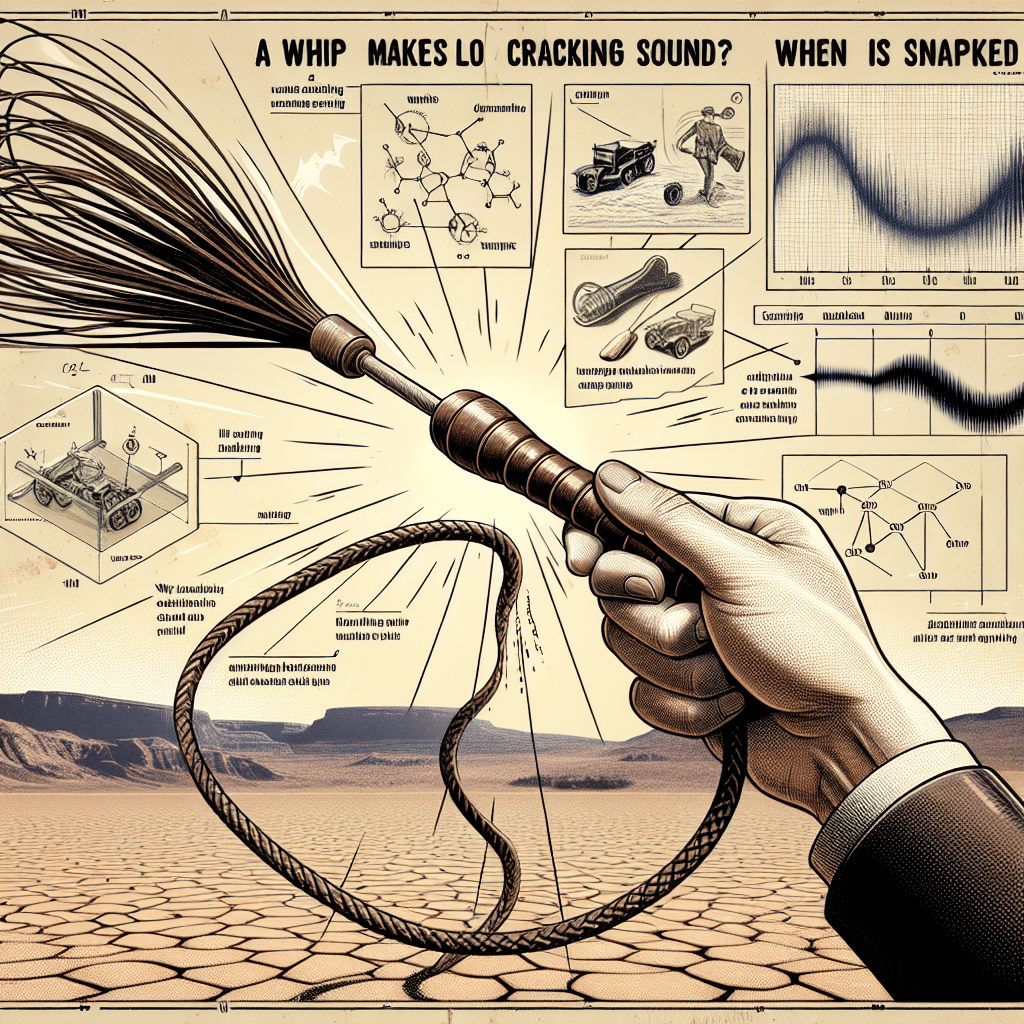
A whip cracks because its tip travels faster than the speed of sound, creating a miniature sonic boom as it breaks the sound barrier.
Breaking the Sound Barrier: Why Does a Whip Make a Loud Cracking Sound When It Is Snapped?
For centuries, the sharp, thunderous "crack" of a whip has signaled authority, directed livestock, and captivated audiences in cinema. While many assume the noise results from the leather striking itself or the ground, the reality is far more explosive. In fact, the whip holds a unique place in human history as likely the first invention capable of breaking the sound barrier. Understanding why does a whip make a loud cracking sound when it is snapped requires a dive into the principles of physics, specifically the conservation of momentum and the mechanics of sonic booms. This post explores the fascinating transition of motion into a miniature shockwave, explaining how a simple flick of the wrist can generate speeds exceeding 760 miles per hour.
The Physics of Tapering and Momentum
The secret to the whip's sound lies in its construction. Most whips, particularly bullwhips, are designed with a significant taper—they are thick and heavy at the handle and become progressively thinner and lighter toward the tip. This design utilizes a fundamental principle of physics known as the conservation of momentum.
When a person snaps a whip, they create a loop of energy that travels from the handle down toward the end. As this loop moves along the whip, it encounters less and less mass because the whip is tapering. According to the law of momentum (momentum = mass × velocity), if the mass decreases while the energy remains constant, the velocity must increase. By the time the energy reaches the very end of the whip, the mass is so minute that the speed of the moving material increases exponentially to compensate.
Creating the Sonic Boom
As the loop reaches the end of the whip, the velocity of the tip accelerates to incredible levels. To answer the question of why does a whip make a loud cracking sound when it is snapped, one must look at the speed of sound. At sea level, sound travels at approximately 767 miles per hour (Mach 1).
Research conducted using high-speed photography, notably studies popularized by educational institutions like the University of Arizona, has demonstrated that the tip of a whip—or more accurately, the loop traveling down it—reaches speeds exceeding Mach 1. When the whip's tip breaks this barrier, it compresses the surrounding air molecules so rapidly that they create a shockwave. This shockwave is what we perceive as a "crack." Essentially, every time you snap a whip correctly, you are witnessing a miniature sonic boom, the same phenomenon produced by a supersonic jet.
The Role of the "Cracker"
While the taper does the heavy lifting of accelerating the whip, the specific sound is amplified by a small component at the very end called the "cracker" or "popper." This is usually a short piece of frayed nylon or silk string. The cracker serves several vital functions:
- Noise Amplification: The frayed ends of the cracker provide more surface area to disturb the air, making the sonic boom sharper and more audible.
- Energy Dissipation: Without a cracker, the intense energy at the tip could cause the leather of the whip to fray or snap off entirely. The cracker acts as a replaceable "fuse" that bears the brunt of the supersonic forces.
- Aerodynamic Stability: It adds a tiny amount of drag at the end, which helps the loop "roll out" smoothly rather than tangling.
Summary of the Process
To visualize how this works, consider these steps:
- The Initial Flick: The user moves the handle, sending a wave of kinetic energy into the thickest part of the whip.
- The Loop Formation: A loop forms and travels down the length of the thong.
- The Acceleration Phase: As the whip thins out, the wave of energy moves faster to maintain momentum.
- The Supersonic Event: The loop reaches the end, and the cracker is whipped around at speeds greater than 1,100 feet per second.
- The Shockwave: The air is compressed and displaced instantly, resulting in the characteristic loud crack.
Conclusion
The answer to why does a whip make a loud cracking sound when it is snapped is a testament to the elegance of classical mechanics. It is not a mechanical collision of materials, but rather a violent interaction between a high-velocity object and the atmosphere. By utilizing a tapered design to concentrate momentum into a tiny mass, the whip becomes a hand-held supersonic device. This phenomenon serves as a perfect real-world example of how energy can be manipulated to achieve extraordinary speeds. Understanding the physics of the whip crack allows us to appreciate the sophisticated science hidden within one of humanity’s oldest tools, reminding us that even the simplest objects can defy the limits of sound.


