
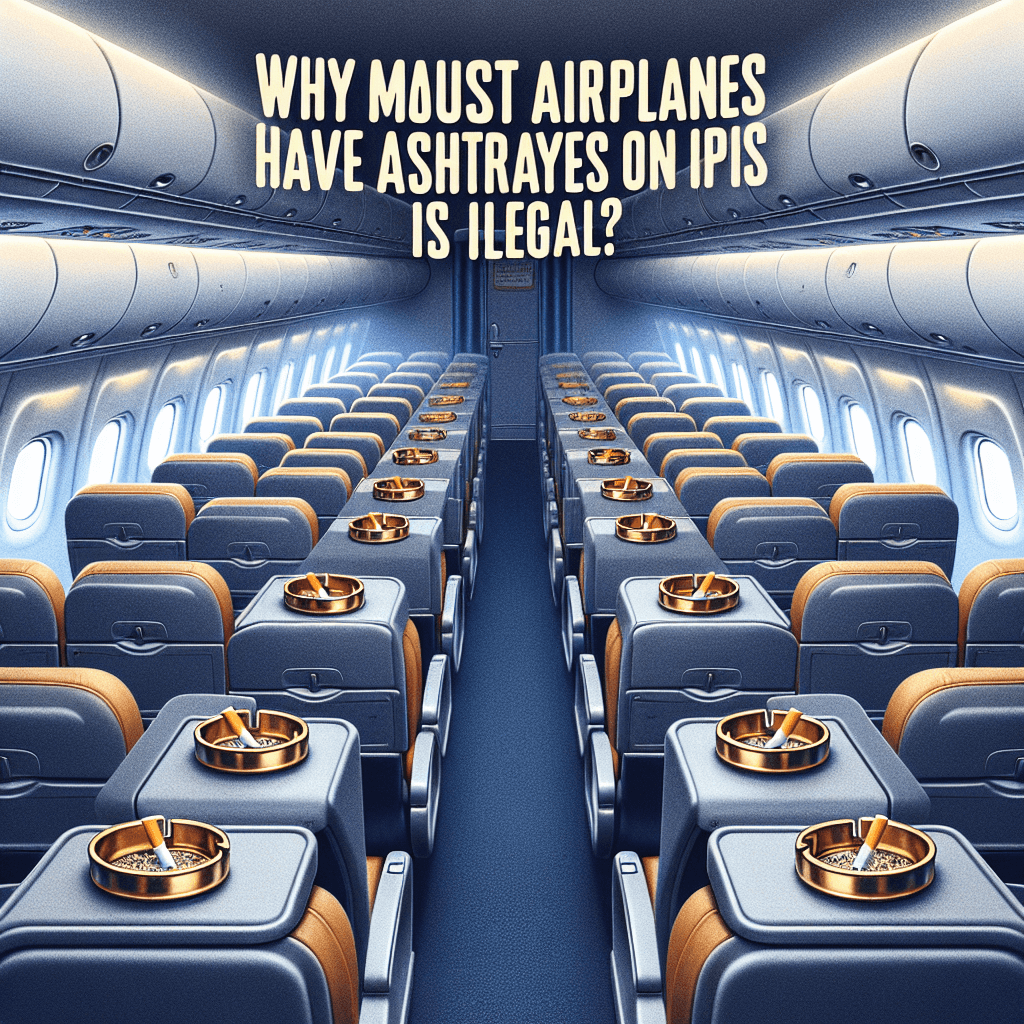
Why must airplanes legally have ashtrays if smoking on them is illegal
It seems like a bizarre contradiction, but the answer isn't about encouraging smokers—it's about containing the inevitable fire risk when someone decides to break the rules at 30,000 feet.

Too Long; Didn't Read
Ashtrays are a legally required safety measure. Because people might still illegally smoke, it is far safer to have a designated place to extinguish a cigarette than for someone to cause a fire by throwing it in a trash can full of flammable paper.
The Ashtray Paradox: Why Must Airplanes Legally Have Ashtrays If Smoking Is Illegal?
Have you ever been on an airplane, gone to use the lavatory, and noticed a small, metal ashtray built into the door or wall? It’s a common sight, yet it raises an immediate and logical question: if smoking on flights has been banned for decades, why are these still here? This isn't an oversight or a leftover from a bygone era. The presence of ashtrays on every commercial aircraft is a mandatory legal requirement enforced by aviation authorities like the Federal Aviation Administration (FAA). This blog post will explore the critical safety reason behind this curious paradox, revealing how a simple ashtray plays a vital role in modern aviation safety by planning for the one thing rules can't always control: human behavior.
A Brief History of the Smoking Ban
For much of aviation history, smoking on planes was as common as ordering a drink. However, growing health concerns and passenger complaints led to a gradual shift. In the United States, the tide turned decisively in 1990 when a federal law banned smoking on almost all domestic flights. By 2000, this ban was extended to all international flights to and from the U.S. Similar regulations were adopted worldwide, making the "No Smoking" sign a permanent fixture on every flight.
This comprehensive ban makes the continued installation of ashtrays seem counterintuitive. If the act is illegal, why provide the equipment for it? The answer lies not in condoning the act, but in mitigating its most dangerous potential consequences.
The Core Reason: Preparing for Rule-Breakers
Aviation safety is built on a foundation of redundancy and preparing for worst-case scenarios. Regulators know that despite strict laws, prominent signage, and pre-flight announcements, there is always a chance someone will attempt to illegally smoke a cigarette in secret, most likely in the lavatory.
The FAA's mandate for ashtrays is a pragmatic safety measure. The logic is simple:
- A person who illegally lights a cigarette needs a place to dispose of it, especially if they are startled by a flight attendant or another passenger.
- Without a designated ashtray, their panicked reaction might be to toss the lit cigarette into the lavatory's trash bin.
- This trash bin is filled with highly flammable materials like paper towels, tissues, and sanitary products.
An improperly extinguished cigarette in a waste bin can easily start a fire. An in-flight fire, particularly in an enclosed space like a lavatory, is one of the most dangerous situations that can occur on an airplane. The ashtray provides a safe, fire-contained place for a rule-breaker to extinguish and dispose of a cigarette, drastically reducing the risk of a catastrophe.
A Lesson Learned from Tragedy: Varig Flight 820
The importance of this rule is tragically underscored by history. In 1973, Varig Flight 820, traveling from Rio de Janeiro to Paris, was forced to make an emergency crash landing in a field just miles from its destination. The cause was an uncontrollable fire that started in one of the rear lavatories. The investigation suggested the fire was likely sparked by a cigarette thrown into a trash bin. The smoke and toxic fumes filled the cabin, incapacitating passengers and crew. Of the 134 people on board, 123 lost their lives. This disaster was a key catalyst for implementing stricter fire safety standards in aircraft, including the mandatory ashtray requirement.
An Essential Piece of Equipment
The ashtray is considered so critical that it is included on the aircraft's "Minimum Equipment List" (MEL). This is a list of components that can be inoperative while still allowing the aircraft to fly safely. However, the rules surrounding lavatory ashtrays are strict. If an ashtray is found to be broken or missing during a pre-flight inspection, the airline is often required to replace it before the plane is cleared for takeoff. Flights have been delayed or even canceled for this very reason, highlighting just how seriously the aviation industry takes this seemingly minor feature.
Conclusion
So, the next time you spot an ashtray on an airplane, you'll know it’s not an invitation to light up or a relic of the past. It is a deliberately placed and legally required piece of safety equipment. It serves as a silent acknowledgment that rules can be broken and that the highest priority in aviation is to ensure the safety of everyone on board, even if it means planning for illegal and reckless actions. This small, often-overlooked feature is a powerful reminder that comprehensive safety is about mitigating risk, not just hoping for the best.


