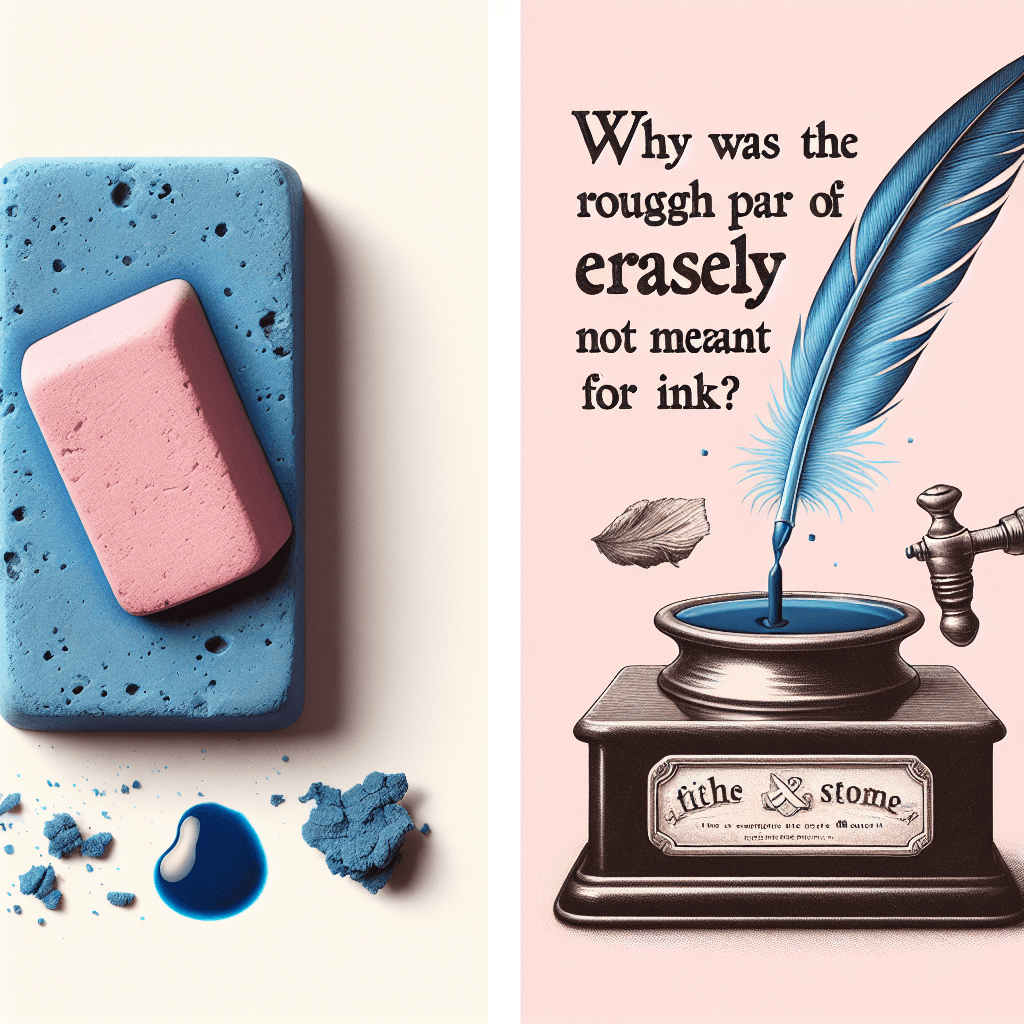
Why was the rough, blue part of an eraser not actually meant for ink
That infamous blue part of your eraser didn't just tear your paper by accident; its real, gritty purpose was never meant for ink at all.

Too Long; Didn't Read
TLDR: The rough blue part of an eraser was not for ink; it was designed to erase pencil marks on heavy, abrasive paper like cardstock. Its gritty texture removes graphite from tough surfaces but just tears regular paper.
The Big Blue Lie: Why Was the Rough, Blue Part of an Eraser Not Actually Meant for Ink?
Remember that moment in school? You make a mistake in pen, and with a surge of confidence, you grab your trusty two-toned eraser. You flip it to the gritty, blue side—the side everyone knew was for ink—and start scrubbing. The result? A smudged, furry hole in your paper and the ink still stubbornly there. This frustrating experience is a nearly universal rite of passage, built on one of the most persistent stationery myths. The truth is, that rough blue end was never the magic ink remover we were led to believe it was. This post will erase that common misconception and reveal the true purpose behind the iconic two-sided eraser.
The Tale of Two Halves: Soft vs. Abrasive
To understand why the blue side fails so spectacularly at removing pen marks, we first need to understand how erasers work. The classic pink or red end and the blue end are made of fundamentally different materials designed for different jobs.
The Gentle Pink Side
The softer, pink portion of the eraser is typically made from a pliable rubber or synthetic compound. When you rub it over pencil marks, its job is twofold:
- Friction: It creates friction that gently loosens the graphite particles sitting on the surface of the paper.
- Adhesion: The eraser's material is stickier than the paper, so the loose graphite particles cling to the eraser, lifting cleanly off the page. The little pink crumbles you see are just the eraser sloughing off with the graphite trapped inside.
This process is delicate and designed to preserve the integrity of the paper.
The Abrasive Blue Side
The rough, blue part tells a different story. It’s not just colored rubber; it is infused with a fine, abrasive grit, often made from pumice or sand. Its function is not to lift marks but to physically scrape them away. Think of it less as an eraser and more like a very fine-grained sandpaper. It works by abrading and removing the top layer of paper fibers where the mark resides. This is why it so often feels like you're sanding a hole straight through your notebook paper—because, on a microscopic level, you are.
The Real Target: Heavy-Duty Erasing on Tough Surfaces
So, if the blue side is a paper-shredding abrasive, why does it exist? The myth that it was for "ink" isn't entirely baseless, but it lacks crucial context. Its true purpose was never for correcting ballpoint pen mistakes on thin, standard paper.
The blue end was designed for much tougher applications, such as:
- Thick, Heavy-Grade Paper: Think artist's drawing paper, cardstock, or drafting vellum. These materials are far more durable and can withstand the abrasive action without tearing.
- Tougher Marks: It was intended to remove marks made by darker graphite pencils or colored pencils, which can embed themselves more deeply into paper fibers than a standard No. 2 pencil.
- Ink on Specialized Surfaces: In the days before modern correction fluid, drafters and artists sometimes used it to scrape away ink from heavy, non-porous drafting paper. The key here is the paper's durability.
The widespread misconception likely started with clever marketing. Some manufacturers, like the German brand Pelikan, famously printed a small fountain pen nib icon on the blue side of their erasers. This visual cue solidified the idea in consumers' minds that blue was for ink, without explaining the critical caveat that it only worked on specific types of paper and could easily cause damage.
The Final Verdict: A Tool Misunderstood
The mystery of the blue eraser is less about a design flaw and more about a misunderstanding of a specialized tool. While it failed us countless times on our homework, it was simply the right tool being used for the wrong job. The modern ballpoint pen uses an oil-based ink that soaks deep into paper fibers, making it nearly impossible to "erase" without destroying the paper itself. The abrasive blue side stands no chance against it on delicate paper.
So, the next time you see a two-toned eraser, you can appreciate it for what it truly is: a versatile tool with two distinct functions. The pink side is your gentle day-to-day workhorse for graphite, while the blue side is a heavy-duty specialist meant for tougher media on more resilient surfaces. The legend of the magic ink eraser may be a myth, but the truth behind its design is a fascinating glimpse into the world of stationery and how a product's purpose can be lost in translation over time.