
Why were 18th-century umbrellas once designed with a built-in lightning rod and a trailing metal ground wire
In the 18th century, a stroll in the rain was a high-stakes scientific experiment where fashion met a shocking new fear. Discover why stylish Parisians once carried "lightning umbrellas" rigged with pointed metal rods and trailing ground wires to survive—or flirt with—the power of the storm.

Too Long; Didn't Read
In the late 1700s, lightning-rod umbrellas became a brief fashion trend in France following Benjamin Franklin’s electrical discoveries. Designed with a metal tip and a trailing ground wire, these accessories were intended to protect pedestrians from strikes, though they were largely impractical and likely increased the user's risk of being hit.
The Shocking Truth: Why Were 18th-Century Umbrellas Once Designed with a Built-in Lightning Rod and a Trailing Metal Ground Wire?
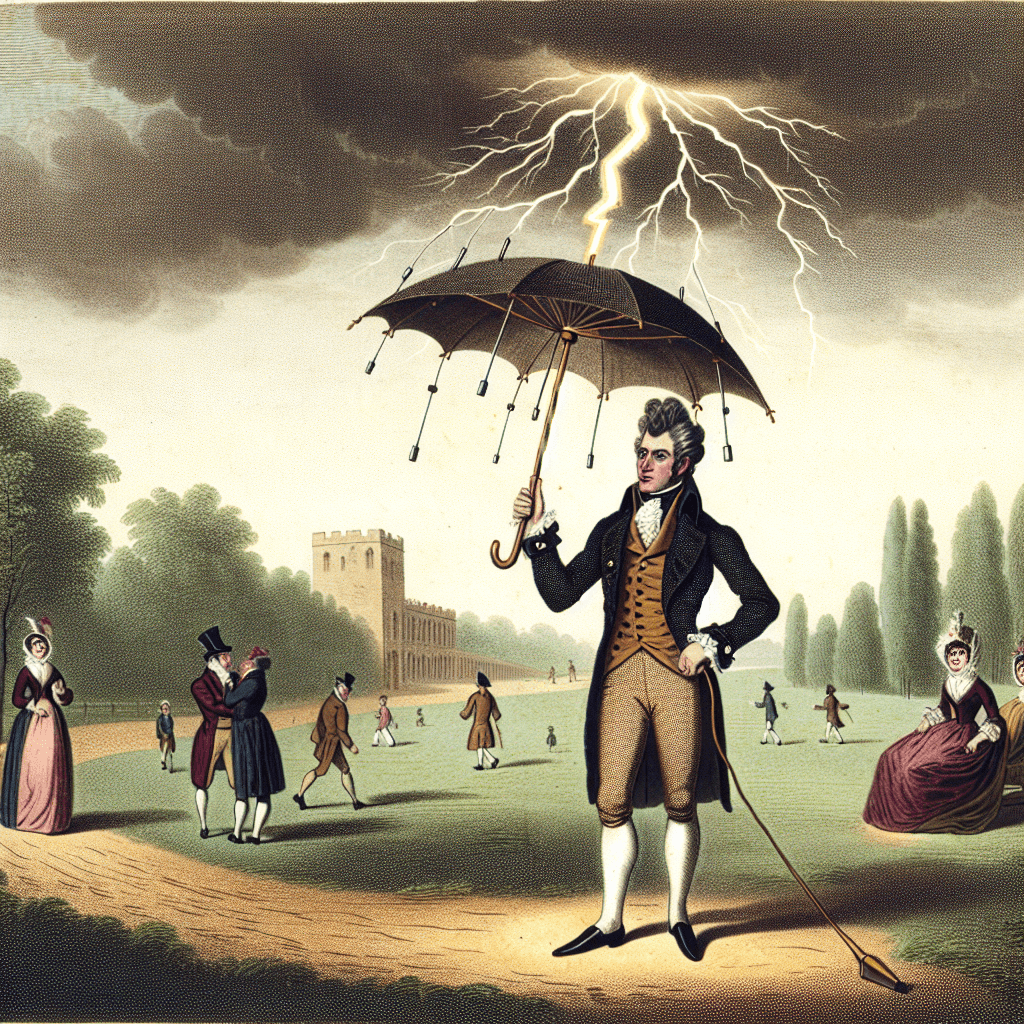
Imagine strolling through the rain-slicked streets of 1780s Paris. While most pedestrians huddle under standard waxed cloth, you spot a gentleman carrying a peculiar contraption: a silk umbrella topped with a sharp metal spike, featuring a long silver chain dragging behind him in the mud. This was the "parapluie-paratonnerre," or lightning rod umbrella. While it may look like a prop from a steampunk novel, it was a real product of its time. This bizarre accessory emerged from a unique intersection of groundbreaking scientific discovery and a public obsession with safety. This blog post explores the historical context, the scientific theories of the era, and the eventual demise of the 18th-century umbrella designed with a built-in lightning rod and a trailing metal ground wire.
The Influence of "Franklin-mania"
The story of the lightning umbrella begins with Benjamin Franklin. After his famous 1752 kite experiment proved that lightning was a form of electricity, Franklin-mania swept through Europe, particularly France. According to historical records from the late 18th century, Franklin became a celebrity scientist, and his invention of the stationary lightning rod for buildings was seen as a triumph of Enlightenment reason over nature.
As the public became increasingly aware of the dangers of lightning strikes, inventors began to look for ways to apply Franklin’s principles to personal protection. If a rod could protect a house, the logic followed, why couldn't a portable version protect a person? This led to a brief but fascinating era of "portable conductors," including lightning-rod hats and, most notably, the lightning umbrella.
Anatomy of the Parapluie-Paratonnerre
The design of these umbrellas was surprisingly technical for the era. Inventors, most notably the Frenchman Jacques Barbier de Tinan, sought to create a mobile version of the Franklin rod. The 18th-century lightning umbrella typically consisted of three main components:
- The Pointed Rod: A gilded or steel spike was attached to the top of the umbrella's central shaft, extending upward to attract the lightning.
- The Conducting Wire: A metal wire ran from the tip, down the length of the umbrella’s ribs or shaft.
- The Grounding Chain: A long metal wire or chain was attached to the conductor and intended to trail behind the user, maintaining constant contact with the wet ground.
The theory was simple: if lightning struck, the metal spike would "invite" the bolt, and the wire and chain would provide a path of least resistance, safely diverting the electrical discharge into the earth rather than through the person holding it.
The Social and Scientific Context
In the late 1700s, science was often a public spectacle. The lightning umbrella was marketed as a high-tech safety device for the elite. It represented a shift in how humans viewed natural disasters—moving from a perspective of divine punishment to one of manageable physical phenomena.
However, the practical application of this technology was deeply flawed. While the principle of grounding is scientifically sound, several factors made these umbrellas more dangerous than useful:
- Proximity: The user was holding the conductor. Any flaw in insulation or a particularly powerful strike would likely jump to the person.
- Insufficient Grounding: A thin chain dragging on the ground rarely provides a reliable enough connection to safely dissipate the massive voltage of a lightning strike.
- Attraction: By carrying a pointed metal rod into a storm, the user was significantly increasing their chances of being struck in the first place.
The Decline of the Lightning Umbrella
Despite the initial excitement, the lightning umbrella never achieved mainstream success. It was heavy, cumbersome, and expensive. Furthermore, as the early 19th century approached, the scientific community began to express skepticism regarding the safety of portable conductors. Physicians and physicists of the time noted that the "protection" offered was largely illusory and potentially lethal. By the mid-1800s, the design had faded into the realm of historical oddities, replaced by a more practical understanding of lightning safety—namely, seeking substantial shelter rather than carrying a lightning rod.
Conclusion
The 18th-century lightning umbrella remains a fascinating example of how society reacts to transformative scientific discoveries. Why were 18th-century umbrellas once designed with a built-in lightning rod and a trailing metal ground wire? They were the physical manifestation of a society eager to harness the power of electricity and protect themselves from the unpredictable forces of nature. Although the invention was ultimately impractical and dangerous, it highlights the bold, experimental spirit of the Enlightenment. Today, these umbrellas serve as a reminder that the path to modern safety is often paved with well-intentioned, albeit "shocking," trial and error. To learn more about the history of unusual inventions, consider exploring the archives of early patent offices or scientific journals from the 18th century.


