
Why were the first living passengers in a hot air balloon a sheep, a duck, and a rooster
It sounds like the setup for a joke, but this bizarre barnyard trio actually paved the way for human history. Discover the surprising logic behind why the first passengers to touch the clouds were a sheep, a duck, and a rooster.

Too Long; Didn't Read
In 1783, the Montgolfier brothers launched a sheep, a duck, and a rooster to test the safety of high-altitude flight before risking human lives. The sheep served as a physiological stand-in for humans, while the birds acted as controls to see how altitude affected different creatures. Their successful landing proved the atmosphere was breathable, paving the way for human aviation.
The Farmyard Pioneers: Why Were the First Living Passengers in a Hot Air Balloon a Sheep, a Duck, and a Rooster?
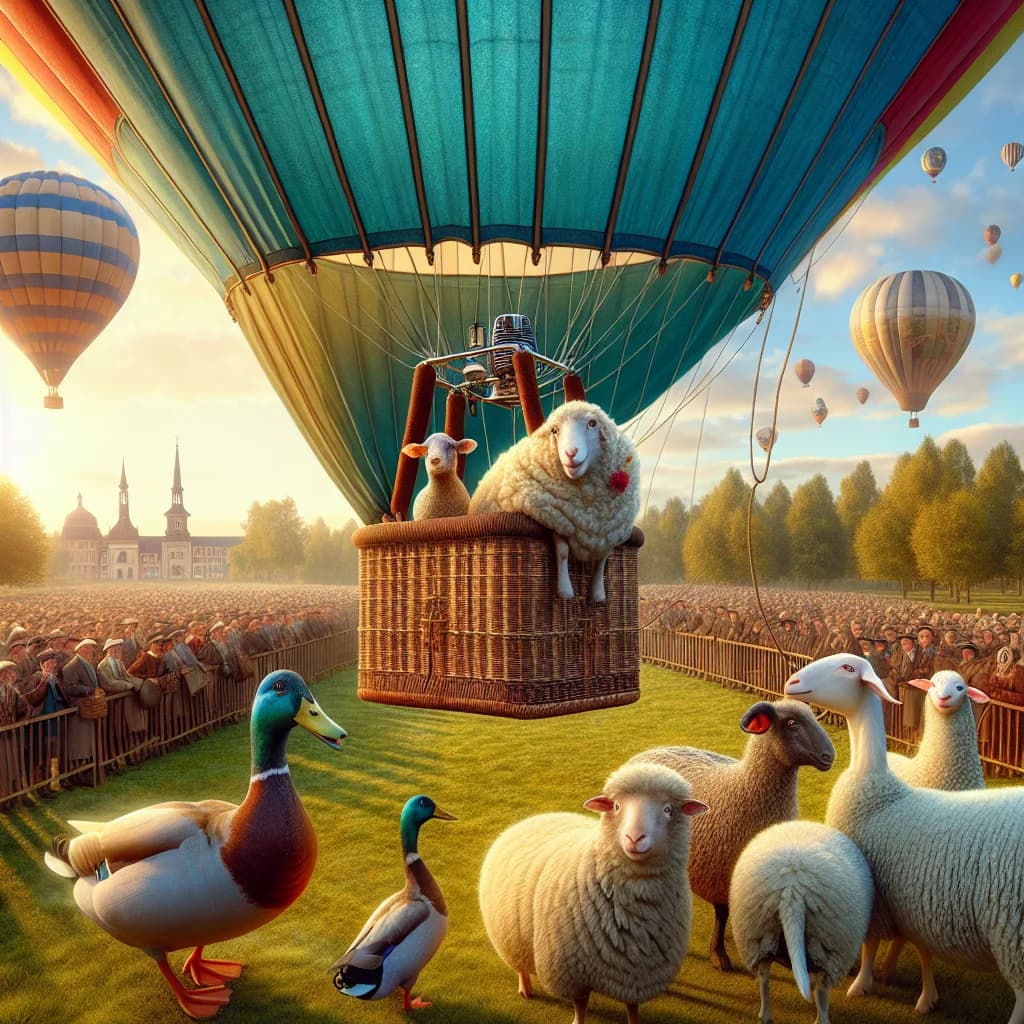
Imagine the courtyard of the Palace of Versailles on September 19, 1783. A crowd of 130,000 people, including King Louis XVI and Marie Antoinette, gathered in hushed anticipation. They weren’t there to see a royal procession, but to witness a scientific miracle: the launch of a giant, sky-blue balloon adorned with golden suns. However, the most curious aspect of this event wasn’t the balloon itself, but its passengers. Tucked inside a wicker basket were a sheep, a duck, and a rooster. But why were the first living passengers in a hot air balloon a sheep, a duck, and a rooster? This unusual choice was not a whim of the inventors, the Montgolfier brothers, but a calculated scientific experiment designed to test the safety of the upper atmosphere.
The Montgolfier Experiment: Testing the Unknown
In the late 18th century, the sky was a complete mystery. Scientists of the era, including Joseph-Michel and Jacques-Étienne Montgolfier, did not know if humans could breathe or survive at high altitudes. There were prevailing theories that the air became thinner, colder, or even poisonous the higher one traveled.
Before risking human life, the brothers needed biological "test pilots." While King Louis XVI originally suggested using two condemned criminals for the flight, the Montgolfiers and their peers argued that the honor of being the first aerial travelers should go to something less controversial. They settled on three farm animals, each serving a specific scientific purpose to help researchers understand how different physiologies reacted to flight.
The Biological Reasoning Behind the Trio
The selection of the sheep, the duck, and the rooster was a brilliant example of early experimental design. Each animal acted as a proxy for different aspects of human health and environmental adaptation.
The Sheep: The Human Proxy
The sheep, famously named Montauciel (translated as "climb-to-the-sky"), was chosen because its physiology was thought to be remarkably similar to that of a human. Scientists believed that if the sheep survived the journey without respiratory distress or physical injury, a human passenger would likely fare the same. It was the ultimate test for the safety of "common" mammalian biology in the sky.
The Duck: The Scientific Control
The duck served as the "control" group in this experiment. Since ducks are natural flyers that frequently reach high altitudes, the researchers expected it to be unaffected by the journey. If the duck returned distressed, it would signal that the altitude or the "gas" in the balloon (which was actually just hot air and smoke) was inherently toxic, rather than just physically demanding.
The Rooster: The Mid-Altitude Mystery
The rooster was the most nuanced choice. While it is a bird, it is essentially flightless—or at least limited to very low altitudes. By including a bird that does not naturally fly high, the Montgolfiers could observe if the height itself caused any specialized physiological trauma to a creature not adapted to the upper atmosphere.
A Successful Landing and the Path to Human Flight
The flight lasted approximately eight minutes and covered a distance of about two miles, reaching an altitude of roughly 1,500 feet. When the balloon finally touched down in the woods of Vaucresson, the animals were found to be in excellent health.
- The Sheep was found calmly grazing.
- The Duck was perfectly fine.
- The Rooster had sustained a slight wing injury, but not from the flight itself; it was later determined that the sheep had accidentally stepped on it during the landing.
This successful mission provided the empirical evidence needed to prove that the atmosphere was breathable and safe for living creatures. Just two months later, on November 21, 1783, Jean-François Pilâtre de Rozier and the Marquis d'Arlandes became the first humans to complete a free flight in a Montgolfier balloon.
Conclusion
The story of the sheep, the duck, and the rooster is more than just a historical quirk; it marks the beginning of biological aerospace research. By asking "why were the first living passengers in a hot air balloon a sheep, a duck, and a rooster?", we uncover the origins of the safety protocols that eventually led to modern aviation and space exploration. These farmyard pioneers proved that the sky was not a place of poisonous vapors, but a new frontier waiting to be explored. Today, their legacy lives on every time a pilot takes off or an astronaut launches into orbit, reminding us that the greatest leaps in science often begin with the humblest of passengers.


