
How do honeybees describe a map to each other just by dancing
Forget GPS—a honeybee's "waggle dance" is a living treasure map, a secret language that gives the hive precise coordinates to the best flowers using only wiggles and the angle of the sun.

Too Long; Didn't Read
TLDR: Honeybees perform a waggle dance to share directions. The angle of the dance tells other bees the direction to fly in relation to the sun, and the duration of the waggle tells them how far away the food is.
Decoding the Bee's Map: How Do Honeybees Describe a Map to Each Other Just by Dancing?
Imagine giving a friend directions to a new café. You might pull out your phone, point to a map, and describe landmarks. Now, what if you had to do all that without speaking or writing, using only a carefully choreographed dance? This is exactly what honeybees do every day. These tiny insects possess one of the most sophisticated and fascinating communication systems in the animal kingdom. This post will decode the secrets of the honeybee's "waggle dance" and explore how these creatures create a detailed, living map for their hive-mates through movement alone.
The Language of the Hive: Cracking the Code
For centuries, humans were mystified by the coordinated efficiency of bee colonies. It wasn't until the 1940s that Austrian ethologist Karl von Frisch dedicated his research to this puzzle. Through meticulous observation and clever experiments, he proved that honeybees communicate complex information about food sources through specific dances. His groundbreaking work was so significant that it earned him the Nobel Prize in Physiology or Medicine in 1973. Von Frisch identified two primary forms of this dance language, each serving a distinct purpose.
More Than Just a Wiggle: The Two Key Dances
Not all food sources are created equal, and bees have a dance for every occasion. The type of dance a returning forager performs depends entirely on the distance of the nectar or pollen she has found.
The Round Dance: "Food is Nearby!"
When a food source is close to the hive, typically within 100 meters, the forager bee performs the "Round Dance." She runs in narrow circles, rapidly changing direction to the left and right. This dance doesn't provide a precise map with direction or distance. Instead, its primary function is to communicate, "Hey, I found something really good, and it's very close!" The scent of the flower on the dancer's body gives the other bees a clue about what to look for, and the dance's vigor signals the quality of the find. Excited by the news, other foragers fly out and search in the immediate vicinity of the hive.
The Waggle Dance: "Here's the Map!"
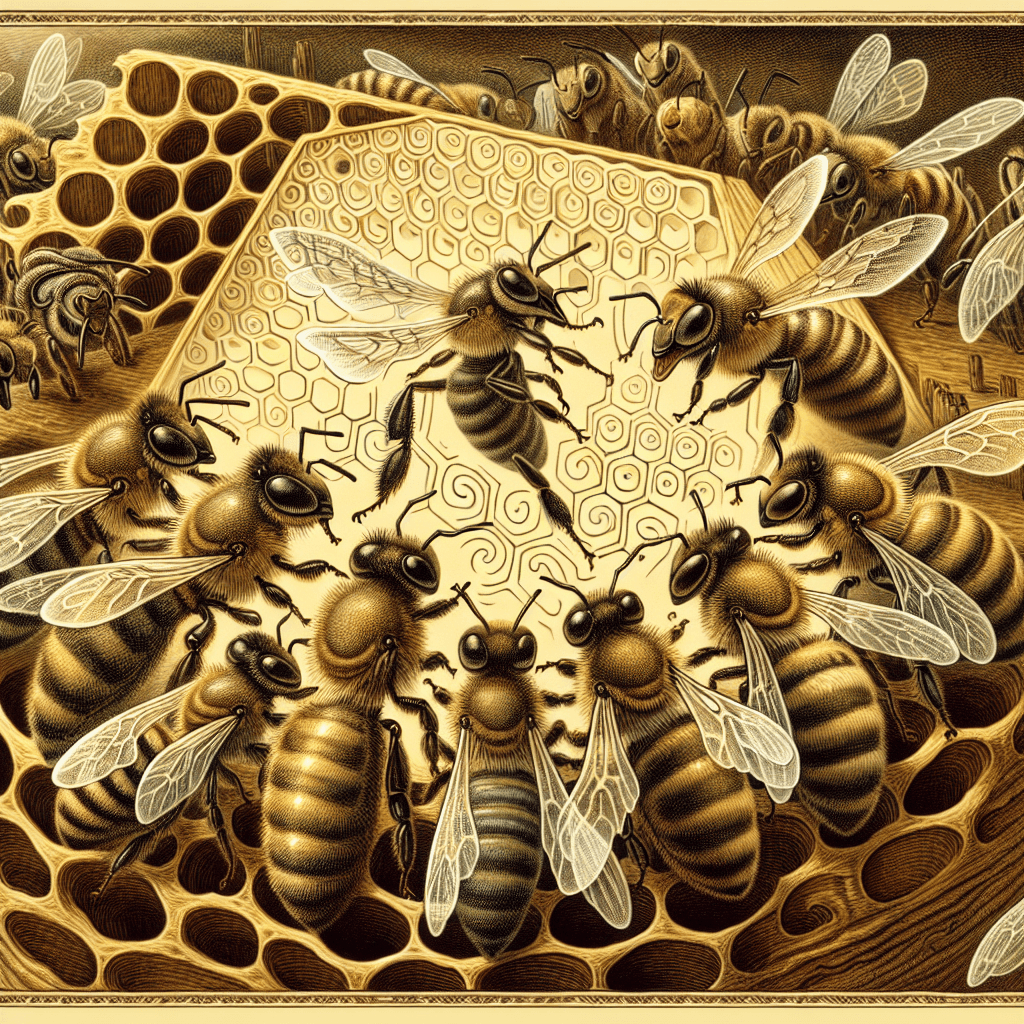
For food sources located farther away, the honeybee performs the far more complex and informative "Waggle Dance." This is where the true map-making happens. The bee moves in a figure-eight pattern. The critical part of this dance is the straight run in the middle of the figure-eight, known as the "waggle run," where the bee vigorously waggles her abdomen from side to side and vibrates her wings. This single movement contains an astonishing amount of information.
Reading the Map: Direction, Distance, and Quality
The waggle dance is a symbolic language where each element translates into a specific navigational instruction. To understand it, fellow bees crowd around the dancer, touching her with their antennae to feel the vibrations and interpret the code.
-
Direction: The direction of the food source is communicated by the angle of the waggle run relative to the sun. Bees perform this dance on the vertical honeycomb inside the dark hive. The "up" direction on the comb represents the direction of the sun outside.
- If the bee performs her waggle run straight up the comb, it means the food source lies directly towards the sun.
- If she runs straight down, the food is directly away from the sun.
- If the run is angled 60 degrees to the left of vertical, the food source is 60 degrees to the left of the sun's current position. Honeybees have a remarkable internal clock that allows them to adjust this angle throughout the day as the sun moves across the sky.
-
Distance: The distance to the food source is encoded in the duration of the waggle run. The longer the run, the farther away the food. For example, a waggle run lasting for one second might indicate a distance of approximately one kilometer. The other bees measure this duration to know exactly how far they need to fly.
-
Quality: The bee also communicates the quality of the food source. A more enthusiastic and rapid waggle, with more vibrations per second, signals a richer, more valuable source of nectar or pollen. A less vigorous dance might indicate a food source that is good, but not great, helping the colony allocate its foraging efforts efficiently.
Conclusion
The honeybee's waggle dance is a masterclass in communication and a powerful reminder of the complexity hidden within the natural world. Through a simple yet precise set of movements, a single bee can convey a detailed map containing direction, distance, and even a "quality rating" for a food source miles away. This incredible ability ensures the colony's survival, allowing thousands of individuals to work as one cohesive unit. So, the next time you see a honeybee buzzing by, remember that she might not just be flying; she could be following an intricate map, created for her by a dancing sister back at the hive.


