
Why are some people born with a visible tendon in their wrist while others are missing it entirely
Flex your wrist and look closely: if you see a prominent tendon, you’re carrying a piece of evolutionary history that 14% of the population has already lost. Discover the fascinating reason behind this "missing" muscle and what it reveals about your unique genetic makeup.

Too Long; Didn't Read
The visible wrist tendon is called the palmaris longus, a vestigial muscle inherited from our tree-climbing ancestors. Approximately 14 percent of the population lacks it because it is no longer necessary for modern hand function or grip strength.
The Mystery of the Wrist: Why Are Some People Born With a Visible Tendon in Their Wrist While Others Are Missing It Entirely?
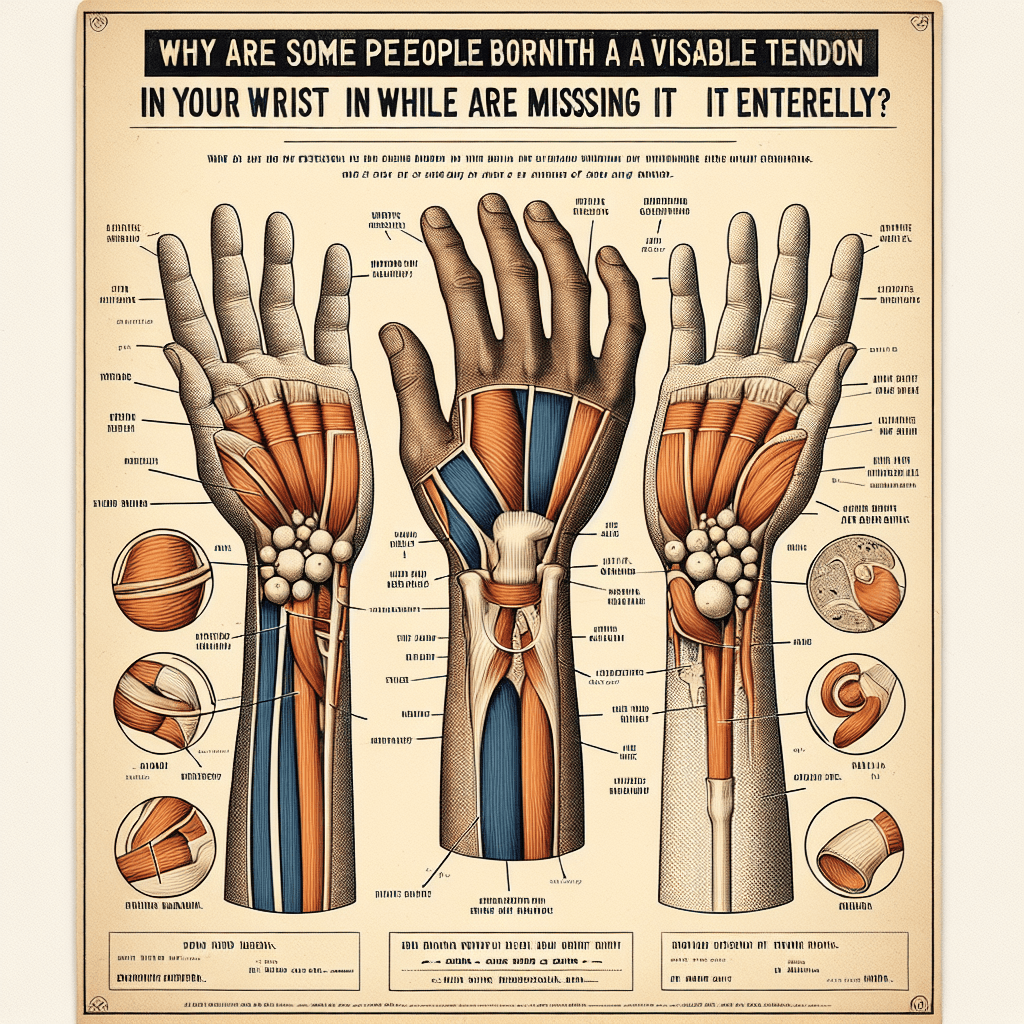
Touch your thumb to your pinky finger and tilt your hand slightly toward you. Do you see a thin, cord-like band popping up in the center of your wrist? If you do, you are looking at the palmaris longus tendon. If your wrist remains smooth, you are among the estimated 14% of the global population who lack this specific muscle entirely. This anatomical quirk often sparks curiosity: is one group "more evolved," and does missing a tendon affect your physical strength? The answer lies in the fascinating intersection of evolutionary biology and vestigial structures. This blog post explores why are some people born with a visible tendon in their wrist while others are missing it entirely, examining its history, its role in modern medicine, and what its absence says about our species.
What Is the Palmaris Longus?
The palmaris longus is a slender muscle located in the forearm, terminating in a long tendon that passes over the wrist. Anatomically, it is classified as a "weak flexor." While it technically aids in flexing the wrist and tensing the palm's skin (the palmar aponeurosis), its contribution to overall hand strength is negligible.
Interestingly, its presence or absence is determined before birth. Because the muscle provides such a minor functional advantage in modern humans, its absence—whether in one arm (unilateral) or both (bilateral)—does not result in any measurable loss of grip strength or dexterity. This has led biologists to categorize the palmaris longus as a vestigial structure: a remnant of our biological past that is gradually disappearing from the human blueprint.
The Evolutionary Roots of the Wrist Tendon
To understand why this tendon is disappearing, we must look at our primate ancestors. In the animal kingdom, the palmaris longus is highly developed in species that rely heavily on their forelimbs for locomotion.
- Arboreal Species: For lemurs and monkeys that spend their lives leaping through trees, a long, elastic tendon provides essential tension for hanging and climbing.
- Terrestrial Adaptation: As human ancestors transitioned from swinging through canopies to walking upright on the ground, the mechanical requirement for this specific muscle diminished.
According to evolutionary biology, when a trait no longer provides a survival advantage, it is no longer "selected for" by evolution. Over millions of years, the genetic instructions for the palmaris longus have become optional. Consequently, some people are born without it simply because the evolutionary pressure to maintain it has vanished.
Why Do Some People Lack the Tendon?
The absence of the palmaris longus is a prime example of "anatomical variation." The prevalence of this trait varies significantly across different global populations and demographics:
- Global Statistics: On average, roughly 14% of the world's population lacks the tendon. However, this number fluctuates by region.
- Regional Variations: Studies published in journals like the Journal of Hand Surgery indicate that the absence is more common in Caucasian populations (up to 25%) and much rarer in Asian and African populations (often less than 5%).
- Gender and Symmetry: Research suggests it is more frequently missing in women than in men and is more likely to be absent in the left arm than the right.
These variations occur because the trait is hereditary. If your parents lacked the tendon, you are more likely to be born without it, reflecting the slow, non-uniform pace of human evolution.
Medical Significance: A Built-In Spare Part
While the palmaris longus may be "useless" for daily movement, it is a goldmine for surgeons. Because its absence causes no functional deficit, it has become the "spare part" of the human body.
- Tendon Grafts: When a patient suffers a severe injury to the tendons in their hands or feet, surgeons often harvest the palmaris longus to use as a graft.
- Reconstructive Surgery: It is frequently used in reconstructive procedures for the eyelids, lips, and even the "Tommy John" surgery common in professional baseball.
- The Schaeffer's Test: This is the standard clinical method used by doctors to identify the tendon’s presence before surgery (the thumb-to-pinky pinch mentioned earlier).
In this context, having the tendon isn't necessarily a sign of being "less evolved"—it’s actually a stroke of luck if you ever require orthopedic surgery.
Conclusion
The question of why are some people born with a visible tendon in their wrist while others are missing it entirely serves as a tangible reminder of our evolutionary journey. The palmaris longus is a biological relic, a piece of "software" left over from a time when our ancestors lived in the trees. Whether you have it or not, your body is functioning exactly as it should; its presence simply offers a fascinating glimpse into the diversity of human anatomy.
Understanding these variations highlights the fact that evolution is not a finished process but an ongoing shift. Whether you view the tendon as a vestigial curiosity or a convenient medical backup, it stands as a testament to the incredible, ever-changing nature of the human body. If you’re curious about other vestigial traits, you might look toward your wisdom teeth or your tailbone next!


