
Why did a Victorian inventor believe twelve live leeches could accurately predict an incoming storm
Long before modern radar, one Victorian inventor built a "Tempest Prognosticator" powered entirely by the instincts of twelve agitated, blood-sucking leeches. Step inside the bizarre intersection of biology and meteorology to see if these slimy forecasters actually held the secret to surviving the storm.

Too Long; Didn't Read
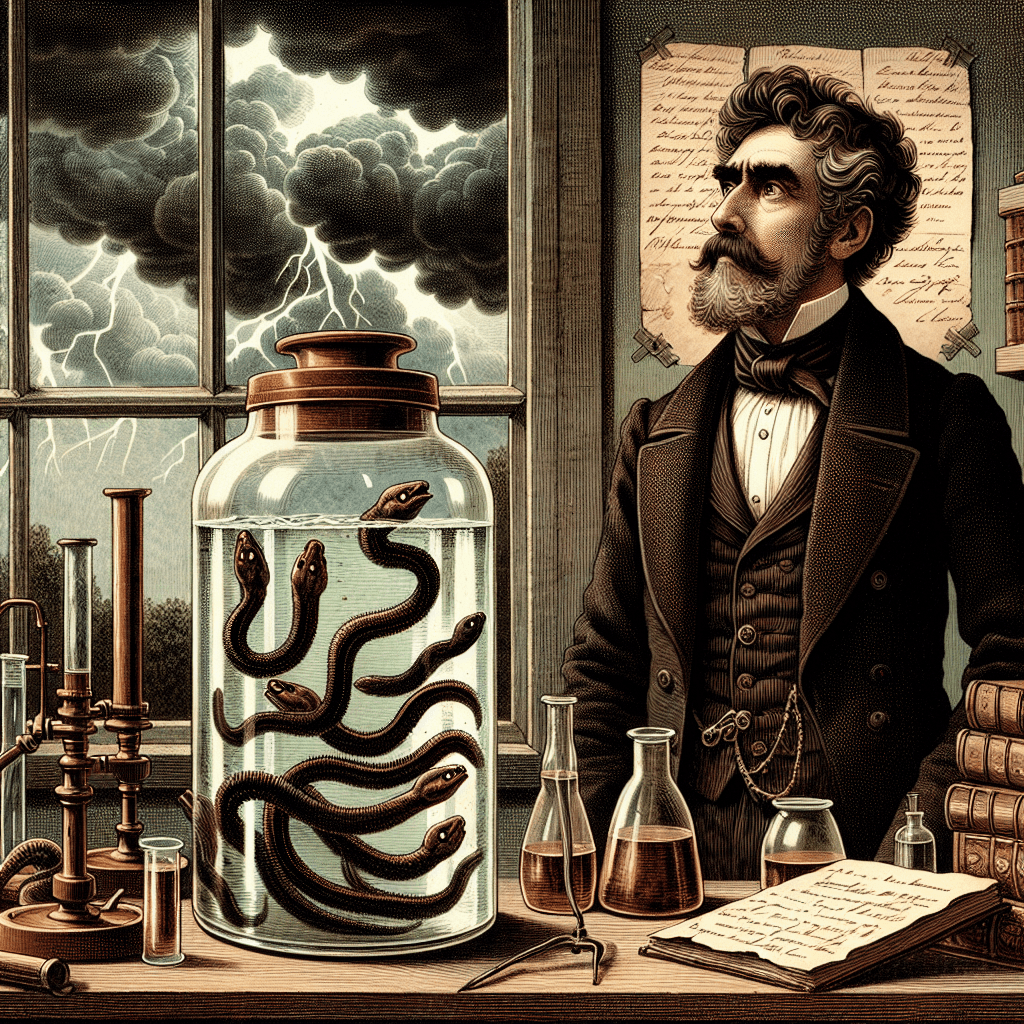
Victorian inventor George Merryweather created the Tempest Prognosticator, a device housing twelve leeches that reacted to atmospheric changes. He believed the leeches were sensitive to electrical shifts before a storm, causing them to crawl up their jars and trigger a warning bell to alert sailors of danger.
The Tempest Prognosticator: Why did a Victorian inventor believe twelve live leeches could accurately predict an incoming storm?
In the mid-19th century, the British Empire was the epicenter of global innovation, a time when the line between eccentric folklore and rigorous science was often blurred. Amidst the high-tech steam engines and telegraphs of the era, one inventor proposed a weather-tracking device that seemed to belong more to a medieval apothecary than a modern laboratory. Dr. George Merryweather, a physician from Whitby, presented a grand, ornate carousel known as the "Tempest Prognosticator." At its heart were twelve live leeches. While the concept sounds like a bizarre footnote in history, it was rooted in a genuine scientific curiosity: Why did a Victorian inventor believe twelve live leeches could accurately predict an incoming storm? This blog post explores the logic, the mechanics, and the historical context behind this fascinating intersection of biology and meteorology.
The Observation: Nature’s Living Barometers
Dr. Merryweather did not choose leeches at random. His invention was based on centuries of observations by naturalists and poets who noted that certain animals behaved erratically before a change in weather. Leeches, in particular, were known to be highly sensitive to atmospheric shifts.
According to historical accounts of Merryweather’s research, he observed that when the weather was fair, leeches remained at the bottom of their water-filled containers. However, as barometric pressure dropped—a precursor to a storm—the leeches would become agitated and climb to the top of the vessel. Merryweather theorized that these creatures possessed an innate "animal instinct" or a sensitivity to the electromagnetic state of the atmosphere that humans lacked.
The Mechanics of the Tempest Prognosticator
To turn this biological observation into a reliable tool, Merryweather designed a sophisticated apparatus. The device consisted of twelve glass bottles arranged in a circle, each containing a small amount of rainwater and one medicinal leech.
The "warning system" worked through a clever mechanical trigger:
- The Whalebone Lever: A piece of whalebone was placed at the neck of each bottle.
- The Chain and Bell: This lever was connected to a series of chains that led to a central hammer and a large metal bell.
- The Trigger: When a leech sensed an approaching storm and climbed to the top of the bottle, it would displace the whalebone lever.
- The Alarm: This movement tripped the mechanism, causing the central bell to ring, alerting the observer to the impending "tempest."
Why Twelve Leeches? The "Jury" System
One of the most intriguing aspects of the device was the choice to use exactly twelve leeches. Merryweather was a man of science and understood the risks of "false positives." He famously referred to his leeches as a "jury of philosophical councilors."
He believed that:
- Redundancy was key: A single leech might be temperamental or unwell, leading to an inaccurate reading.
- Consensus mattered: If only one or two bells rang, the weather might simply be changing slightly. However, if all twelve leeches rose to the top simultaneously, it indicated a significant and certain atmospheric disturbance.
- The "Jury" Principle: By having twelve separate "voters," the device operated on a democratic principle of biological data, ensuring that the warning was based on a collective response rather than an individual fluke.
The Scientific Context: Electricity and the Atmosphere
In the 1850s, the scientific community was obsessed with the new frontier of electromagnetism. Merryweather didn't just think the leeches felt a change in pressure; he believed they were sensitive to the "electric state" of the air. At the time, many believed that storms were essentially electrical phenomena.
During the Great Exhibition of 1851, where the Prognosticator was famously displayed, Merryweather argued that his "Atmospheric Electromagnetic Telegraph" was superior to the standard mercury barometer. While a barometer measured pressure at a single point in time, Merryweather claimed the leeches could sense the approaching storm’s electrical signature before the pressure even began to drop significantly.
The Legacy of the Leech Weather Glass
Despite Merryweather's enthusiasm and a series of successful tests—during which he sent letters to the President of the Philosophical Society of Whitby accurately predicting storms—the Tempest Prognosticator never saw mass production. The reasons were largely practical:
- Maintenance: Keeping twelve leeches alive and healthy required constant care and fresh rainwater.
- Competition: Admiral Robert FitzRoy was developing the "storm glass" and more portable barometers, which were easier to use on ships.
- Aesthetics: The device was large, expensive, and somewhat cumbersome for the average home or vessel.
Conclusion
Dr. George Merryweather’s quest to answer why twelve live leeches could accurately predict an incoming storm led to one of the most unique inventions of the Victorian era. While it may look like a piece of steampunk fiction today, the Tempest Prognosticator represented a serious attempt to bridge the gap between biological sensitivity and mechanical precision. It reminds us that before we had satellite imaging and digital sensors, humanity looked to the natural world for clues about the future. Though we have moved on to more sophisticated technologies, the story of the "jury of leeches" remains a testament to the creative and often surprising ways Victorian inventors sought to master the elements.


