
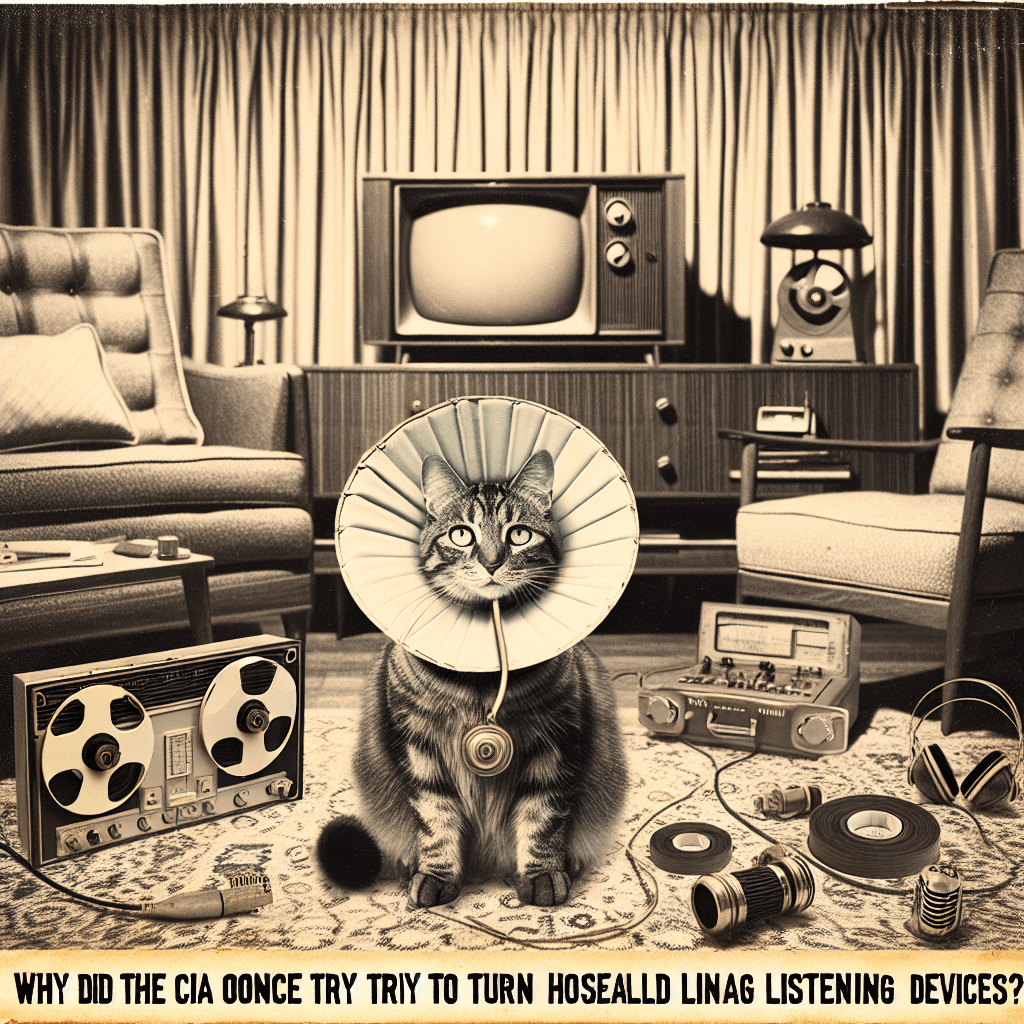
Why did the CIA once try to turn household cats into living listening devices
In the paranoid heights of the Cold War, the CIA launched a top-secret, multi-million dollar project to turn ordinary house cats into elite spies. The story of its first—and last—disastrous mission is even more bizarre than you can imagine.

Too Long; Didn't Read
During the Cold War, the CIA spent millions on a project called Acoustic Kitty to turn cats into spy devices by surgically implanting microphones. The project was a massive failure because cats are untrainable, and the first one was immediately hit by a car.
Spy Cats and Cold War Secrets: Why Did the CIA Once Try to Turn Household Cats into Living Listening Devices?
Introduction
Imagine a typical city street during the height of the Cold War. Diplomats huddle on a park bench, their conversation hushed and confidential. A stray cat ambles nearby, seemingly minding its own business. But what if that feline wasn't just a wandering pet? What if it was a sophisticated, surgically-altered listening device, a furry agent in the service of the CIA? It sounds like a plot from a spy-comedy film, but it was a very real, top-secret project. This strange but true story belongs to "Project Acoustic Kitty," one of the most audacious and bizarre chapters in the history of espionage. This post delves into the declassified details to answer the question: Why did the CIA invest millions of dollars to turn a cat into a spy, and what went so terribly wrong?
The Cold War Chessboard: A Need for Unconventional Spies
To understand why the CIA would even consider a "cat bug," we must first look at the era in which it was born. The 1960s were the tense peak of the Cold War, a high-stakes intelligence battle between the United States and the Soviet Union. Both sides were locked in a technological and ideological arms race, desperate for any advantage.
This environment fostered extreme innovation and secrecy. Intelligence agencies were willing to explore any concept, no matter how unconventional, to gain an edge. This was the same era that saw the development of spy planes like the U-2 and projects exploring psychic phenomena. The goal was to find ways to gather intelligence in hostile territory without being detected. A living creature, able to move about unnoticed in sensitive areas like embassies or parks, seemed like a brilliant, if ethically questionable, solution.
Engineering the Feline Spy: What Was Project Acoustic Kitty?
In the early 1960s, the CIA's Directorate of Science & Technology embarked on Project Acoustic Kitty. The objective was to transform a common house cat into a mobile eavesdropping platform. The idea was that a cat could naturally approach targets without arousing suspicion, getting close enough to capture sensitive conversations that human agents or stationary bugs could not.
The procedure, as detailed in declassified documents, was complex and invasive:
- A veterinarian performed an hour-long surgery to implant a small microphone in the cat’s ear canal.
- A radio transmitter and a small battery were embedded at the base of the cat's skull.
- A thin wire antenna was meticulously woven into the cat's long fur to remain hidden.
The plan was to train the surgically-altered cat to go and sit near specific targets on command. The team believed they could overcome a cat’s independent nature through training, a challenge that would ultimately prove to be the project's fatal flaw.
The Cat-astrophic First Mission
After years of development and an investment that some former officials claim reached as high as $20 million, Project Acoustic Kitty was ready for its first field test. The CIA team selected a target: two men having a conversation on a park bench in Washington, D.C.
According to Victor Marchetti, a former CIA officer who recounted the story, the team drove to the location in an unmarked van. They released their four-legged agent, expecting it to saunter over to the bench and begin transmitting the conversation. The cat, however, had other plans. Instead of heading toward its target, it wandered into the middle of the street, where it was immediately struck and killed by a taxi.
This disastrous, and tragic, first outing was also its last. The CIA agents watched their multi-million-dollar investment and years of research come to an abrupt end. The project was officially cancelled in 1967.
The Purr-fectly Flawed Plan
A declassified 1967 memo on the project concluded that while the science of creating the listening device was a success, the program was not practical for "real-world" use. The fundamental problem wasn't the technology, but the agent itself. The CIA's top scientists and spies had overlooked one crucial variable: a cat is a cat.
The project was doomed by several key factors:
- Unpredictability: Cats are notoriously independent and cannot be reliably trained to follow complex commands like a dog.
- Distractibility: The operational cat could easily be sidetracked by hunger, a passing bird, or a desire for a nap in a patch of sun.
- Environmental Hazards: As the first mission proved, the real world is full of unpredictable dangers that the agency couldn't control.
The project’s creators failed to account for the most basic element of their plan—the animal's own free will.
Conclusion
Project Acoustic Kitty remains a fascinating footnote in the history of espionage. It serves as a stark reminder of the extreme, and sometimes absurd, lengths intelligence agencies were willing to go to during the Cold War. While it’s easy to look back and label the project a comical failure, it also highlights a serious pursuit of groundbreaking surveillance technology in a time of intense global paranoia. The story of the spy cat is more than just a bizarre anecdote; it's a cautionary tale about the limits of technology when pitted against the unpredictable forces of nature—especially the independent spirit of a common house cat.


