
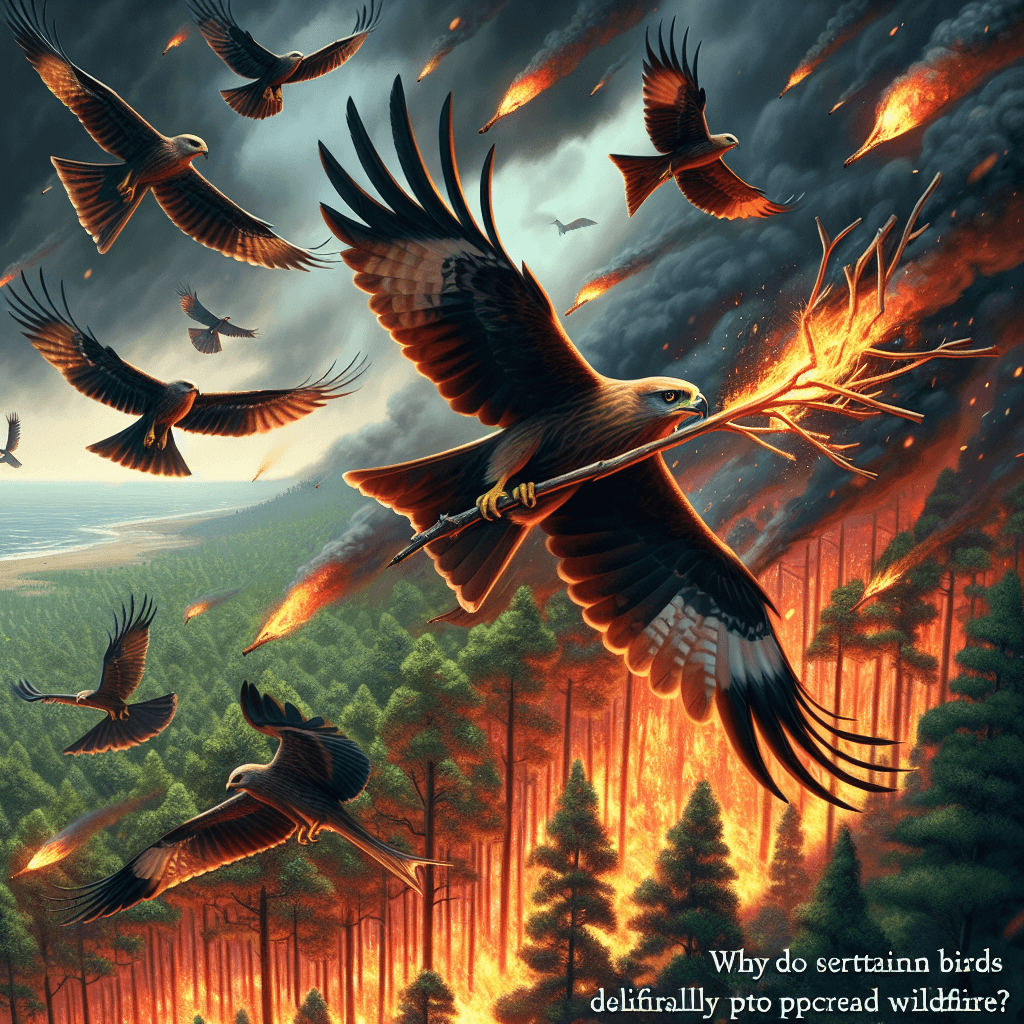
Why do certain birds deliberately pick up burning sticks to spread wildfires
Think humans are the only species that can control fire? Discover the bone-chilling reality of "avian arsonists" that deliberately spread wildfires to trap their prey in a circle of flames.

Too Long; Didn't Read
Certain raptors known as firehawks intentionally spread wildfires by transporting burning sticks to unburnt patches of land. This behavior flushes out hidden prey like small mammals and insects, allowing the birds to easily hunt animals fleeing the flames.
Nature’s Firestarters: Why Do Certain Birds Deliberately Pick Up Burning Sticks to Spread Wildfires?
Imagine a raging wildfire in the Australian Outback. While most creatures are fleeing for their lives, a group of predatory birds is doing the exact opposite. They are diving toward the flames, not to perish, but to scavenge. Even more startling is the observation that these birds aren't just following the fire—they are actively spreading it. For years, stories of "fire-starting birds" were dismissed as myth, but recent scientific documentation has confirmed a fascinating and chilling behavior. Why do certain birds deliberately pick up burning sticks to spread wildfires? The answer lies in a sophisticated, predatory hunting strategy that challenges our understanding of avian intelligence and the natural world.
The "Firehawks" of Northern Australia
In the tropical savannas of Australia’s Northern Territory, three specific species of raptors have earned the nickname "firehawks" due to their unique relationship with fire. These species include:
- The Black Kite (Milvus migrans)
- The Whistling Kite (Haliastur sphenurus)
- The Brown Falcon (Falco berigora)
While many birds are known to forage at the edge of a fire to catch fleeing insects and rodents, these three species take it a step further. They have been observed by park rangers, firefighters, and researchers picking up smoldering sticks or glowing embers in their talons or beaks and transporting them up to 50 meters away to unburned patches of grass. By dropping these "torches," they ignite new fires, effectively trapping prey between two fronts of flame.
The Strategy: Hunting with Fire
The primary motivation for this behavior is simple: efficiency. In the dense grasslands of the Australian bush, small mammals, reptiles, and large insects are experts at hiding. Traditional hunting requires significant energy and stealth. Fire, however, acts as a "beater," flushing out every living thing in its path.
Flushing Out Prey
As the new fire spreads, lizards, snakes, and small marsupials are forced out of their burrows and thickets. The birds wait at the "black front"—the edge of the fire—to snatch up the panicked animals. This "buffet" allows the raptors to consume a high volume of protein with minimal physical exertion.
Creating New Opportunities
If a fire begins to die down or hits a natural barrier like a road or a stream, the birds may find their easy food source disappearing. By intentionally moving a burning brand across the barrier, they ensure the fire continues, providing a fresh "killing field" for the flock.
Indigenous Knowledge and Scientific Confirmation
While Western science only recently focused on this phenomenon, the Indigenous peoples of Australia have known about fire-spreading birds for millennia. According to a study published in the Journal of Ethnobiology in 2017, researchers collaborated with Aboriginal groups to document these behaviors.
Aboriginal "Dreamtime" stories and traditional ecological knowledge have long integrated the "firehawk" into their cultural history. Many groups even have specific names for these birds that translate to "the fire-bringers." This collaboration highlighted that what was once considered "accidental" by some observers was, in fact, a deliberate and coordinated effort by the birds.
A Shift in Our Understanding of Intelligence
The fact that birds can manipulate fire—a tool long thought to be the exclusive domain of humans—has significant implications for biology.
- Tool Use: Using a burning stick to achieve a goal is a sophisticated form of tool use. It requires the bird to understand the properties of fire and predict the outcome of its actions.
- Cooperation: Observers have noted that this behavior often occurs in groups. While one bird may not successfully start a new blaze, a dozen birds dropping embers into a specific area can quickly escalate a small flame into a wildfire.
- Environmental Impact: This behavior forces ecologists to reconsider how wildfires spread. It suggests that some fires previously attributed to lightning strikes or human activity may have actually been avian-driven.
Conclusion
The discovery of why certain birds deliberately pick up burning sticks to spread wildfires reveals a remarkable level of adaptation. By harnessing the destructive power of fire, the Black Kite, Whistling Kite, and Brown Falcon have turned a natural disaster into a highly effective hunting tool. This behavior underscores the deep, complex relationship between wildlife and their environment, particularly in fire-prone landscapes like the Australian Outback.
Understanding these "firehawks" doesn't just change our view of bird intelligence; it also provides crucial insights for fire management and conservation. As we continue to study these avian arsonists, we are reminded that nature is rarely as simple as it seems, and the line between human and animal innovation is thinner than we once thought.


