
Why do frogs use their eyeballs to help them swallow their food
Ever wondered why a frog blinks every time it takes a bite? Discover the bizarre biological secret of how these amphibians use their own eyeballs as "pistons" to shove prey down their throats.

Too Long; Didn't Read
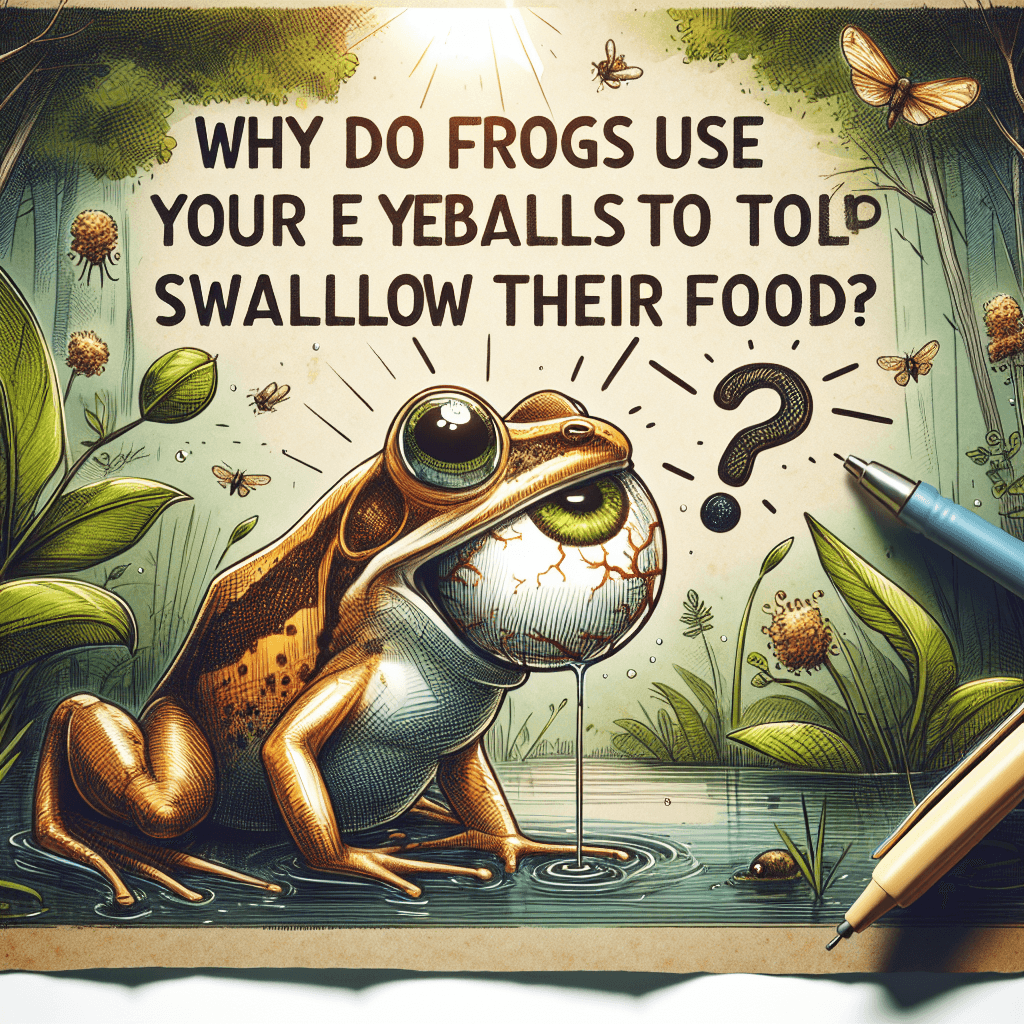
Frogs retract their eyeballs into the roof of their mouths to act like pistons, physically pushing prey down their throats to assist with swallowing since they cannot chew.
Gulping with a Gaze: Why Do Frogs Use Their Eyeballs to Help Them Swallow Their Food?
Imagine for a moment that every time you took a bite of a sandwich, you had to pull your eyeballs deep into your skull to force the food down your throat. While this sounds like a scene from a horror movie, it is a daily reality for millions of amphibians. Frogs possess one of the most bizarre and fascinating feeding mechanisms in the animal kingdom. Unlike humans, who rely on powerful tongue muscles and a complex throat structure to move food, frogs utilize their ocular anatomy to complete their meals. This blog post explores the biological necessity and mechanical process behind why do frogs use their eyeballs to help them swallow their food, shedding light on a unique evolutionary adaptation that allows these creatures to thrive.
The Mechanics of the "Eye-Gulp"
To understand why do frogs use their eyeballs to help them swallow their food, one must first look at the unique anatomy of a frog's head. Most vertebrates have a bony shelf that separates the eye sockets from the roof of the mouth. Frogs, however, lack this barrier. Only a thin, flexible membrane exists between the bottom of the eye socket and the oral cavity.
When a frog captures prey, it doesn't just close its eyes to protect them from a struggling insect. Instead, it employs the retractor bulbi muscle. This muscle pulls the eyeballs downward through the openings in the skull and into the roof of the mouth. As the eyeballs descend, they act like biological pistons, physically shoving the food toward the esophagus.
The Role of the Retractor Bulbi Muscle
- Engagement: Once the prey is in the mouth, the retractor bulbi muscle contracts.
- Displacement: The eyeballs move downward, occupying space in the mouth cavity.
- Pressure: This movement creates the necessary pressure to slide the prey backward into the throat.
Why Frogs Can’t Swallow Normally
The primary reason why do frogs use their eyeballs to help them swallow their food is rooted in their lack of specialized mouth structures. Most animals use their tongues or the muscles in their pharynx to manipulate food. While frogs have incredibly fast tongues for capturing prey, their tongues are not well-suited for moving large items toward the stomach.
Furthermore, most frogs are essentially "toothless" in the traditional sense. While some species possess maxillary teeth (on the upper jaw) or vomerine teeth (on the roof of the mouth), these are used primarily for gripping struggling prey rather than chewing. Because frogs swallow their meals whole and alive, they need an extra mechanical "shove" to overcome the resistance of a large or active insect.
Scientific Evidence: Seeing Inside the Swallowing Process
For years, the idea of "eye-swallowing" was a widely held theory among naturalists, but it wasn't until the late 20th and early 21st centuries that technology confirmed it. Research published in the Journal of Experimental Biology utilized X-ray cinematography to observe Northern Leopard Frogs during feeding.
According to these studies, the researchers discovered that:
- The eyeballs can descend significantly into the oral cavity, sometimes nearly touching the bottom of the mouth.
- Frogs "blink" much more frequently when consuming large, difficult prey than when eating smaller insects.
- When the nerves controlling the retractor muscles were temporarily deactivated, the frogs struggled significantly to swallow, requiring many more gulps to move the food.
Evolutionary Advantages
This "ocular-assisted" swallowing provides several benefits that have allowed frogs to remain successful predators for millions of years:
- Energy Efficiency: Using existing anatomy (the eyes) to assist in digestion reduces the need for heavy, bulky jaw muscles, keeping the frog’s head light and aerodynamic for jumping.
- Handling Large Prey: It allows frogs to consume prey that is nearly as wide as their own heads.
- Speed: By using the eyes as pistons, frogs can clear their mouth quickly, reducing the time they are vulnerable to predators while distracted by a meal.
Conclusion
The natural world is full of ingenious solutions to life's basic challenges. The reason why do frogs use their eyeballs to help them swallow their food is a perfect example of evolutionary efficiency. By utilizing their eyes as mechanical tools, frogs compensate for a lack of chewing teeth and powerful throat muscles, allowing them to process large, whole prey with ease.
Understanding these unique biological quirks gives us a deeper appreciation for the complexity of amphibian life. The next time you see a frog catch a fly and "blink" with intensity, you’ll know you aren't just seeing a reflex—you are witnessing a vital part of its digestive process in action. To learn more about the incredible world of amphibians, consider observing local species in their natural habitats or supporting wetland conservation efforts.


