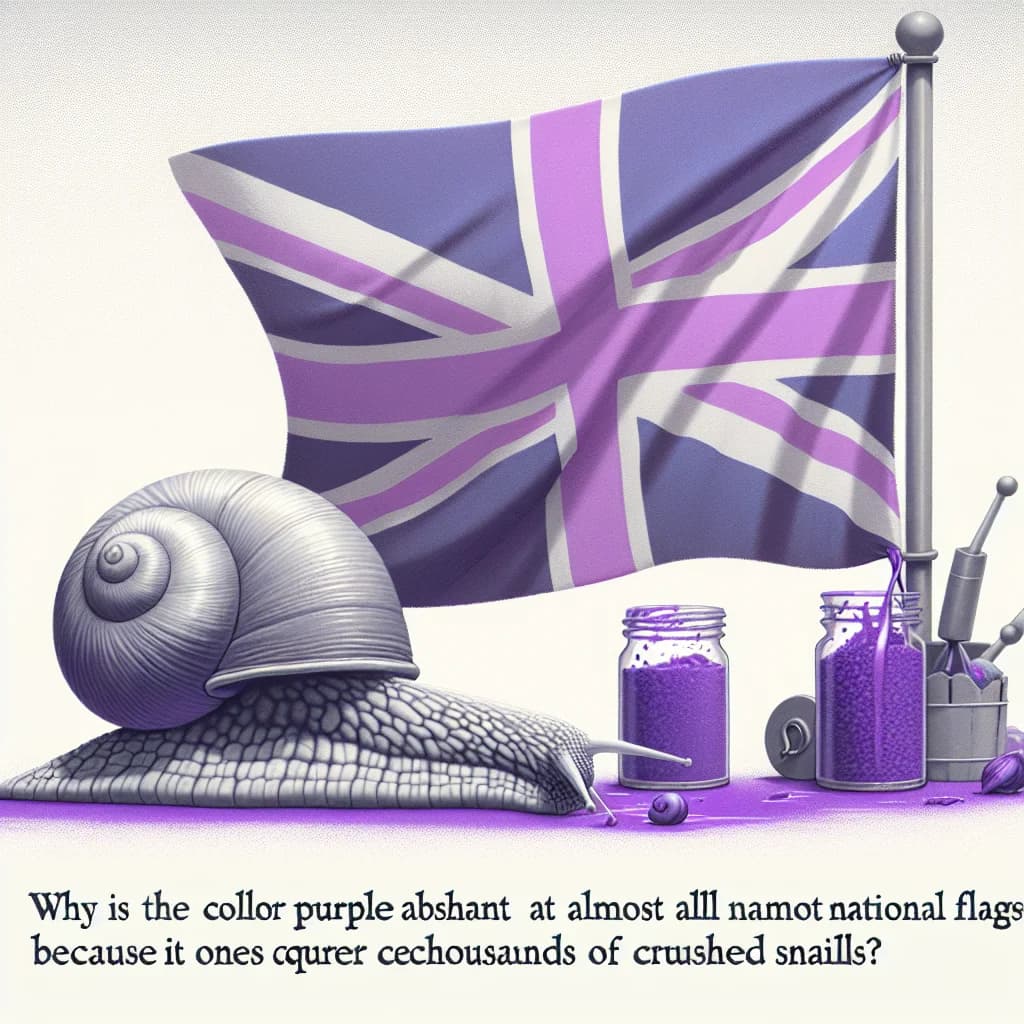
Why is the color purple absent from almost all national flags because it once required thousands of crushed snails
Have you ever noticed that purple is missing from almost every national flag? Discover the bizarre history of a dye so expensive it required thousands of crushed snails to produce, making it a luxury that even entire empires couldn’t afford.

Too Long; Didn't Read
Purple is absent from most national flags because it was historically too expensive to produce. Until the mid-1800s, the dye required harvesting thousands of rare sea snails for a tiny amount of pigment, making it a luxury reserved for royalty and far too costly for mass-produced flags.
The Royal Rarity: Why is the Color Purple Absent From Almost All National Flags Because It Once Required Thousands of Crushed Snails?
When you look at a sea of national flags during the Olympics or outside the United Nations, a vibrant pattern of red, white, blue, and yellow dominates the landscape. However, one color is conspicuously missing: purple. While purple is associated with royalty and luxury today, it is almost entirely absent from the world’s 190-plus national flags. This isn’t a matter of aesthetic preference or color theory. Instead, it is the result of a grueling, expensive, and centuries-old production process. For most of human history, the color purple was simply too expensive for any nation to mass-produce on a piece of fabric meant to fly in the wind. The primary reason why is the color purple absent from almost all national flags because it once required thousands of crushed snails?
The Gruesome Origins of Tyrian Purple
The history of the color purple begins not with a plant or a mineral, but with a predatory sea snail. Specifically, the dye known as "Tyrian purple" was harvested from the Murex genus of sea snails, primarily found in the Mediterranean Sea.
The production process was notoriously difficult and unpleasant. According to historical records from the Phoenician era—the civilization credited with developing the dye in the city of Tyre—the process involved the following steps:
- Harvesting: Thousands of snails had to be gathered from the ocean floor.
- Extraction: The snails’ tiny mucus-secreting glands were removed.
- Processing: The glands were boiled in large lead vats for several days, creating a pungent, rotting stench that was legendary in the ancient world.
- Exposure: The resulting liquid only turned purple after being exposed to sunlight during the drying process.
To produce just one gram of pure Tyrian purple dye, it took approximately 10,000 to 12,000 snails. This astronomical requirement made the substance more valuable by weight than gold.
A Color Reserved for the Elite
Because of the staggering cost and labor involved, purple became the ultimate status symbol. In Ancient Rome, the use of purple was strictly regulated by sumptuary laws. For a period, only the Emperor was permitted to wear a solid purple toga. High-ranking senators were allowed only a stripe of the color.
During the Byzantine Empire, the term "Porphyrogenitus" (born in the purple) was used to describe children born to a reigning emperor, further cementing the color’s association with divine right and extreme wealth. Because a single purple garment could cost the equivalent of a modern-day fortune, no country could justify the expense of standardizing the color for thousands of military uniforms or national banners. Flags were designed to be easily and cheaply reproduced so they could be replaced after fading in the sun or being torn in battle. Purple simply did not fit that logistical requirement.
The 19th-Century Chemical Revolution
The status of purple changed overnight in 1856. An 18-year-old English chemist named William Henry Perkin was attempting to synthesize quinine, a treatment for malaria, when he accidentally created a permanent purple residue. This substance, which he named "Mauveine," was the world’s first synthetic organic dye.
Perkin’s discovery made the color purple mass-producible and affordable for the first time in human history. However, by the mid-19th century, most established nations—such as the United Kingdom, France, and the United States—had already solidified their national flag designs. Tradition is difficult to change, and these nations saw no reason to overhaul their symbolic identities just because a new color had become available.
The Rare Exceptions
Today, only two national flags feature purple, and both were designed after the advent of synthetic dyes:
- Dominica: Their flag, adopted in 1978, features a Sisserou parrot, which has purple feathers.
- Nicaragua: Their flag includes a small rainbow within the coat of arms, which contains a thin stripe of purple.
Conclusion
The absence of purple from national flags serves as a fascinating window into the intersection of biology, economics, and history. Why is the color purple absent from almost all national flags because it once required thousands of crushed snails? It is because, for millennia, the color was a luxury that even entire kingdoms could not afford to fly. While we now have the chemistry to produce purple with ease, the flags of the world remain a testament to a time when color was dictated by the availability of rare natural resources. Understanding this history helps us appreciate the hidden complexities behind the simple colored cloths that represent nations today.