
Why was a lawyer once appointed to legally represent a colony of rats in a sixteenth-century French court
When a sixteenth-century French village took a colony of rats to court, one brilliant lawyer stepped up to offer a defense so ingenious it changed legal history. Discover the bizarre true story of the trial where justice was served to the most unlikely defendants of all.

Too Long; Didn't Read
In 16th-century France, rats were formally charged with destroying crops, leading to the appointment of Barthélemy de Chasseneuz as their defense attorney. This reflected a medieval legal tradition where animals could be tried in court, and Chasseneuz famously used the case to argue for due process and highlight the practical impossibility of his clients attending trial safely.
Justice for Rodents: Why was a lawyer once appointed to legally represent a colony of rats in a sixteenth-century French court?
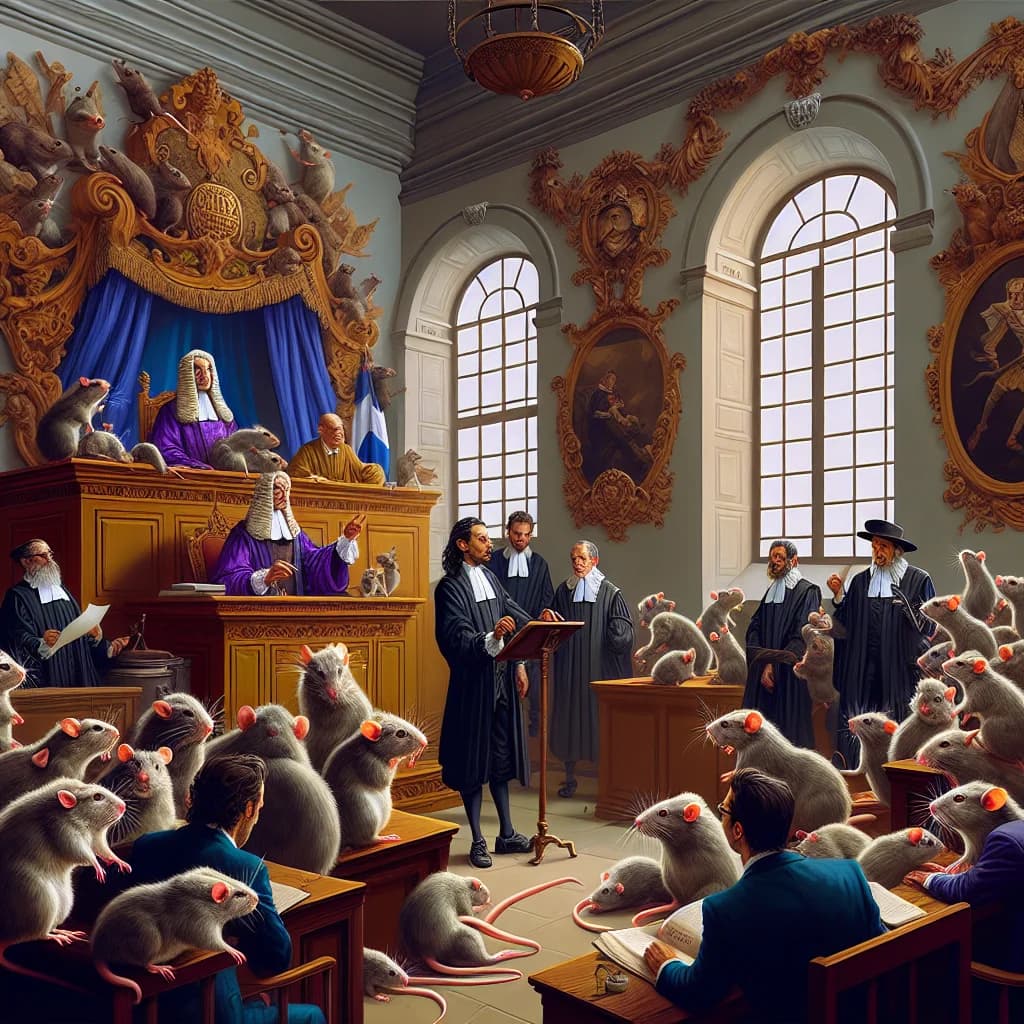
Imagine standing in a somber, 16th-century French courtroom, where the air is thick with the scent of old parchment and incense. The judge sits high on his bench, the prosecutor is ready to deliver a scathing indictment, and the defense attorney stands prepared to protect his clients. However, the defendants are not humans; they are a colony of rats accused of systematically destroying the local barley crop. While this sounds like the plot of a satirical novel, it is a well-documented historical event.
The appointment of a human lawyer to defend animals was a legitimate practice during this era, rooted in a complex intersection of theology and law. By exploring this bizarre case, we gain a unique window into the legal mindsets of the past. This post explores the fascinating reasons behind the trial of the rats in Autun and how one lawyer’s clever defense became a landmark in legal history.
The Unusual World of Animal Trials
In the late Middle Ages and the Renaissance, the concept of the "Great Chain of Being" dictated that all creatures were part of a divine hierarchy. Consequently, it was believed that animals were subject to God’s laws and, by extension, human legal systems. There were two main types of animal proceedings:
- Secular Trials: Typically involved individual larger animals (like pigs or bulls) accused of harming humans.
- Ecclesiastical Trials: Handled by church courts, these usually involved "pests" like locusts, weevils, or rats that damaged crops.
Because the church had the power to excommunicate or curse living things, these trials were taken with extreme gravity. In the early 1500s, the rats of Autun were formally indicted for their "felonious" consumption of the harvest. To ensure a fair trial, the court appointed a young, ambitious lawyer named Bartholomé Chasseneé to represent the rodents.
The Brilliant Defense of Bartholomé Chasseneé
The case against the rats seemed open and shut; after all, the barley was gone, and the rats were clearly responsible. However, Chasseneé took his appointment seriously, employing a series of ingenious legal maneuvers that delayed the proceedings for months. His tactics focused on the procedural rights of his "clients."
The Problem of the Summons
Chasseneé’s first victory involved the legal summons. He argued that since the rats were spread across many villages, a single notice read in one location was insufficient. According to historical records of the event, he insisted that a general summons must be read in every parish to ensure all his clients were properly notified. The court agreed, causing a significant delay.
The Argument of Lawful Excuse
When the rats failed to appear at the second hearing, Chasseneé presented what is perhaps the most famous argument in legal history. He stated that his clients were more than willing to obey the court's command, but they were prevented by a "reasonable fear" for their lives. He pointed out that the roads to the courthouse were infested with the rats' mortal enemies: cats.
Chasseneé argued that:
- A defendant is not required to attend court if doing so poses a mortal danger.
- The townspeople were responsible for restraining their cats if they truly wanted the rats to appear.
- Since the cats remained at large, the rats had a valid legal excuse for their absence.
Why Did the Legal System Allow This?
To modern sensibilities, a rat trial seems like a waste of resources. However, for 16th-century society, these trials served a critical function. According to researchers specializing in medieval law, such as those featured in the Journal of Legal History, these trials were a way for humans to exert a sense of order over a chaotic and often cruel natural world.
By bringing the rats into court, the community was essentially asserting that no creature was outside the reach of the law. If the pests could be tried, they could be formally cursed or excommunicated. If the crops failed after a formal trial, it could be blamed on a failure of the legal process or a divine judgment rather than mere biological bad luck.
The Legacy of the Autun Rats
Bartholomé Chasseneé’s defense of the rats was so successful that the trial was essentially abandoned. More importantly, it launched his career. He went on to become an esteemed jurist and eventually the President of the Parlement of Provence. He later detailed his arguments regarding animal trials in his major legal work, Consilia, where he analyzed whether animals could be treated as legal persons.
The case remains a significant example of:
- Due Process: The insistence that even "pests" deserved a fair hearing.
- Legal Personhood: Early debates on which entities have rights within a court.
- The Power of Advocacy: How a skilled lawyer can use the letter of the law to achieve a desired outcome, regardless of the defendant's nature.
Conclusion
The story of the lawyer appointed to represent a colony of rats is more than a historical curiosity; it is a testament to the enduring human desire for justice and order. Why was a lawyer once appointed to legally represent a colony of rats in a sixteenth-century French court? Because the legal minds of the era believed that for law to be truly sovereign, it had to apply to every living thing.
Bartholomé Chasseneé’s defense of the Autun rats reminds us that the principles of due process—such as the right to notice and the consideration of safety—have deep roots in our history. Today, while we no longer summon rodents to the witness stand, the intellectual rigor displayed in that 16th-century courtroom continues to influence the way we view the universality of the law. To learn more about the intersection of history and law, exploring the works of Chasseneé provides an excellent starting point.


