
Why were dinosaur fossils once believed to be the bones of fallen angels or giants
Long before the word 'dinosaur' existed, colossal bones unearthed from the earth weren't scientific marvels—they were the terrifying, divine proof that giants and fallen angels had once walked among us.

Too Long; Didn't Read
TLDR: Lacking a scientific understanding of extinction or deep time, people interpreted enormous, unfamiliar fossils through the only frameworks they had: religion and myth. The massive bones were therefore attributed to familiar figures from their stories, such as giants, fallen angels, or mythical beasts.
Bones of Behemoths: Why Were Dinosaur Fossils Once Believed to Be the Bones of Fallen Angels or Giants?
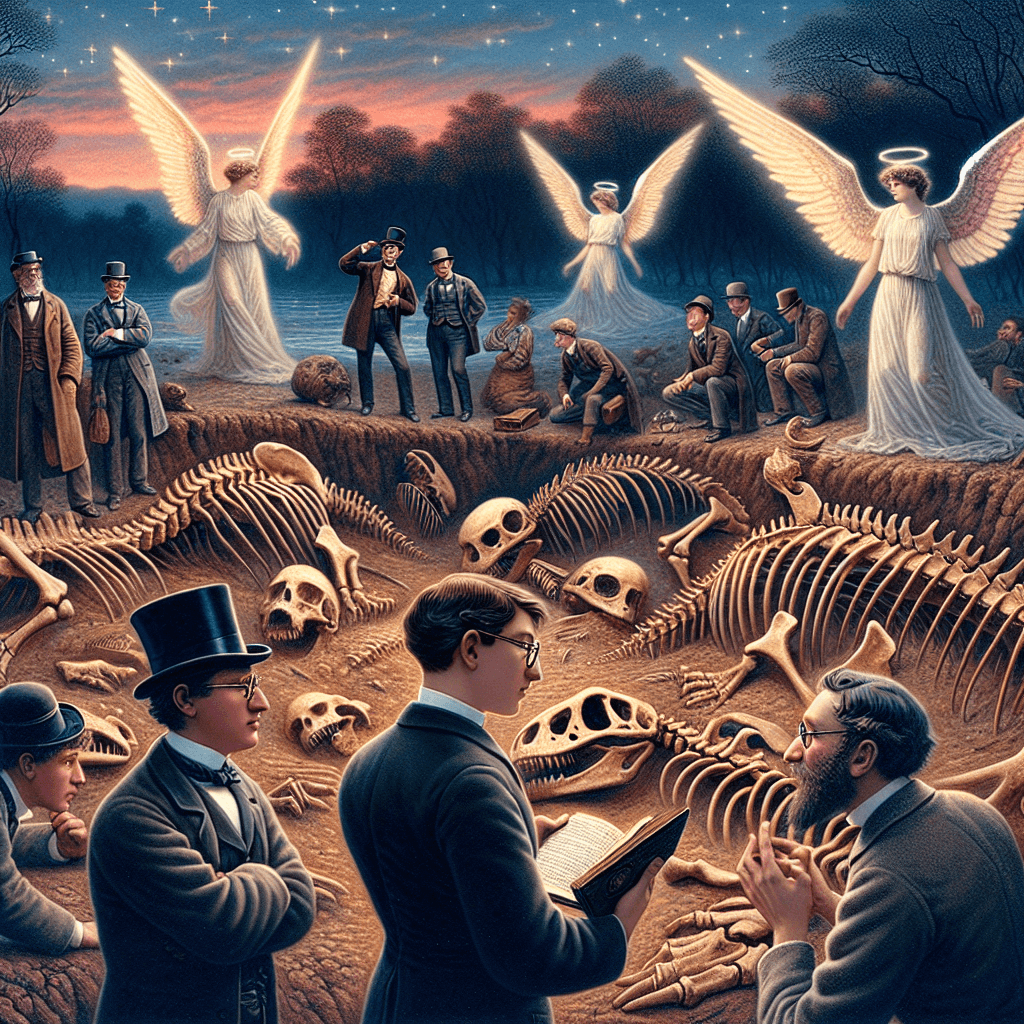
Imagine digging in a field centuries ago and unearthing a bone as thick as your torso and longer than you are tall. With no concept of geology, deep time, or extinction, what could you possibly conclude? Today, we would immediately recognize it as a dinosaur fossil. But for our ancestors, such a discovery was not evidence of a prehistoric past, but rather physical proof of a mythological one. These colossal remains were often explained through the only frameworks available: religion and folklore. This post explores the fascinating historical context of why the bones of ancient reptiles were once confidently identified as the skeletons of giants, fallen angels, and other mythical beings.
The World Before "Dinosaur"
Before the 19th century, the scientific and cultural landscape was vastly different. The word "dinosaur" (meaning "terrible lizard") wasn't even coined until 1842 by paleontologist Sir Richard Owen. The prevailing worldview, heavily influenced by religious doctrine, held that the Earth was only a few thousand years old and that the species on it were static and unchanging, created by a divine hand. The concept of extinction—that entire species could be wiped out—was not widely accepted until the work of naturalists like Georges Cuvier in the late 1700s.
Within this limited framework, any discovery had to be rationalized. When a farmer or quarry worker stumbled upon an enormous femur or a strangely shaped skull, they had to fit it into their known world. The most logical explanation was not an extinct giant reptile, but a creature from their own stories and sacred texts.
A Framework of Myths and Legends
Nearly every culture has stories of giants. From the Titans of Greek mythology to the Jötunn of Norse legend, the idea of colossal humanoids who once walked the Earth is a near-universal theme. In Europe, the most influential source for these beliefs was the Bible.
The Giants of the Bible
The Old Testament contains several references to giants. The most famous is Goliath, the Philistine champion, but even more significant were the Nephilim. Genesis 6:4 describes them as the offspring of the "sons of God" and the "daughters of men" who were "heroes of old, men of renown." These beings were often interpreted as a race of giants who lived before the Great Flood.
When enormous bones that resembled human anatomy—like a massive thigh bone or a section of a spinal column—were discovered, they were seen as undeniable proof of these biblical accounts.
- In 1677, Robert Plot, a professor at Oxford University, described the lower part of a massive femur, now known to belong to the dinosaur Megalosaurus. While he correctly identified it as a thigh bone, he concluded it was too large for any known animal and must have belonged to a giant human mentioned in the Bible. This fossil was famously given the first binomial name of a dinosaur part: Scrotum humanum, though this name was later suppressed.
- In the early 1700s, workers in Germany uncovered a fossil skeleton that was declared to be Homo diluvii testis ("Man who witnessed the Flood"), believed to be a human who had drowned in the biblical deluge. It was later correctly identified by Georges Cuvier as the fossil of a giant, extinct salamander.
Fallen Angels and Divine Punishment
The connection to fallen angels is directly linked to the interpretation of the Nephilim. Early Christian and Jewish texts often identified the "sons of God" from Genesis as fallen angels who came to Earth and procreated with human women. Their giant offspring were seen as corrupt, violent, and unnatural—a primary reason for God sending the Great Flood to cleanse the world.
Therefore, discovering their "bones" was more than just a curiosity; it was a powerful theological statement. These fossils served as a tangible reminder of divine wrath and the consequences of sin. They were physical evidence of a fallen world, proof that the stories in the holy books were literal history etched in stone. In some regions, these bones were even venerated as relics of saints or, conversely, seen as the cursed remains of dragons and monsters slain in epic battles with heroes and holy men.
The Dawn of a Scientific Explanation
This mythological interpretation began to crumble as a new age of scientific inquiry dawned. The rise of geology revealed that the Earth was millions, not thousands, of years old. The pioneering work of paleontologists like Mary Anning and Gideon Mantell in the early 1800s unearthed more complete skeletons of creatures that were clearly not giant humans, but enormous reptiles unlike anything alive today. The pieces of the puzzle began to form a new picture—not of a mythological past, but of a prehistoric one.
Conclusion
The belief that dinosaur fossils were the bones of giants or fallen angels was not a product of ignorance, but of logic within a specific worldview. Lacking a scientific framework for extinction and deep time, people used the rich tapestry of their myths, legends, and religious texts to make sense of a world filled with strange and awe-inspiring discoveries. These early interpretations reveal a profound human need to explain the unknown and connect with a deeper history. The journey from seeing a Megalosaurus femur as the bone of a biblical giant to understanding it as part of a long-extinct reptile is a testament to the power of scientific discovery to reshape our entire understanding of the world and our place in it.


