
How can some birds navigate using a built-in compass they can actually see
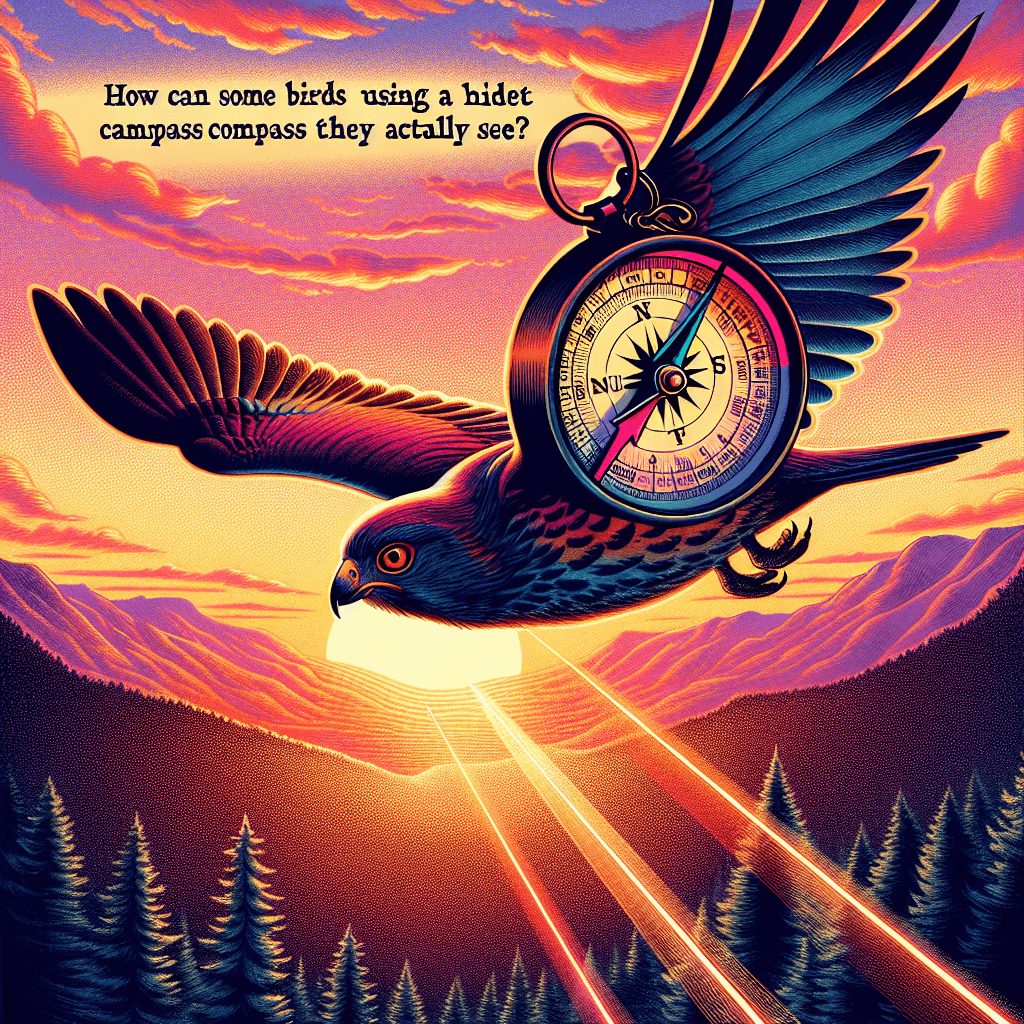
It sounds like science fiction, but some birds don't just feel the Earth's magnetic field—they may actually be able to see it as a pattern of light overlaid on their vision.

Too Long; Didn't Read
TLDR: Birds have a protein in their eyes that, when struck by light, creates a quantum effect sensitive to the Earth's magnetic field. This generates a visual pattern or filter over their normal sight, allowing them to literally see the magnetic field and use it as a compass for navigation.
Title: The Avian Sixth Sense: How Can Some Birds Navigate Using a Built-in Compass They Can Actually See?
Introduction
Have you ever wondered how an Arctic tern can fly from pole to pole, a journey of over 40,000 miles, and find its way back to the exact same nesting spot? For centuries, the incredible navigational abilities of migratory birds have mystified scientists and nature lovers alike. While we know they use cues like the sun, stars, and landmarks, one of their most extraordinary tools is a sense that sounds like it’s straight out of science fiction: a built-in magnetic compass that they can actually see. This isn't just an abstract feeling; for these birds, the Earth's magnetic field may be a visible pattern overlaid on the world around them. This post will explore the fascinating science behind this "quantum compass," delving into how some birds can visually perceive our planet's invisible magnetic forces to navigate their epic journeys.
The Mystery of Magnetoreception
The ability to sense magnetic fields is known as magnetoreception, and it’s a superpower found in many animals, from sea turtles to lobsters. In birds, this sense is particularly refined. For a long time, researchers debated how it worked. Was it based on iron particles in their beaks acting like tiny compass needles, or something else entirely? While the beak-based mechanism may play a role in sensing magnetic intensity (a magnetic map), the leading theory for their magnetic compass is far more bizarre and elegant, and it all happens within the bird's eye.
The Quantum Compass: A Radical Pair Mechanism
The most widely accepted explanation for this visual magnetic sense is a complex process rooted in quantum physics called the Radical Pair Mechanism. It sounds intimidating, but the core concept is stunning. It proposes that a chemical reaction in a bird's eye is directly influenced by the Earth's magnetic field, and the outcome of that reaction creates a visual signal.
Here’s a simplified breakdown of how it’s believed to work:
- The Key Protein: Inside the retina of a bird's eye are light-sensitive proteins called cryptochromes.
- Light Activation: When a photon of light strikes a cryptochrome molecule, it creates a "radical pair"—two molecules that are now chemically linked and have unpaired electrons.
- Quantum Influence: These electrons spin, and their alignment is incredibly sensitive to external magnetic fields. The Earth's magnetic field, though weak, is strong enough to influence how long these electrons remain in a specific quantum state.
- A Visual Signal: The alignment of these electrons determines the final chemical product of the reaction. This process happens across the retina, creating a pattern of neural signals that are sent to the bird's visual processing center in the brain.
In essence, the Earth's magnetic field alters a chemical reaction in the bird's eye, and the bird experiences this change as a visual pattern.
What Does the Magnetic Field Look Like to a Bird?
It’s crucial to understand that a bird doesn't see a compass needle floating in the air. Instead, scientists theorize that this magnetic sense provides a "filter" or an overlay on top of its normal vision. This pattern might look like shifting patches of light and shadow or colors that change as the bird turns its head.
- An Inclination Compass: Birds don't sense polarity like a traditional compass (which points to North). Instead, they sense the inclination, or the angle, at which the magnetic field lines intersect the Earth. This angle is steepest at the poles and parallel to the surface at the equator, giving them a reliable indicator of latitude.
- A Biological "Heads-Up Display": Think of it like a heads-up display in a fighter jet cockpit. The pilot sees the world outside but also has crucial data overlaid on the screen. Similarly, the bird sees the landscape but also has this magnetic pattern providing constant directional information.
This light-dependent mechanism is supported by strong evidence. Experiments conducted by researchers at the University of Oldenburg, Germany, have shown that the magnetic sense of European robins only works when there is light and can be disrupted by specific types of artificial magnetic fields predicted by the radical-pair model.
Conclusion
The ability of a bird to "see" the Earth's magnetic field is a remarkable testament to the elegance of evolution. What once seemed like magic is now understood to be a breathtaking interplay between quantum mechanics and biology, all occurring within the eye of a migrating bird. This quantum compass provides a constant, reliable directional cue, allowing these incredible travelers to perform some of the most impressive feats of endurance and navigation in the animal kingdom. As research continues to unravel this mystery, it reminds us that the natural world still holds profound secrets, often operating on principles that challenge our everyday understanding of reality.


