
Why is a narwhal's spiral tusk actually a giant inside-out sensory tooth
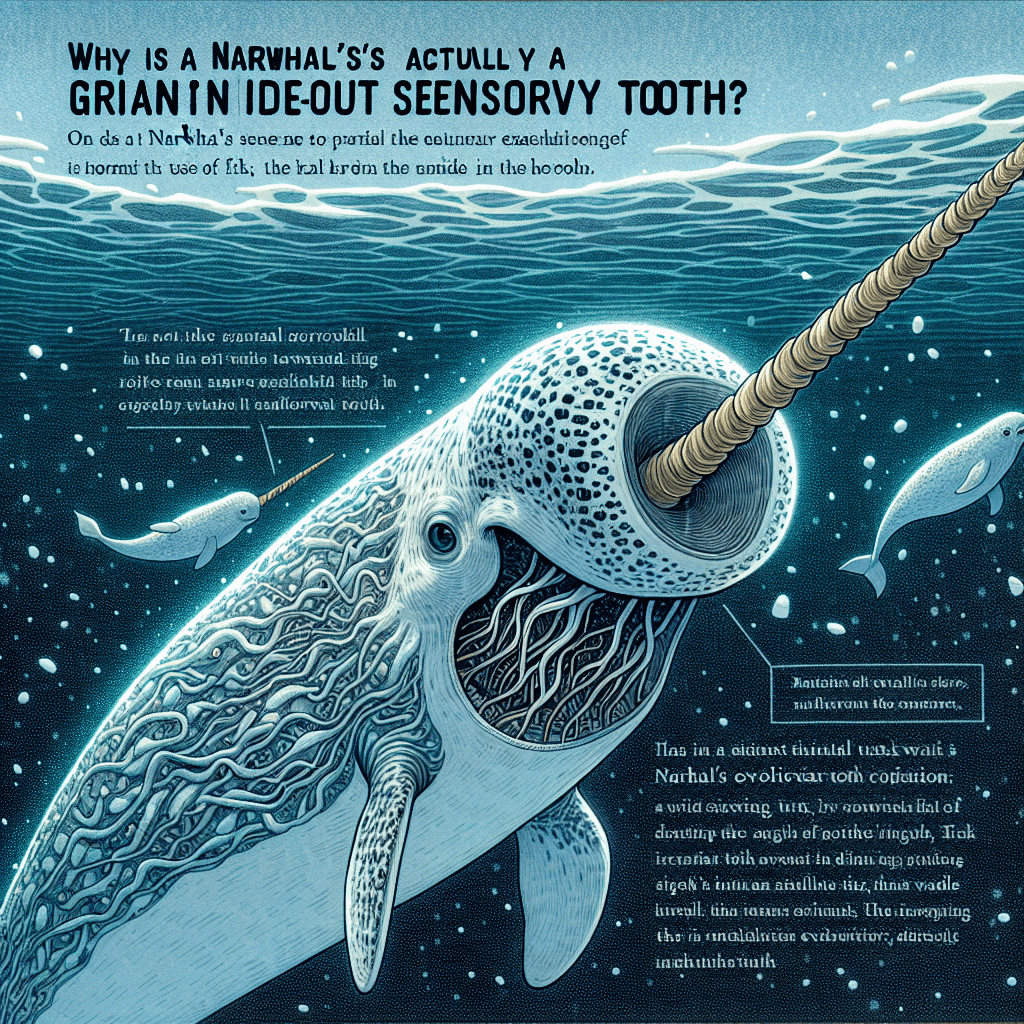
The narwhal's legendary tusk is far stranger than myth; it's a giant, inside-out tooth with millions of nerve endings on its surface, allowing the whale to literally "taste" and feel its way through the ocean.

Too Long; Didn't Read
The narwhal's tusk is an inside-out tooth with exposed nerve endings, acting as a sensory organ. It detects changes in water pressure, temperature, and saltiness to help the narwhal find food and navigate.
Unicorn of the Sea: Why is a Narwhal's Spiral Tusk Actually a Giant Inside-Out Sensory Tooth?
Often called the "unicorn of the sea," the narwhal has captivated human imagination for centuries. Its most striking feature, a magnificent spiral tusk that can grow up to 10 feet long, has long been a subject of myth and scientific debate. Was it a weapon for jousting with rivals? A tool for breaking through Arctic ice? For years, its true purpose remained a mystery. However, groundbreaking research has revealed a far more fascinating reality: the narwhal's legendary tusk is not a weapon, but a highly complex and unique sensory organ. This post will explore the incredible biology that makes this tusk a giant, inside-out sensory tooth, giving the narwhal a sixth sense in its harsh, frozen world.
Deconstructing the Tusk: More Than Just a Tooth
Before we can understand its function, we must understand its structure. The narwhal’s tusk is, in fact, an overgrown and elongated canine tooth that erupts from the left side of the upper jaw and grows straight through the narwhal's upper lip. While nearly all males grow one, a small percentage can even grow two.
For a long time, scientists theorized about its purpose. While narwhals are occasionally seen gently rubbing tusks together in a behavior known as "tusking," research suggests this is more likely a form of communication or information sharing than combat. The theory that it's an ice-breaking tool has also been largely dismissed; the tusk is both strong and flexible, but using it as a battering ram would risk catastrophic damage. The real purpose is far more subtle and lies in the tooth's bizarre internal structure.
An "Inside-Out" Marvel of Evolution
The key to the tusk's sensory function is its unique "inside-out" design, which is the reverse of almost every other tooth known in nature.
In human teeth (and most other mammals), a hard, non-porous layer of enamel forms the outer shell. This enamel protects a more sensitive layer of dentin and the central pulp, which contains the nerves and blood vessels. The narwhal’s tusk flips this anatomy on its head. The very center of the tusk contains the nerve-rich pulp, but the hard, dense enamel is found near the center, while the outer surface is covered by a porous material called cementum.
This porous outer layer is riddled with millions of tiny, open tubules that run from the outside ocean environment directly to the nerve endings in the tusk's core. This effectively turns the entire tusk into a single, massive sensory membrane, connecting the narwhal's nervous system directly to the Arctic sea.
What Does a Sensory Tooth Actually Sense?
With a direct line from the ocean to its brain, the narwhal can gather a wealth of critical environmental data. Research led by Dr. Martin Nweeia at the Harvard School of Dental Medicine has shown that the tusk is capable of detecting subtle changes with remarkable precision.
- Salinity: The nerve endings can detect changes in water salt concentration. By dipping its tusk, a narwhal can essentially "taste" the water to find areas where fish are more abundant or locate freshwater river mouths. This is also vital for survival, as the salinity of water determines its freezing point, helping narwhals avoid areas where they could become trapped by freezing ice. Studies confirmed this by showing a narwhal's heart rate changes when different salt solutions are applied to its tusk.
- Temperature and Pressure: The tusk is also believed to be sensitive to minute changes in water temperature and barometric pressure, which are crucial indicators for navigating and hunting in the deep, dark Arctic waters.
- Finding Prey: It's possible the tusk can detect chemical traces left by prey animals, like the Arctic and polar cod that make up a large part of the narwhal's diet, helping it to hunt more effectively.
Conclusion
The narwhal's tusk is far more than a mythical horn; it is a testament to the incredible power of evolution. By turning a tooth inside-out, nature has equipped this remarkable whale with a sophisticated sensory tool perfectly suited to its challenging environment. This single, elegant appendage allows it to navigate, find food, and survive in the ever-changing waters of the High Arctic. The unicorn of the sea is no fantasy—it is a marvel of biological engineering, and its legendary tusk is a reminder that the truth of nature is often more wondrous than any myth we can imagine.


