
Why can the word dust mean both to add fine particles and to remove them
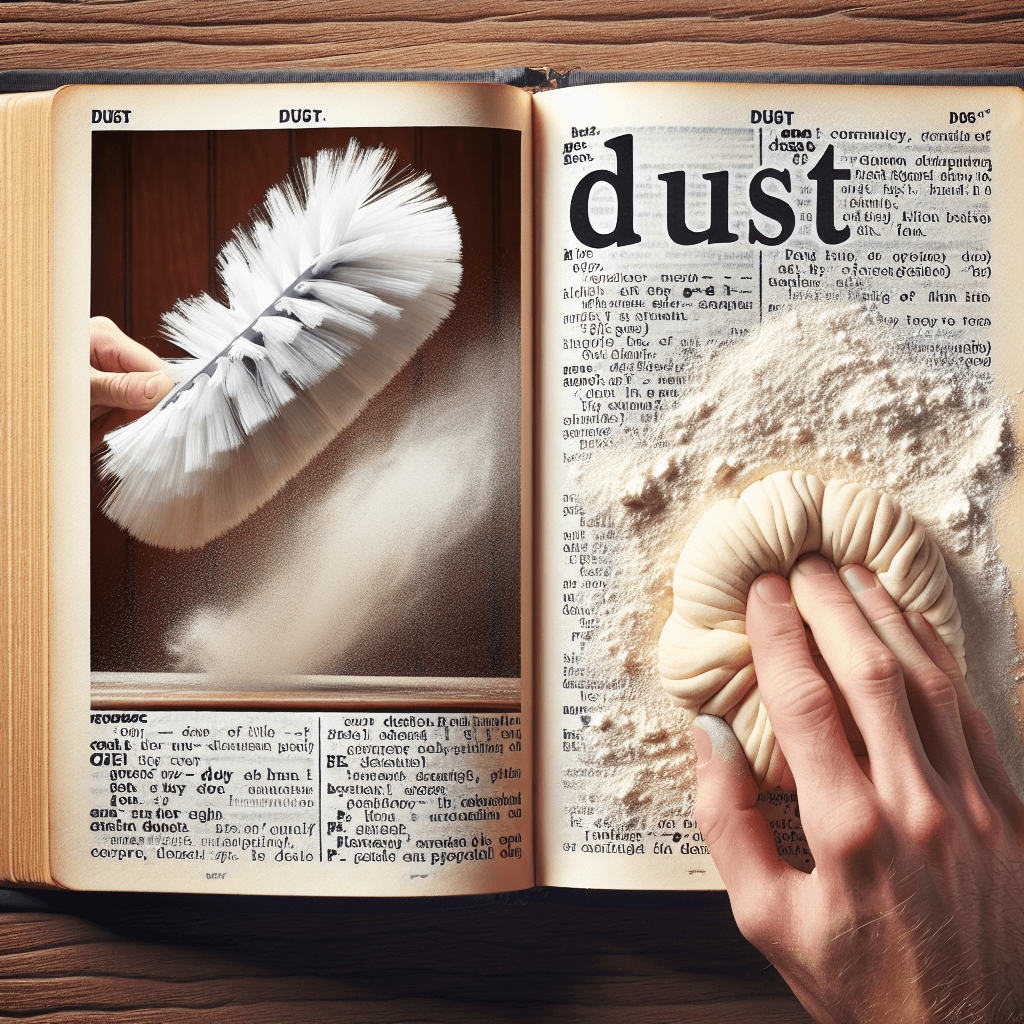
Ever dusted a cake with sugar and then dusted your furniture? You’ve just performed two opposite actions using the exact same word, and its bizarre linguistic history is a puzzle worth solving.

Too Long; Didn't Read
TLDR: The verb to dust comes from the noun dust. Its meaning, whether adding or removing particles, depends entirely on the context of the action, such as dusting a cake with sugar versus dusting a bookshelf.
The Duality of Dust: Why Can the Word Dust Mean Both to Add and Remove Fine Particles?
Have you ever paused while describing your weekend chores? You might have spent Saturday morning dusting the furniture, only to spend the afternoon dusting a cake with powdered sugar. In one instance, you’re removing fine particles; in the other, you’re adding them. This isn't a mistake; it's a fascinating quirk of the English language. The word "dust" is a special type of word known as a contronym—a word with two opposite meanings. This blog post will delve into the linguistic journey of "dust" to uncover how one simple word came to perform two completely contradictory actions.
First, What is a Contronym?
Before we tackle "dust" specifically, it's helpful to understand the concept behind it. A contronym, also known as an auto-antonym or a Janus word (after the two-faced Roman god), is a word that can be its own opposite. The meaning is entirely dependent on the context in which it's used.
The English language has several of these tricky words. For example:
- Sanction: Can mean to permit or to penalize.
- Cleave: Can mean to split apart or to cling to.
- Oversight: Can mean supervision or an error.
"Dust" fits perfectly into this category, with its meaning shifting from removal to addition based on the words around it.
The Linguistic Split: From Noun to Two Verbs
The entire puzzle can be solved by tracing the word back to its origin and understanding how nouns evolve into verbs in English.
The Original Noun
The journey begins with the noun. The word "dust" comes to us from the Old English dūst, which referred to fine, dry particles of earth or other matter. For centuries, this was its primary and only meaning. It was simply a name for a thing.
The Fork in the Road: Creating the Verbs
In a process linguists call "conversion" or "verbing," nouns are frequently turned into verbs. This is where "dust" took two different paths, leading to its contradictory meanings.
Path 1: To Remove Dust This is the meaning we associate with cleaning. When you "dust the bookshelf," the action is defined by its goal: to make the shelf free of dust. The verb "to dust" became a shorthand for the phrase "to remove dust from." This is a logical and efficient linguistic leap. The focus is on the result of the action (a dust-free surface).
- Example: "I need to dust the living room before our guests arrive."
Path 2: To Add Dust The second meaning also springs directly from the original noun but focuses on a different aspect of the action. When you "dust a cake with sugar" or "dust crops with pesticide," you are applying a fine, dust-like substance. The verb here means "to cover with" or "to sprinkle like dust." The focus is on the application of a substance that has the physical properties of dust.
- Example: "The forensic analyst dusted the crime scene for fingerprints."
The key is that the direct object of the verb tells us everything we need to know. Dusting furniture implies removal because furniture naturally collects unwanted dust. Dusting a cake or a crime scene implies addition because you are actively applying a new, dust-like material.
Conclusion: Context is King
The fascinating duality of the word "dust" is a perfect example of the efficiency and flexibility of language. It’s not a mistake but a logical evolution where a single noun was adapted for two distinct, action-oriented purposes. One path focused on the goal of removing the noun (cleaning), while the other focused on the action of applying something with the noun's qualities (sprinkling). So, the next time you use the word "dust," you can appreciate the linguistic magic at play. It’s a small reminder that in language, as in life, context is what gives our words their true meaning.


