Why is the Great Pyramid of Giza actually eight-sided instead of four when viewed from directly above
Hidden in plain sight for millennia, the Great Pyramid holds a secret geometry that only reveals itself twice a year under the perfect light. Discover the mind-bending reason behind its eight-sided design and why this architectural mystery went unnoticed for centuries.

Too Long; Didn't Read
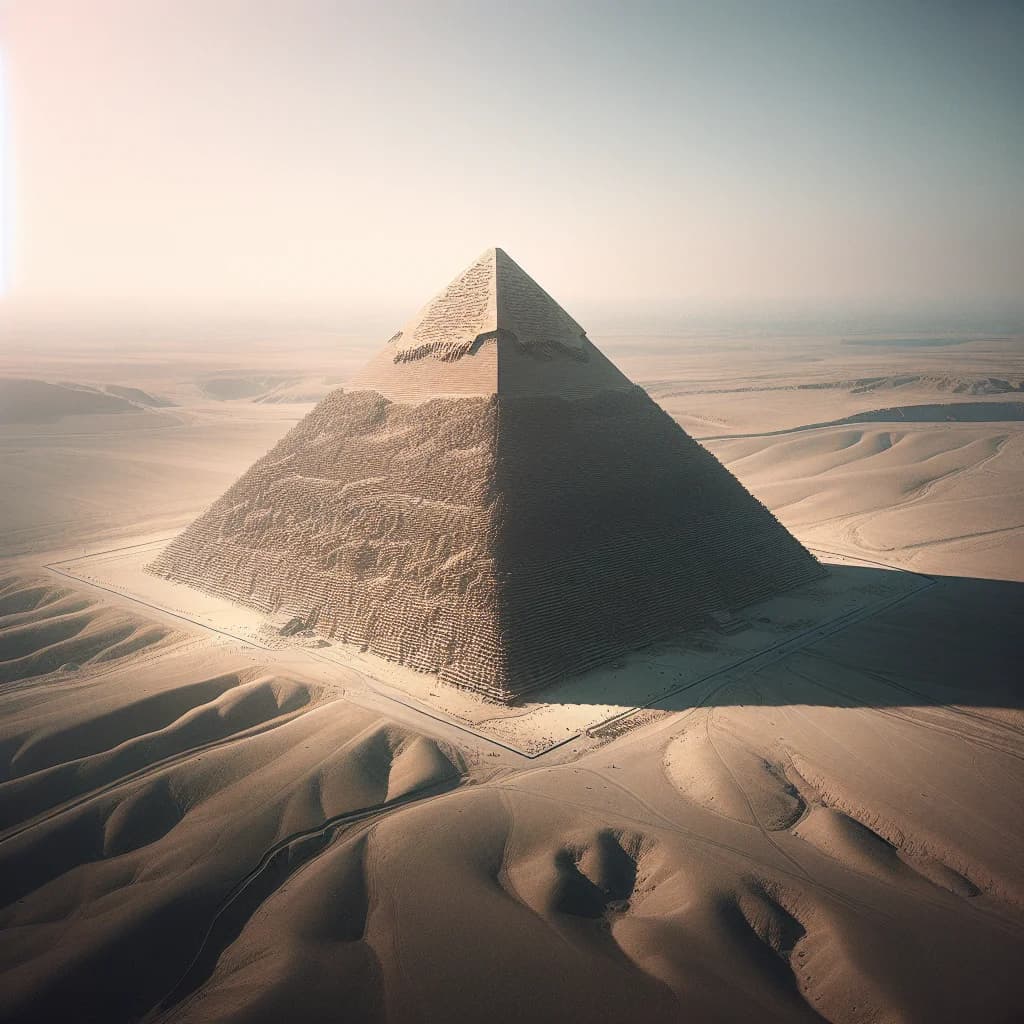
The Great Pyramid appears eight-sided because its four main faces are slightly concave, with a subtle indentation running down the center of each side. This unique architectural feature is nearly invisible from the ground and can only be clearly seen from directly above during the spring and autumn equinoxes when the low sun casts a specific shadow over the structure. While its exact purpose is debated, theories suggest it was designed for structural stability, to better hold the original limestone casing stones, or for astronomical significance.
The Hidden Geometry of Giza: Why is the Great Pyramid of Giza Actually Eight-Sided instead of Four when Viewed from Directly Above?
For millennia, the Great Pyramid of Giza has stood as the ultimate symbol of ancient engineering, appearing to the casual observer as a perfect four-sided monument. However, a stunning revelation occurs when the sun hits the structure at just the right angle: the Great Pyramid is actually an eight-sided polygon. This subtle architectural feature is nearly invisible from the ground and remains hidden under most lighting conditions, making it one of the most intriguing mysteries of the ancient world. Why is the Great Pyramid of Giza actually eight-sided instead of four when viewed from directly above? This post delves into the discovery of this phenomenon, the astronomical precision required to witness it, and the leading theories explaining its existence.
A Hidden Dimension: The Discovery of the Eight-Sided Shape
The eight-sided nature of the Great Pyramid—specifically the Pyramid of Khufu—is defined by a slight concavity in each of its four faces. Each face is divided from base to apex by a subtle indentation, effectively splitting the four primary sides into eight. While researchers like Sir William Matthew Flinders Petrie noted a hollowing in the core masonry in the late 19th century, the phenomenon wasn't famously documented until the 20th century.
In 1940, a British Air Force pilot, P. Groves, flew over the pyramid and captured a photograph that changed our understanding of the structure forever. The image, taken during the golden hour, clearly showed one half of a pyramid face in shadow while the other half remained illuminated. This revealed that the faces are not flat planes but are indented by approximately 0.5 to 1 degree. This precision is so minute that it is virtually impossible to detect from the ground or during high-noon sun.
The Role of the Equinoxes
The secret of the pyramid’s eight sides is governed by the movement of the sun. Because the indentation is so shallow, it requires a very specific angle of light to become visible to the naked eye. This occurs most prominently during the Spring and Autumn Equinoxes.
According to astronomical observations and historical photography, at sunrise and sunset on these two days, the sun's position aligns perfectly to cast a shadow over exactly one-half of each face. For a few fleeting moments, the "four-sided" pyramid transforms into an eight-sided figure. This level of precision suggests that the builders possessed an advanced understanding of:
- Solar cycles: Knowledge of the exact timing of the equinoxes.
- Geodetic alignment: The ability to align a massive structure with the cardinal points (North, South, East, West) within a fraction of a degree.
Why the Eight-Sided Design? Leading Theories
Archaeologists and engineers have proposed several explanations for why the Great Pyramid of Giza is actually eight-sided instead of four when viewed from directly above. While there is no single consensus, the theories generally fall into three categories:
1. Structural Integrity and Pressure Management
Some engineers suggest the concavity was a functional choice. The sheer weight of the pyramid—estimated at 6 million tons—exerts immense pressure on the core. By creating a slight indentation, the architects may have intended to:
- Centrally distribute weight: Channeling the pressure toward the center of each face to prevent the casing stones from sliding or bulging outward.
- Account for settling: Providing a structural "buffer" for the natural settling of the massive limestone blocks over centuries.
2. Aesthetic Perfection and Casing Stones
It is important to remember that the pyramid we see today is the "core" structure. Originally, it was covered in polished Tura limestone casing stones. Some researchers argue that the concavity in the core masonry was designed to provide a better "grip" for these outer stones. Conversely, others believe the casing stones themselves may have followed this eight-sided pattern to create a shimmering, multi-faceted effect when the sun hit the polished white limestone.
3. Mathematical and Symbolic Significance
The Great Pyramid is often cited for its mathematical constants, such as Pi and the Golden Ratio. Some theorists believe the eight-sided design represents a complex geometric intent. According to research cited by various alternative historians and mathematicians, the concavity may be used to calculate the radius of the Earth or represent the three-dimensional "squaring of the circle." While these theories are debated in mainstream Egyptology, the mathematical precision required to maintain an even 1-degree indentation across 480 feet of height is undeniable.
Conclusion
The realization that the Great Pyramid of Giza is actually eight-sided instead of four when viewed from directly above adds yet another layer of sophistication to an already legendary monument. Whether this feature was a deliberate astronomical marker, a structural necessity, or a symbolic mathematical statement, it highlights the peerless skill of Old Kingdom architects.
Summarizing the key takeaways, we find that the eight-sided shape is a result of a 1-degree concavity in each face, visible primarily during the equinoxes due to specific solar alignment. As we continue to study the Giza plateau with modern satellite imaging and LIDAR technology, we may find that this ancient wonder still has more secrets to reveal. For those fascinated by ancient engineering, the Great Pyramid remains the ultimate testament to the idea that there is always more than meets the eye.