
Why is the nose of a bullet train modeled after the beak of a kingfisher bird
What if the secret to silent, high-speed travel was hidden in the beak of a tiny bird? Discover the fascinating story of biomimicry that solved a deafening engineering crisis and gave the bullet train its iconic, record-breaking shape.

Too Long; Didn't Read
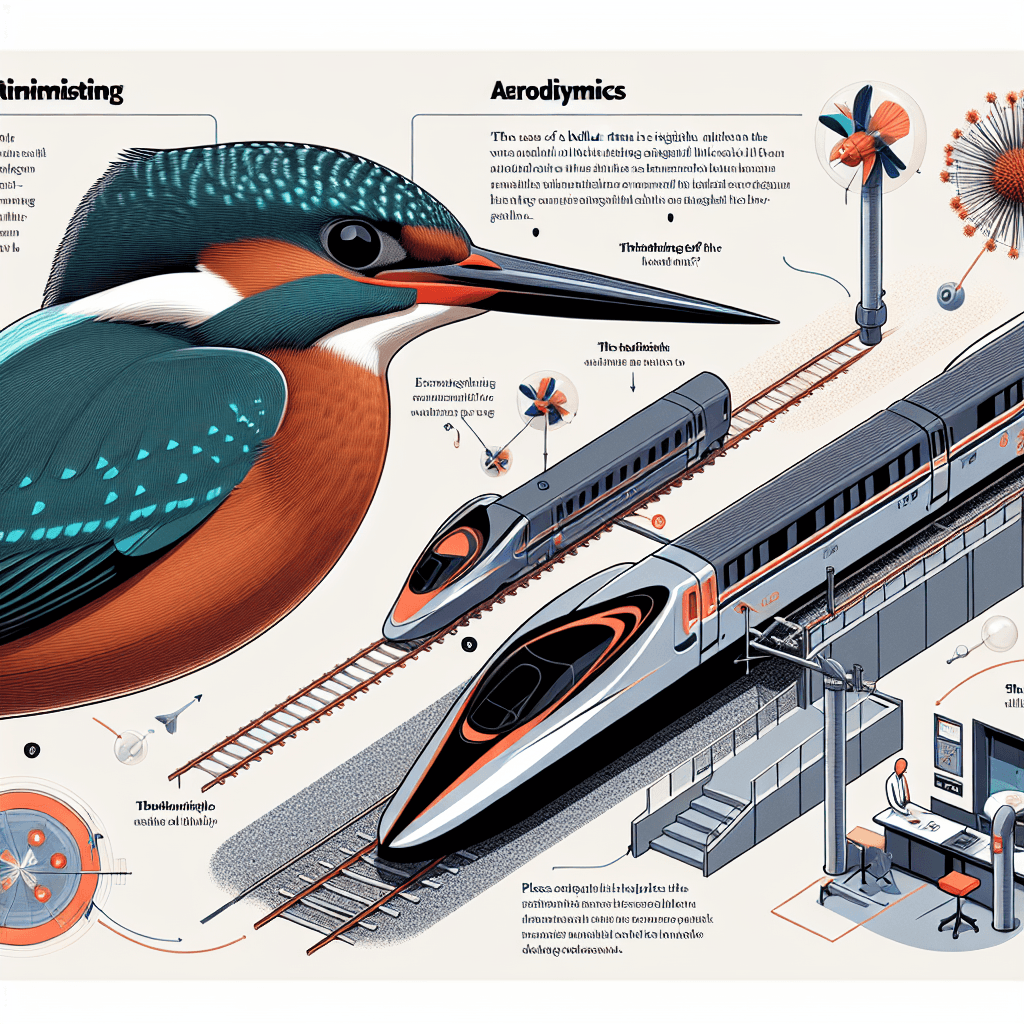
Engineers modeled the Shinkansen bullet train nose after a kingfishers beak to solve the problem of loud sonic booms caused by pressure changes in tunnels. This biomimicry design allows the train to slice through air more efficiently, reducing noise while increasing speed and energy efficiency.
From Flight to High-Speed Rail: Why is the nose of a bullet train modeled after the beak of a kingfisher bird?
Imagine a train hurtling through the Japanese countryside at 300 kilometers per hour. As it enters a narrow tunnel, the air in front of it compresses into a massive shockwave. When that wave reaches the tunnel's exit, it releases with a thunderous "boom" that can be heard for miles, shattering the peace of local neighborhoods and even damaging the tunnel structures. This phenomenon, known as the "tunnel boom," was the primary hurdle facing Japanese engineers in the 1990s as they sought to make the Shinkansen, or bullet train, faster and more efficient.
The solution didn't come from a computer lab, but from the keen observations of a birdwatcher. By looking to nature, engineers discovered a master of fluid dynamics: the kingfisher. This blog post explores why is the nose of a bullet train modeled after the beak of a kingfisher bird and how this transition revolutionized high-speed rail through the science of biomimicry.
The Physics of the "Tunnel Boom"
To understand the redesign, one must first understand the problem. When a high-speed train enters a tunnel, it acts like a piston in a cylinder. Because the train is traveling so fast, the air cannot move out of the way quickly enough. Instead, it bunches up, creating a high-pressure atmospheric wave.
According to research from the West Japan Railway Company (JR West), this pressure wave travels at the speed of sound. When it hits the tunnel exit, the sudden expansion of air creates a sonic boom. For years, this noise pollution prevented the Shinkansen from reaching its maximum speed potential because of strict environmental regulations in residential areas.
Eiji Nakatsu: The Engineer and Birdwatcher
The breakthrough occurred thanks to Eiji Nakatsu, the then-general manager of the technical development department at JR West. Nakatsu was an avid birdwatcher who realized that the challenges faced by the train were remarkably similar to those faced by certain birds.
He asked himself a pivotal question: Is there an animal that manages sudden changes in air pressure smoothly? His search led him to three specific birds:
- The Owl: Whose serrated feathers inspired quieter pantographs (the arms that collect electricity).
- The Adelie Penguin: Whose smooth body inspired better airflow.
- The Kingfisher: Whose beak provided the ultimate solution for the train’s nose.
The Kingfisher’s Splashless Dive
The kingfisher is a predatory bird that dives from the air into the water to catch fish. This is a significant feat of physics because water is roughly 800 times denser than air. Normally, such a transition at high speed would create a large splash and a significant impact force, which could stun the bird or alert the prey.
However, the kingfisher’s beak is unique. It is long, wedge-shaped, and has a diamond-shaped cross-section that gradually increases in size from the tip to the head. This specific geometry allows the bird to slice into the water, allowing the fluid to flow past the beak rather than being pushed in front of it. By the time the bird's head enters the water, the beak has already created a path, resulting in a "splashless" entry.
Applying Biology to Engineering
Nakatsu and his team hypothesized that if a beak could transition from low-density air to high-density water without a splash, a similarly shaped train nose could transition from the open air into a congested tunnel without a pressure wave.
The team conducted various tests, firing different-shaped bullets into pipes to measure pressure waves. The results were undeniable: the nose modeled after the kingfisher’s beak performed the best. This design was eventually integrated into the 500-Series Shinkansen.
The Benefits of Biomimicry in Rail Design
Modeling the train after the kingfisher wasn't just about noise reduction; it led to a cascade of technical improvements. The implementation of the long, beak-like nose resulted in several key benefits:
- Elimination of the Sonic Boom: The pressure wave was reduced significantly, allowing the train to pass through tunnels quietly and meet strict environmental noise standards.
- Increased Speed: Because the train could now travel through tunnels without causing a boom, its operating speed increased by approximately 10%.
- Energy Efficiency: The aerodynamic shape reduced air resistance (drag). According to JR West, the new design utilized 15% less electricity than its predecessors while traveling at higher speeds.
- Improved Passenger Comfort: The reduction in pressure fluctuations made for a smoother, steadier ride for those inside the train.
Conclusion
The evolution of the Shinkansen is a masterclass in biomimicry—the practice of looking to nature’s time-tested patterns and strategies to solve human problems. By asking why is the nose of a bullet train modeled after the beak of a kingfisher bird, we uncover a story of how an engineer’s hobby led to a breakthrough that combined physics, biology, and environmental stewardship.
Today, the kingfisher-inspired nose remains a hallmark of efficient design, proving that the most advanced technological solutions are often already written in the natural world. As we look toward the future of sustainable transportation, the Shinkansen serves as a reminder that observing the world around us is just as important as the data on our screens. To learn more about how nature influences modern technology, exploring the wider field of biomimicry is a great next step.


