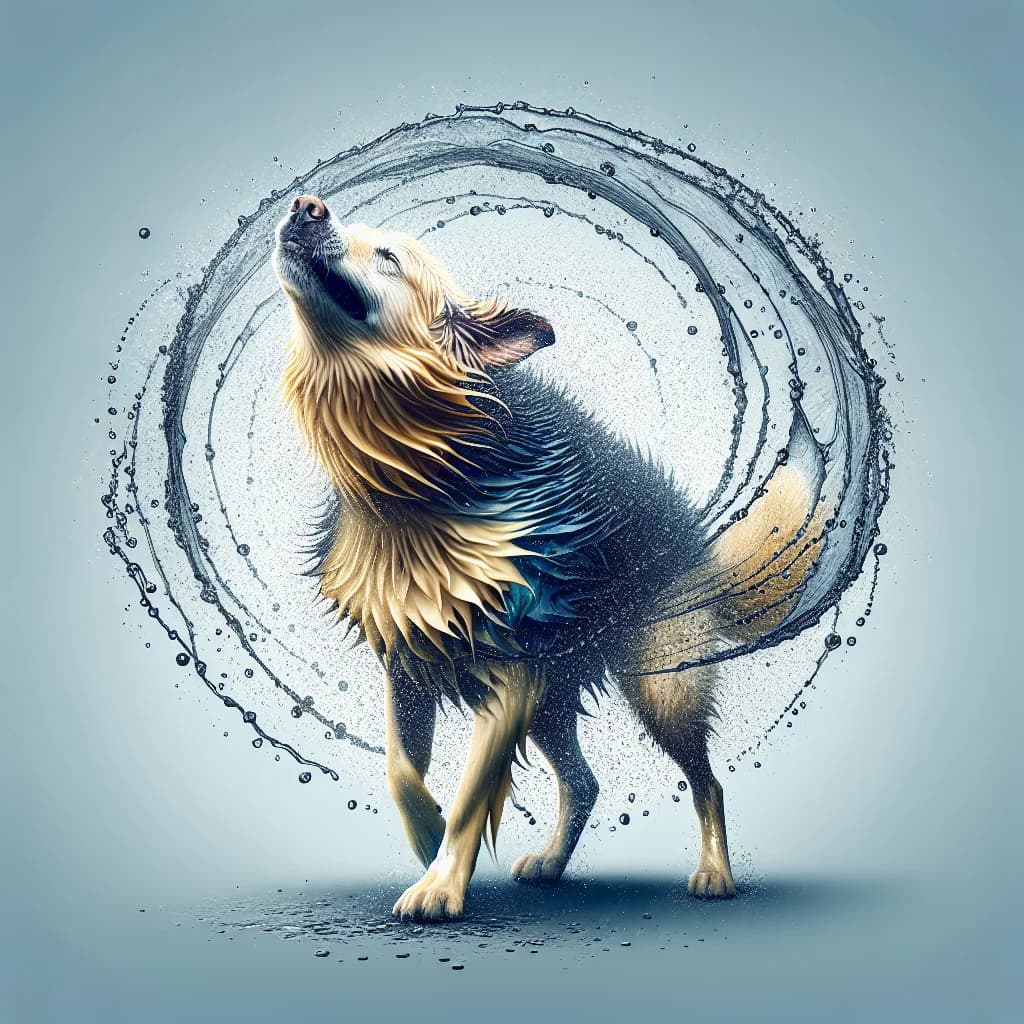
Why can a wet pet dog shake off seventy percent of the water on its fur in one second
Your dog isn't just making a mess—they’re a high-speed physics marvel capable of shedding 70% of the water on their coat in a single heartbeat. Discover the fascinating biological secret behind the "wet dog shake" and how loose skin creates the ultimate drying machine.

Too Long; Didn't Read
Dogs use their loose skin to oscillate at high speeds, creating powerful centrifugal forces that overcome surface tension. This rapid motion ejects the majority of water in seconds, allowing them to conserve energy and maintain body heat.
The Physics of the Splash: Why Can a Wet Pet Dog Shake Off Seventy Percent of the Water on Its Fur in One Second?
Every dog owner is familiar with the "wet dog shake"—that sudden, vigorous oscillation that occurs immediately after a bath or a dip in a pond. While it usually results in a soaked owner and damp furniture, this behavior is far more than a simple mess-making habit. It is a sophisticated, lightning-fast biological mechanism that has fascinated physicists and biologists alike. From an evolutionary perspective, the ability to dry off rapidly is a critical survival trait, ensuring that a canine can maintain its core body temperature even after a frigid soak.
This blog post explores the incredible biomechanics behind this movement. We will examine how a dog’s unique anatomy and the laws of physics work in tandem to explain why a wet pet dog can shake off seventy percent of the water on its fur in one second. Understanding this process offers a deeper appreciation for canine physiology and the remarkable ways animals have adapted to their environments.
The Mechanics of Centripetal Force
At the heart of the "wet dog shake" is the principle of centripetal force. When a dog shakes, it does not simply move its body in a circle; it oscillates its torso back and forth at high frequencies. Research conducted by mechanical engineers, most notably at the Georgia Institute of Technology, reveals that as the dog rotates its body, the water droplets on the fur are accelerated outward.
The force required to fling the water off must exceed the surface tension holding the water to the hair shaft. Because dogs can oscillate their bodies with such speed, they generate enough force to break that tension. Interestingly, the frequency of the shake is inversely proportional to the animal's size. Smaller dogs must shake much faster than larger dogs to achieve the same drying efficiency:
- Labradors: Approximately 4.5 Hz (shacks per second)
- Terriers: Approximately 7 Hz
- Chihuahuas: Approximately 27 Hz
The Secret Weapon: Loose Skin
While the speed of the oscillation is impressive, the real secret to the dog’s efficiency lies in its skin. Unlike humans, whose skin is relatively tight against the underlying muscle and bone, dogs possess a significant amount of "skin redundancy" or loose skin.
As the dog’s spine rotates, the loose skin travels much further and faster than the backbone itself. This "whip-like" effect allows the skin to move at speeds up to three times faster than the body’s internal structures. This increased velocity generates significantly higher centripetal force, allowing the animal to expel the majority of the moisture in a fraction of a second. Without this loose skin, a dog would have to expend significantly more energy and time to achieve the same level of dryness.
Evolutionary Necessity and Heat Regulation
The reason dogs evolved such an efficient drying method is rooted in thermoregulation. Fur is an excellent insulator when dry, but when saturated with water, it loses its ability to trap heat. For a wild canine, staying wet in a cold environment is a recipe for hypothermia.
Furthermore, the energy required to dry off through metabolic heat alone is staggering. Scientists estimate that if a 60-pound dog had to wait for its fur to air dry using only its body heat, it would lose roughly 20% of its daily caloric intake in the process. By shaking off 70% of the water in a single second, the dog preserves vital energy and maintains its internal temperature, a clear advantage for survival in the wild.
Behavioral Triggers and Animal Welfare
The "shake" is often a reflexive response triggered by receptors in the skin that detect the weight and coldness of water. However, pet owners may also notice their dogs shaking when they are not wet. In animal behavior science, this is often referred to as a "reset" or "displacement" behavior.
After a stressful event—such as a veterinary exam or a tense encounter with another dog—a dog may perform a full-body shake. In this context, the movement serves to "shake off" tension and return the nervous system to a state of equilibrium. Recognizing this helps owners better understand their pet’s emotional state and provides insight into their psychological well-being.
Conclusion
The wet dog shake is a marvel of mammalian physics, combining loose-skin anatomy with rapid centripetal acceleration to achieve a level of efficiency that manual towel-drying can rarely match. By shaking off seventy percent of the water on its fur in one second, a dog isn't just making a mess; it is utilizing an evolutionary adaptation designed to conserve energy and prevent life-threatening heat loss.
Understanding the science behind this common behavior allows us to appreciate the complex biological engineering present in our daily companions. The next time your pet leaves you standing in a cloud of spray, remember that you are witnessing a high-speed survival mechanism in action. For further insights into canine health and behavior, always consult with your veterinarian to ensure your pet stays healthy and comfortable in every season.