Why do pet goats have rectangular pupils that stay parallel to the ground even when they are grazing
Discover the "self-leveling" superpower behind a goat’s strange rectangular gaze and how their eyes defy gravity to provide a constant panoramic view of danger. It’s nature’s ultimate survival tool, and the science behind their "horizontal" vision is more fascinating than you ever imagined.

Too Long; Didn't Read
Goats have horizontal, rectangular pupils that provide a wide-angle view to detect predators. By rotating their eyes to stay parallel with the ground while grazing, they maintain a constant, clear view of the horizon for maximum safety.
Panoramic Vision: Why Do Pet Goats Have Rectangular Pupils That Stay Parallel to the Ground Even When They Are Grazing?
If you have ever spent a quiet afternoon with a pet goat, you likely noticed their most striking and unusual feature: their eyes. Unlike the circular pupils of humans or the vertical slits of domestic cats, goats possess horizontal, rectangular-shaped pupils that give them a somewhat otherworldly appearance. This distinct biological trait is not merely a quirk of evolution but a sophisticated survival mechanism deeply rooted in their history as prey animals. Understanding the mechanics of caprine vision is essential for any goat owner, as it influences how these animals perceive their environment, react to movement, and interact with their human caregivers. This blog post will explore the fascinating science behind why pet goats have rectangular pupils and how their eyes rotate to maintain a constant lock on the horizon.
The Evolutionary Strategy of Horizontal Pupils
In the animal kingdom, pupil shape is closely linked to an animal’s place in the food chain. According to visual ecology research, including a notable 2015 study by researchers at UC Berkeley and Durham University, horizontal pupils are most commonly found in terrestrial herbivores that serve as prey.
The primary advantage of a rectangular pupil is the creation of a panoramic view. While humans have a field of vision of about 210 degrees, a goat’s horizontal pupils allow for a much wider field of view, typically between 320 and 340 degrees. This means a goat can see almost everything around its body without moving its head. For a species that evolved in open terrains where predators could approach from any direction, this wide-angle "widescreen" view is a vital early-warning system.
Enhanced Image Quality on the Horizon
Beyond just a wider field of view, the horizontal orientation improves the quality of the image along the ground. By capturing more light from the sides and less from the bright sky above or the dark ground immediately below, the rectangular shape reduces glare and sharpens the goat's peripheral vision. This allows them to detect the slight movement of a predator against the landscape across a vast distance.
Cyclovergence: Why Pupils Stay Parallel to the Ground
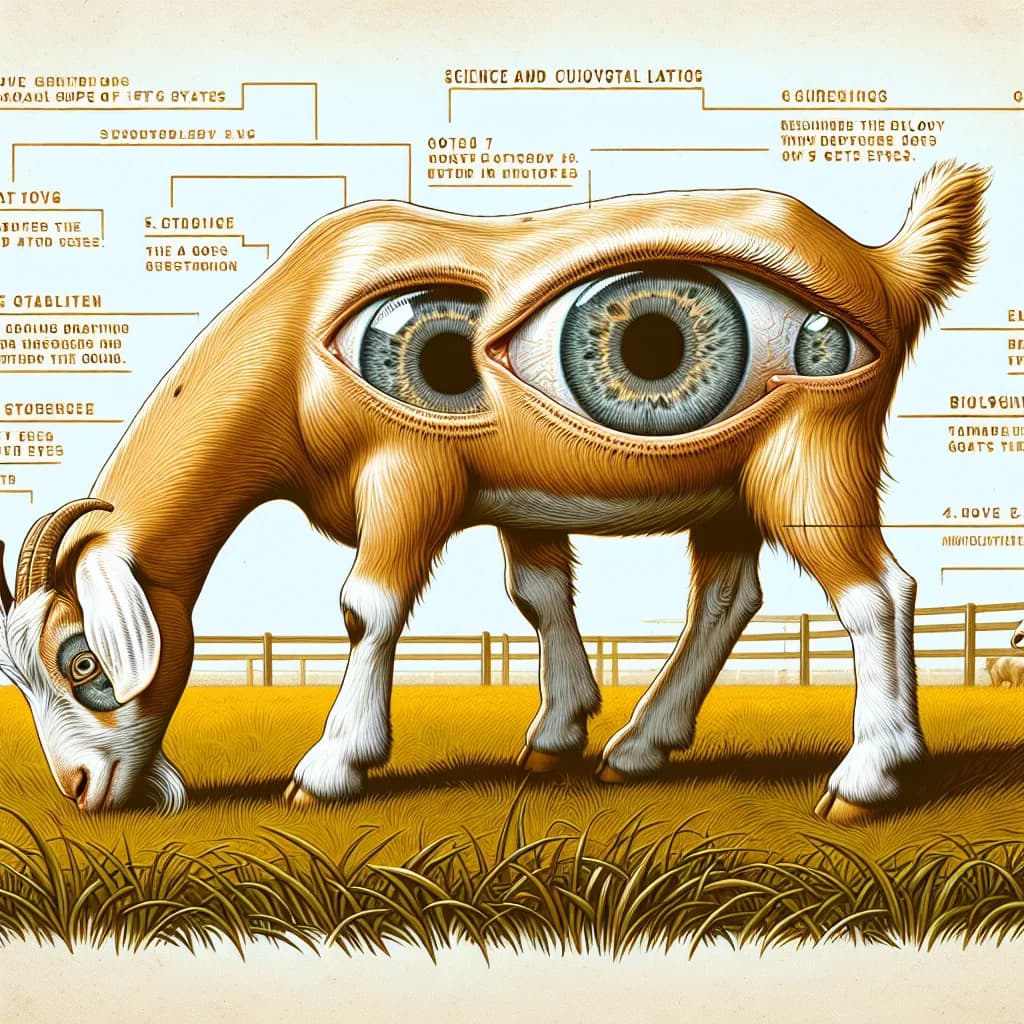
Perhaps the most incredible aspect of goat biology is how these pupils behave when the animal lowers its head. When a goat bends down to graze, its eyes undergo a process called cyclovergence.
In most animals, the eyes move in tandem with the skull. However, goats have the specialized ability to rotate each eye independently within the socket by more than 50 degrees. As the goat’s nose points toward the grass, the eyeballs rotate in the opposite direction to ensure the rectangular pupils remain perfectly parallel to the ground.
The Purpose of Grazing Alignment
This stabilization is critical for several reasons:
- Constant Surveillance: Even while focused on eating, the goat maintains its panoramic "horizon watch." If the pupils tipped vertically when the head dropped, the goat would lose its wide-angle perspective and become vulnerable to ambush.
- Depth Perception: Keeping the pupils level helps the goat maintain better depth perception across its entire field of view, which is necessary for a quick escape over rocky or uneven terrain.
- Visual Clarity: By keeping the pupil aligned with the horizon, the goat ensures that the most sensitive part of its retina receives the most important visual information from the surrounding landscape.
Practical Implications for Goat Care
For pet owners and farmers, understanding caprine vision leads to better husbandry and more empathetic handling. Because of their wide field of vision, goats are particularly sensitive to sudden movements in their periphery.
- Approaching Your Goat: Since a goat’s only true blind spot is directly behind them, approaching from the rear can startle them. It is best to approach from the side where they can see you clearly.
- Handling and Stress: Rapid movements or shadows appearing from the side can trigger a flight response. Recognizing that their vision is designed to detect "movement" rather than "detail" helps owners create a calmer environment.
- Health Checks: Because their eyes are so specialized, any change in pupil orientation or cloudiness should be addressed immediately by a veterinarian specializing in ruminants.
Conclusion
The rectangular pupils of pet goats are a masterclass in evolutionary engineering. By providing a panoramic view and utilizing the remarkable ability of cyclovergence to stay level with the horizon, goats have adapted to remain vigilant even during their most vulnerable moments of grazing. For the responsible pet owner, appreciating these biological "superpowers" is more than just a fascinator; it is a way to better understand the sensory world of these intelligent animals. By respecting their wide field of view and their natural instinct for horizon-scanning, we can build stronger, more trusting bonds with our caprine companions. If you ever notice changes in your goat's vision or eye behavior, always consult with a qualified veterinarian to ensure their unique ocular health is maintained.