Why do pet hermit crabs form an orderly lineup called a vacancy chain to trade shells with each other
When a prime piece of real estate opens up, hermit crabs don’t just scramble; they form a sophisticated, orderly lineup to upgrade their homes in a behavior known as a "vacancy chain." Dive into the fascinating social logic behind nature’s most organized and cooperative real estate swap.

Too Long; Didn't Read
Hermit crabs form vacancy chains to efficiently upgrade their homes without fighting. When a new shell becomes available, they line up by size so each crab can move into a larger shell vacated by the crab ahead of it, ensuring everyone finds a better fit through a coordinated exchange.
The Science of Vacancy Chains: Why Do Pet Hermit Crabs Form an Orderly Lineup to Trade Shells with Each Other?
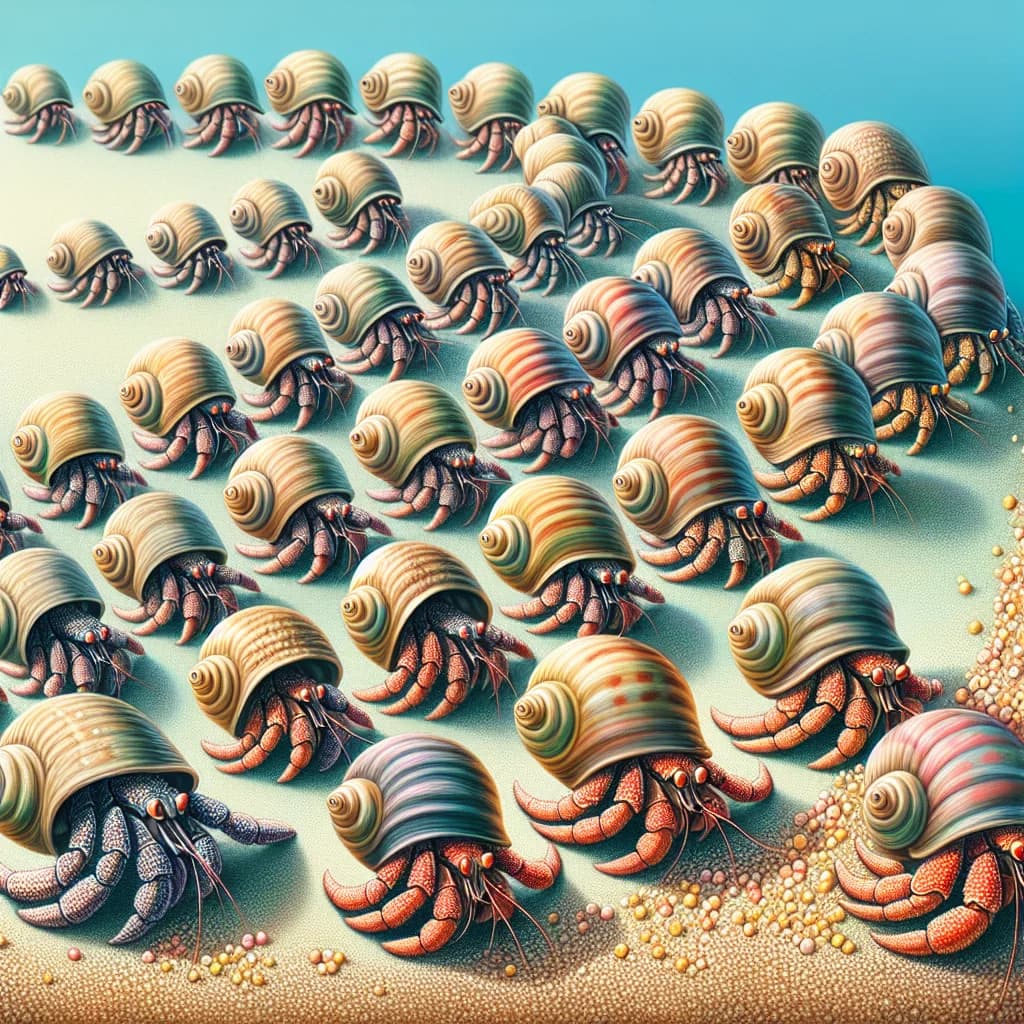
Imagine a crowded real estate market where, instead of bidding wars, residents form a neat, orderly line to exchange homes in a perfectly synchronized sequence. While this may sound like a social utopia, it is a daily reality for one of the most fascinating creatures in the pet trade: the hermit crab. For pet owners, witnessing a group of crabs standing "piggyback" in a size-ordered queue can be a baffling sight. This behavior is known to biologists as a "synchronous vacancy chain."
Understanding why pet hermit crabs form these lineups is not just a matter of curiosity; it is vital for proper animal husbandry. This social queuing is a sophisticated survival mechanism driven by biological necessity and resource scarcity. This post will explore the evolutionary science behind vacancy chains, the physiological needs that trigger them, and how this knowledge can help you provide a better environment for your pet crabs.
The Biological Drive: Why Shells are Not Optional
Unlike most crabs that grow their own hard exoskeletons to protect their entire bodies, hermit crabs (from the superfamilies Paguroidea and Coenobitoidea) possess a soft, spirally curved abdomen. This anatomical vulnerability makes them susceptible to predators and, crucially for land-based pets, to desiccation (drying out).
A shell is more than a home; it is a mobile life-support system. It protects the crab’s delicate pleon (abdomen) and allows the crab to maintain a small reservoir of water to keep its modified gills moist. Because hermit crabs cannot produce their own shells, they are entirely dependent on the discarded shells of gastropods (snails). As a hermit crab grows, it must find a larger shell to accommodate its increasing biomass, making shell acquisition a lifelong quest.
The Mechanics of the Vacancy Chain
A vacancy chain is an ecological process where a single new resource (a shell) triggers a series of moves that benefit multiple individuals. In the wild and in home "crabitats," this occurs in two distinct ways:
Synchronous vs. Asynchronous Chains
- Asynchronous Vacancy Chains: This occurs when a crab finds an empty shell, moves in, and leaves its old shell behind for a future passerby.
- Synchronous Vacancy Chains: This is the "orderly lineup" behavior. When a crab finds a shell that is too large for its current size, it does not simply walk away. Instead, it waits. Other crabs eventually congregate around the shell.
The Formation of the Lineup
When a group gathers, the crabs begin to measure one another and the empty shell using their antennae and chelipeds (claws). They organize themselves into a queue based on size, with the largest crab at the front and the smallest at the rear. Each crab holds onto the shell of the crab in front of it.
Once a crab large enough to fit the "new" shell arrives, the chain reaction begins. The largest crab moves into the new shell, the second crab moves into the first crab’s old shell, and so on down the line. This "domino effect" allows multiple crabs to upgrade their housing simultaneously within minutes.
Why This Behavior Matters for Survival
Evolutionary biologists, such as Ivan Chase, have noted that vacancy chains are a highly efficient way to distribute limited resources. For the hermit crab, this behavior offers several evolutionary advantages:
- Reduced Vulnerability: Switching shells is a dangerous moment. By lining up, crabs minimize the time their soft abdomens are exposed to the air and potential predators.
- Resource Efficiency: In an environment where shells are scarce, a vacancy chain ensures that no shell goes to waste. It allows a single "discovery" to benefit a dozen or more colony members.
- Conflict Avoidance: While hermit crabs can be aggressive and may attempt to "shell jack" (forcibly remove another crab from its shell), the vacancy chain provides a non-violent alternative that preserves the health of the colony.
Practical Guidelines for Pet Owners
Knowing that your pets are hardwired for vacancy chains should change how you manage their environment. To support this natural behavior and reduce stress, consider the following:
- Shell Variety: Always provide at least 3–5 appropriate shells per crab. These should be of varying sizes and species (such as Turbo or Magpie shells) to ensure there is always a "catalyst" shell to start a chain.
- Size Gradation: Ensure you have a smooth gradient of sizes. If you have a very small crab and a very large crab but no "middle" sizes, the vacancy chain will fail, leading to potential aggression.
- Observation, Not Interference: If you see your crabs lining up, do not move them or "help" them. Interrupting a vacancy chain can cause extreme stress and leave a crab exposed at a critical moment.
Conclusion
The orderly lineup of pet hermit crabs is one of nature’s most remarkable examples of social cooperation. Driven by the biological need to protect their soft bodies, these creatures have developed the vacancy chain as an elegant solution to the problem of limited housing. By understanding that this behavior is a science-based survival strategy rather than a random quirk, pet owners can better appreciate the complex social structures of their decapod companions. Providing an abundance of shell options and respecting their natural processes ensures your hermit crabs lead a low-stress, healthy life, allowing you to witness these fascinating biological "real estate" trades firsthand.