Why is a human’s yawn often contagious to their pet dog, suggesting a primitive form of emotional empathy
When you yawn and your dog follows suit, it’s not just a sign of sleepiness—it’s a profound echo of your own emotions. Discover the hidden science behind this "primitive empathy" and what it reveals about the deep-rooted psychological bond you share with your pup.

Too Long; Didn't Read
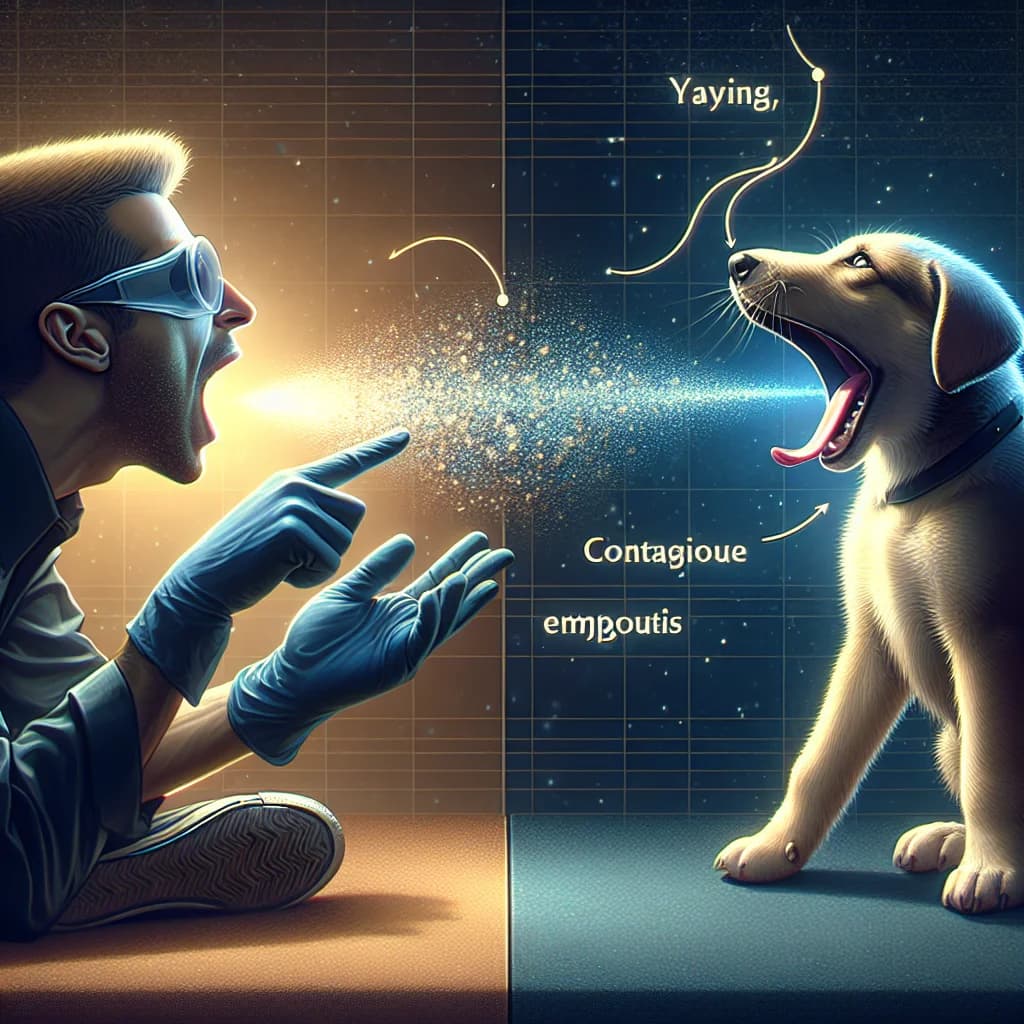
Dogs catch human yawns due to emotional contagion, a primitive form of empathy that reflects the deep social bond between species. This mirror behavior suggests dogs are evolutionarily tuned to sense and share their owners' internal states.
Echoes of Empathy: Why Is a Human’s Yawn Often Contagious to Their Pet Dog?
Have you ever settled onto the sofa after a long day, let out a wide yawn, and noticed your dog immediately following suit? This curious phenomenon, known as contagious yawning, is more than just a coincidence or a shared need for a nap. While yawning is a basic biological reflex—observed in birds, reptiles, and mammals alike—the act of "catching" a yawn from another individual is a complex social behavior. In humans, contagious yawning is linked to high levels of empathy and social awareness.
In recent years, animal behaviorists and evolutionary psychologists have turned their attention to the domestic dog, discovering that our canine companions are one of the few species capable of catching yawns across the species barrier. Understanding why is a human’s yawn often contagious to their pet dog, suggesting a primitive form of emotional empathy, offers a fascinating window into the evolution of the human-animal bond and the sophisticated emotional lives of dogs.
The Science of Contagious Yawning
Contagious yawning falls under a category of behaviors known as "echophenomena," which involves the automatic imitation of another’s actions. In humans, this typically develops around age four or five, coinciding with the development of social skills and the ability to identify others' emotions.
From a neurological perspective, researchers believe this reflex is powered by "mirror neurons." These are specialized brain cells that fire both when an individual performs an action and when they observe that same action performed by another. In the context of yawning, these neurons create a bridge of shared experience, effectively "tricking" the brain into mimicking the physiological state of the other person.
The Connection Between Familiarity and Empathy
One of the most compelling arguments for yawning as a sign of empathy is the role of social closeness. Studies, such as those conducted at the University of Tokyo and the University of Porto, have demonstrated that dogs are significantly more likely to catch a yawn from their owners than from a complete stranger.
- Social Bonding: Dogs responded with higher frequency to the yawns of familiar people, suggesting that the behavior is rooted in the emotional connection between the pet and the owner.
- Acoustic Triggers: Interestingly, dogs can "catch" a yawn even if they only hear the sound of their owner yawning, reinforcing the idea that this is a response to a specific individual rather than just a visual stimulus.
- Heart Rate Variables: In some studies, dogs showed no significant spike in cortisol (the stress hormone) during these exchanges, indicating that the yawn is a social "echo" rather than a stress response.
Primitive vs. Cognitive Empathy
When scientists discuss empathy in dogs, they often distinguish between "cognitive empathy"—the complex ability to understand another’s perspective—and "affective contagion" or "primitive empathy." Primitive empathy is the most basic form of emotional sharing; it is the capacity to automatically mirror the emotional state of another. Because yawning is involuntary, it is considered a prime example of this affective contagion. It suggests that dogs are biologically "tuned in" to our internal states.
Evolutionary Advantages of Social Mirroring
The reason dogs possess this trait likely dates back thousands of years to the early stages of domestication. As dogs moved from wild wolves to domestic companions, their survival depended heavily on their ability to interpret human cues.
- Group Coordination: In a pack environment, synchronized yawning may have helped coordinate sleep-wake cycles, ensuring all members were alert or resting at the same time.
- Conflict De-escalation: In canine body language, a yawn can also serve as a "calming signal," intended to diffuse tension. Catching a human’s yawn may be an ancestral vestige of trying to maintain a peaceful social environment.
- The Domestication Syndrome: Humans likely selected for dogs that were more attentive to our non-verbal communication, leading to a species that is uniquely sensitive to our yawns, gazes, and moods.
Conclusion
Understanding why a human’s yawn is often contagious to their pet dog provides a profound insight into the depth of the interspecies relationship. This behavior is not merely a quirk of biology; it is evidence of a primitive form of emotional empathy that allows dogs to bond with us on a neurological level. By "catching" our yawns, dogs demonstrate their ancient, evolutionary commitment to monitoring our states and staying in sync with their human families.
Recognizing these subtle social cues can enhance the way we interact with our pets. It serves as a reminder that our dogs are constantly observing us, reflecting our emotions, and seeking connection. For the responsible pet owner, this knowledge reinforces the importance of maintaining a calm, positive environment, as our canine friends are quite literally wired to feel what we feel.