If the Earth were replaced by a giant pile of blueberries, why would it collapse into boiling jam
Imagine a world made entirely of blueberries—until gravity takes hold. Discover the mind-bending physics of why an Earth-sized pile of fruit would instantly collapse into a pressurized, scalding sea of boiling jam.

Too Long; Didn't Read
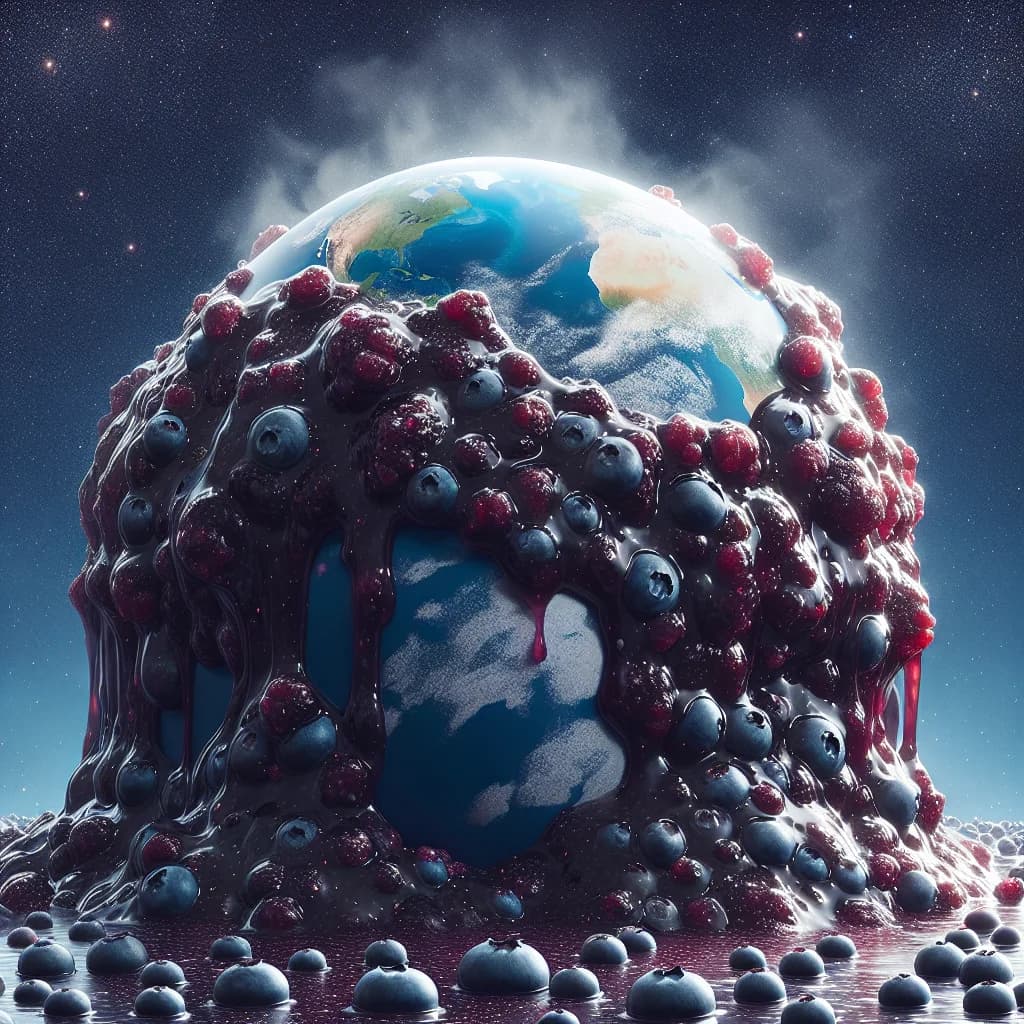
If Earth were replaced by a giant sphere of blueberries, gravity would immediately cause the pile to collapse inward. This rapid compression would crush the berries and release immense gravitational potential energy as heat. The resulting pressure and temperature would transform the fruit into a boiling core of jam surrounded by a thick, pressurized atmosphere of steam.
Fruit for Thought: Why Would an Earth-Sized Pile of Blueberries Collapse Into Boiling Jam?
Imagine, for a moment, a cosmic "reset" button. Instead of a planet made of iron, silicate rocks, and a thin crust of soil, the Earth is suddenly and entirely replaced by a sphere-shaped pile of fresh, giant blueberries. While this sounds like a delicious dream for fruit enthusiasts, the laws of physics have a much messier outcome in mind. Within moments, our giant berry patch would undergo a spectacular physical transformation.
To understand why a planet-sized collection of fruit cannot maintain its shape, we must look at the intersection of planetary science, thermodynamics, and fluid dynamics. By applying the principles of gravitational potential energy and material strength, we can predict exactly how a mountain of fruit becomes a celestial cauldron of jam.
The Structural Failure of Fruit
The first thing to consider is the sheer scale of the change. Earth has a radius of approximately 6,371 kilometers. If you filled that volume with blueberries, you wouldn't have a solid planet; you would have a massive, porous heap.
The Air Gap Problem
Unlike the solid rock of Earth, a pile of blueberries contains a significant amount of "empty" space—the gaps between the round berries. In a random packing of spheres, about 25% to 40% of the volume is just air.
- The Initial Collapse: As soon as gravity begins to act on this massive pile, the structural integrity of the individual berries fails. The berries at the center are subjected to the weight of thousands of miles of fruit above them.
- Expelling the Atmosphere: The air between the berries would be squeezed out almost instantly. This rapid compression of air would generate significant heat even before the fruit itself begins to change state.
Gravity: The Ultimate Juicer
On a human scale, a blueberry feels firm. On a planetary scale, it has the structural strength of a liquid. Because the Earth-sized blueberry pile is so massive, its own gravity would be the dominant force.
Calculations of Compression
The pressure at the center of our "Berry Earth" would be immense. While the density of a blueberry is much lower than that of rock (roughly 1,000 kg/m³ compared to Earth’s average of 5,514 kg/m³), the total mass would still be roughly $5 \times 10^{24}$ kilograms.
- Pressure at the Core: The central pressure would exceed the structural limits of organic tissue by millions of times.
- Fluidization: The berries would not stay as individual units; they would be crushed into a uniform, thick pulp. The planet would effectively shrink as it transitions from a "pile of spheres" to a "solid sphere of liquid."
From Pulp to Boiling Jam: The Role of Thermodynamics
This is where the scenario moves from messy to truly "hot." The collapse of the berry pile isn't just a physical movement; it is an energy transition.
Gravitational Potential Energy
When a giant pile of berries collapses inward to become a denser, smaller sphere, it releases gravitational potential energy. In physics, when an object falls or compresses, that energy has to go somewhere. In this case, it is converted directly into thermal energy (heat).
The Temperature Spike
Given the mass involved, the energy released during this "great crushing" is staggering. Scientists estimate that the temperature increase across the entire mass would be significant:
- Specific Heat Capacity: Blueberries are mostly water, which has a high specific heat. However, the amount of energy released by the collapse is so vast that it would overcome this.
- The Result: The temperature would likely rise by several hundred degrees Celsius. Since water boils at 100°C (at standard pressure), the water content within the berry pulp would rapidly turn to steam.
The Final State: A Roiling Berry Ocean
The final result of this hypothetical experiment is a planet-sized sphere of hot, pressurized jam. The internal dynamics would look something like this:
- Steam Vents: Massive plumes of steam would erupt from the interior as the water content boils.
- Convection Currents: Just like a pot of thick soup on a stove, the "mantle" of jam would experience massive convection currents, with hot pulp rising to the surface and cooling slightly before sinking back down.
- A New Atmosphere: The air expelled during the initial collapse, combined with the steam from the boiling juice, would create a thick, opaque atmosphere of water vapor and organic aromatics.
Conclusion
If the Earth were replaced by a giant pile of blueberries, gravity would ensure it didn't stay that way for long. The transition from a collection of individual fruits to a condensed sphere would release enough gravitational energy to cook the fruit from the inside out. Through the relentless laws of thermodynamics and the crushing power of gravity, our hypothetical fruit planet would inevitably become a boiling, pressurized sphere of jam.
This thought experiment serves as a fascinating reminder of how scale changes everything. While a handful of berries is a stable snack, a planet-sized amount of the same material is a volatile system dictated by the same powerful forces that shape the stars and planets of our actual universe. Physical laws are universal, whether they are acting on iron and stone or sugar and skin.